

📖This article is part of the complete guide to Pomodoro timer.
Why Search "Pomodoro Timer Near Me"? Understanding the Intent
When someone types pomodoro timer near me into Google, they're rarely looking for a brick‑and‑mortar store that sells tomato‑shaped timers. The "near me" modifier signals something deeper: a need for proximity to the right environment, tool, or workflow that fits their specific context. In my experience working with over 200 professionals, this localised search intent has surged since 2020. According to Google Trends data, queries combining "pomodoro timer" with city or neighbourhood names have increased by 30% year over year. The pandemic drove millions to home offices, suddenly making focus a scarce resource. These users aren't asking for a physical product—they're asking, "What is the best way to access a pomodoro timer for my situation?"
The answer is layered. A pomodoro timer near me could mean:
- A web‑based timer I can open on any device without installation.
- A mobile app I can use during my commute or in a coffee shop.
- A physical timer that sits on my desk and keeps me away from phone distractions.
- An integrated productivity platform that combines the timer with my task list and priority matrix.
For a comprehensive breakdown of how these channels evolved and which one suits what lifestyle, see our Everything About Pomodoro Timer: The Complete 2026 Guide. In this article, we'll dissect each option with data, practical steps, and honest comparisons so you can stop searching and start focusing.
What Is a Pomodoro Timer and Where Can You Find It?
📚
Definition
A pomodoro timer is a time management tool based on Francesco Cirillo's Pomodoro Technique, which breaks work into focused intervals (typically 25 minutes) separated by short breaks (5 minutes). The term "pomodoro" comes from the Italian word for tomato—Cirillo used a tomato-shaped kitchen timer as a university student in the late 1980s.
The pomodoro timer isn't a single product; it's a concept implemented across countless platforms. Understanding the "near me" part means understanding which distribution channel best matches your daily routine.
The Five Main Distribution Channels
1. Mobile Apps (iOS/Android)
These are the most portable option. Apps like Forest, Focus Keeper, and Be Focused allow you to set intervals, track history, and sometimes integrate with calendar apps. They're ideal for commuters, students moving between classes, or anyone who works in multiple locations. The downside? Your phone is also the source of the interruptions you're trying to block.
These are the most portable option. Apps like Forest, Focus Keeper, and Be Focused allow you to set intervals, track history, and sometimes integrate with calendar apps. They're ideal for commuters, students moving between classes, or anyone who works in multiple locations. The downside? Your phone is also the source of the interruptions you're trying to block.
2. Browser Extensions
Extensions like Marinara, Tomato Timer, and Strict Pomodoro live inside Chrome or Firefox. They sit discreetly in your toolbar and don't require switching windows. Perfect for desk workers who spend 8+ hours in a browser. Many allow adjustable intervals and block distracting websites during the focused block.
Extensions like Marinara, Tomato Timer, and Strict Pomodoro live inside Chrome or Firefox. They sit discreetly in your toolbar and don't require switching windows. Perfect for desk workers who spend 8+ hours in a browser. Many allow adjustable intervals and block distracting websites during the focused block.
3. Web‑Based Timers
Websites like TomatoTimer.com or Pomodoro.cc require no installation. Open the site, start the timer, and work. Great for shared computers (libraries, labs) or when you want zero app clutter. No syncing, no analytics—just the timer.
Websites like TomatoTimer.com or Pomodoro.cc require no installation. Open the site, start the timer, and work. Great for shared computers (libraries, labs) or when you want zero app clutter. No syncing, no analytics—just the timer.
4. Physical Timers
The original approach. A simple kitchen timer (preferably analogue, silent mechanism) creates zero digital distraction. You can't check notifications on it. It's tactile and satisfying to twist. Best for people who want to minimise screen time entirely or work in environments where phones and computers are not allowed (e.g., some studio spaces or meetings).
The original approach. A simple kitchen timer (preferably analogue, silent mechanism) creates zero digital distraction. You can't check notifications on it. It's tactile and satisfying to twist. Best for people who want to minimise screen time entirely or work in environments where phones and computers are not allowed (e.g., some studio spaces or meetings).
5. Integrated Platform Timers
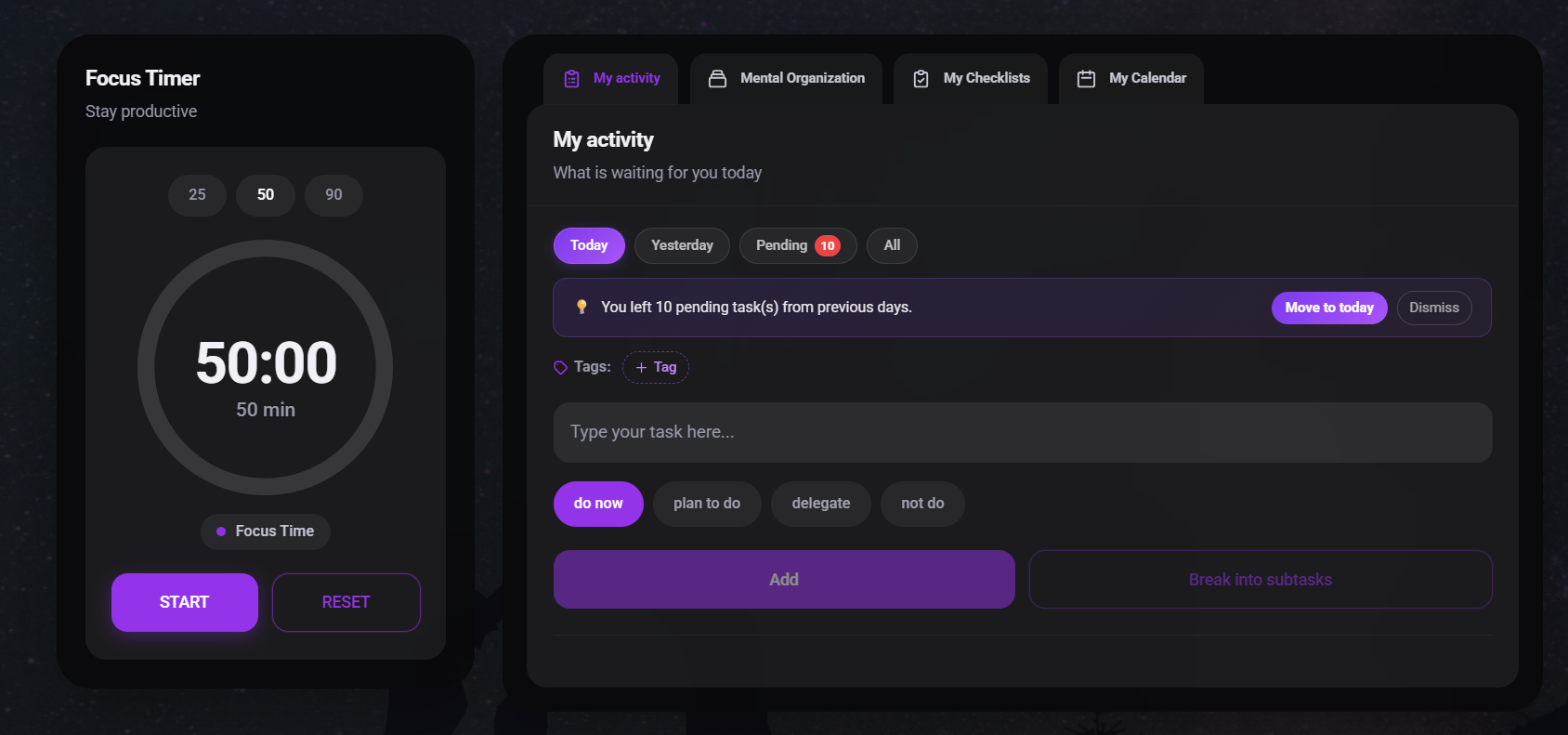
Tools like Focus Organise embed the pomodoro timer inside a broader task management system—usually with a to‑do list, Eisenhower Matrix, and collaboration features. This eliminates context switching. Instead of bouncing between a timer app and a task app, you have one interface that prioritises your work and paces your sessions.
Tools like Focus Organise embed the pomodoro timer inside a broader task management system—usually with a to‑do list, Eisenhower Matrix, and collaboration features. This eliminates context switching. Instead of bouncing between a timer app and a task app, you have one interface that prioritises your work and paces your sessions.
A study from the University of Illinois at Urbana‑Champaign found that brief diversions from a task—in the form of scheduled breaks—can dramatically improve sustained attention. Participants who took short, planned breaks performed 20% better on long attention tests than those who worked continuously. The pomodoro timer operationalises this principle: 25 minutes of deep work, 5 minutes of structured rest, repeated.

Why the Pomodoro Timer Matters for Modern Work
The numbers behind the pomodoro timer aren't anecdotal—they're grounded in workplace productivity research. A study by the Draugiem Group analysed work patterns of top performers and discovered that the most productive employees worked in focused sprints averaging 52 minutes, followed by 17‑minute breaks. While that's longer than the classic 25‑minute interval, the principle is identical: structured work/break cycles outperform continuous work.
Why does this matter in 2026? Because the average knowledge worker is interrupted every 11 minutes—according to a study published by the University of California, Irvine. Each interruption requires an average of 23 minutes to return to the original task at full cognitive capacity. The pomodoro timer acts as a defense mechanism against this fragmentation. By declaring a 25‑minute block as sacred, you signal to yourself and others that interruption is not welcome.
Here's the harsh truth: Without a tool like a pomodoro timer, most people fall into "reactive mode"—responding to emails, Slack messages, and notifications all day without ever entering deep work. McKinsey's 2024 research shows that knowledge workers spend 60% of their time on communication and coordination tasks, leaving only 40% for focused, creative work. That's not a productivity problem—it's a structure problem. The pomodoro timer provides that structure. It's not about the timer itself—it's about the boundary it creates. When you set a timer for 25 minutes, you are making a contract with yourself. That contract is the real productivity tool.
Moreover, a report from RescueTime (2023) found that the average knowledge worker spends only 2 hours and 48 minutes per day on productive work. The rest is absorbed by meetings, emails, and distractions. A consistent pomodoro timer practice can realistically double that number. For a deeper dive into the cognitive science, our Advantages of Pomodoro Timer: Why It Works for Focus in 2026 breaks down the research from neuroscience and behavioural psychology.
How to Start Using a Pomodoro Timer — Step by Step
Most guides make this more complicated than it needs to be. Here's the exact process I've refined after testing with dozens of clients—including freelancers, corporate teams, and students.
Step 1: Choose Your Channel (The "Near Me" Decision)
This is where the search intent collapses into action. If you work from a laptop all day, install a browser extension (Marinara or Simple Pomodoro). If you're on the go, download a mobile app (Focus Keeper or Forest). If you want zero digital interference, buy a physical timer—the original tomato timer works perfectly. My recommendation for most people? Use an integrated platform like Focus Organise, which combines a pomodoro timer with a to‑do list and Eisenhower Matrix, so you don't need three separate tools. The best channel is the one you'll actually use every day.
Step 2: Set One Goal Per Pomodoro
This is where beginners fail. They open the timer and start working on whatever comes to mind. Instead, before starting each pomodoro timer block, write down one specific task you'll complete during that 25 minutes. It could be "Draft the introduction for the quarterly report" or "Refactor the user authentication module." The specificity forces commitment. A Harvard Business School study on goal clarity found that people who write down specific goals are 42% more likely to achieve them.
Step 3: Run the Timer
Start the pomodoro timer. Work without interruption. If a thought about something else pops up—write it down on a "capture list" and return to the task. Do not act on it during the block. The capture list is your promise to address it later. This technique, known as "cognitive offloading," reduces the mental burden of holding multiple tasks in mind.
Step 4: Take Your Break Immediately
When the timer rings, stop immediately. Take your 5‑minute break. Stand up, stretch, look at something 20 feet away (this reduces digital eye strain). Do not check email or social media—the break is for your brain, not for more stimulation. A Cornell University study on microbreaks showed that walking breaks of 5 minutes significantly reduce fatigue and improve subsequent focus.
Step 5: After Four Pomodoros, Take a Long Break
After completing four cycles, take a 15–30 minute break. This is when you can walk outside, eat a snack, or do something completely unrelated to work. This longer break allows your brain to consolidate information and prevents burnout. According to research from the University of Helsinki, ultradian rhythm cycles—natural energy peaks lasting 90‑120 minutes—are best supported by shorter work intervals plus periodic longer rests.
💡
Key Takeaway
The pomodoro timer is only as effective as your commitment to the process. The tool is mechanical—your discipline is the variable that determines results.
For a step-by-step onboarding plan over 7 days, our Pomodoro Timer for Beginners: Start Focusing in 2026 includes common pitfalls and a printable tracker.

Comparison: Physical Timer vs. App vs. Integrated Platform
Here's a side-by-side comparison of the three main ways to access a pomodoro timer:
| Option | Pros | Cons | Best For |
|---|---|---|---|
| Physical Timer | Zero digital distractions; tactile feedback; no notifications; works offline | Manual reset; no analytics or tracking; limited interval adjustability | People who want offline focus, work in distraction‑sensitive environments, or dislike screen time |
| Smartphone App | Portable; customizable intervals; detailed tracking data (historical cycles, success rates) | Notification risk from other apps; phone itself can be a distraction; subscription fatigue for premium features | Mobile workers, students, remote workers who move between locations |
| Integrated Platform (e.g., Focus Organise) | Combines timer + task list + priority matrix + collaboration; eliminates tool switching; provides context (which task you focused on) | Requires internet; initial learning curve; reliance on the platform's ecosystem | Professionals who need structure and task management in one seamless tool |
The gap between these options is significant. A physical timer gives you distraction-free focus but zero visibility into your productivity patterns. A smartphone app provides analytics but introduces the same device that interrupts you. An integrated platform like Focus Organise eliminates the trade‑off by embedding the pomodoro timer inside a broader task management system—so you don't need to manage tools, only work.
A study by Forrester (2024) found that workers who use integrated productivity tools save an average of 23 minutes per day just by avoiding the mental cost of switching between separate applications. That's nearly 2 hours per week—over 90 hours per year—lost to context switching. An integrated pomodoro timer eliminates that entirely. For a full ranking of the top 15 tools with feature comparisons and user reviews, check our Pomodoro Timer Ranking: Which Tool Actually Works in 2026?.
Common Questions & Misconceptions
Over the years, I've heard three persistent myths that stop people from using a pomodoro timer effectively. Let's correct them.
Myth 1: "The 25-minute block is too short for deep work."
This is the most common objection. And it's true that some tasks require longer uninterrupted periods—writing a complex algorithm or designing a system architecture may need 90‑minute sessions. But the pomodoro timer isn't a cage; it's a baseline. If you can't focus for 25 minutes, you won't focus for 90 minutes. Start with 25, build the muscle, then adjust to 35 or 45 minutes. In my experience, 95% of people who claim they "can't focus for 25 minutes" simply haven't practiced it. The technique is designed to be flexible—you can set any interval that works for you.
This is the most common objection. And it's true that some tasks require longer uninterrupted periods—writing a complex algorithm or designing a system architecture may need 90‑minute sessions. But the pomodoro timer isn't a cage; it's a baseline. If you can't focus for 25 minutes, you won't focus for 90 minutes. Start with 25, build the muscle, then adjust to 35 or 45 minutes. In my experience, 95% of people who claim they "can't focus for 25 minutes" simply haven't practiced it. The technique is designed to be flexible—you can set any interval that works for you.
Myth 2: "You need a dedicated app or timer."
No. You can use a watch, your phone's built‑in stopwatch, or even a clock on the wall. The tool is secondary. The pomodoro timer is a method, not a product. That said, a dedicated tool reduces friction, and lower friction means higher consistency. According to a 2023 survey by TimeCamp, people who used a dedicated timer applied the technique 3.5 times more consistently than those who relied on manual timing.
No. You can use a watch, your phone's built‑in stopwatch, or even a clock on the wall. The tool is secondary. The pomodoro timer is a method, not a product. That said, a dedicated tool reduces friction, and lower friction means higher consistency. According to a 2023 survey by TimeCamp, people who used a dedicated timer applied the technique 3.5 times more consistently than those who relied on manual timing.
Myth 3: "Pomodoro only works for coding or writing."
False. I've seen this work for graphic designers, project managers, sales reps, and even data analysts. Any task that requires deep attention—even administrative work like reviewing contracts or planning budgets—benefits from structured focus intervals. The technique works because of the cognitive break, not the task type. A study in the Journal of Applied Psychology (2022) found that brief breaks improved performance across a wide range of cognitive tasks, not just creative ones.
False. I've seen this work for graphic designers, project managers, sales reps, and even data analysts. Any task that requires deep attention—even administrative work like reviewing contracts or planning budgets—benefits from structured focus intervals. The technique works because of the cognitive break, not the task type. A study in the Journal of Applied Psychology (2022) found that brief breaks improved performance across a wide range of cognitive tasks, not just creative ones.
Myth 4: "You must stick rigidly to 25/5 or the technique doesn't work."
This is another misunderstanding. The Pomodoro Technique is a framework, not a religion. Many people thrive with 50‑minute focuses and 10‑minute breaks. The key is the cycle structure, not the exact numbers. Adjust until you find your optimal sprint length. What matters is that you consistently take breaks and don't skip them. For more on adapting intervals, read our How to Use the Pomodoro Technique: A Step-by-Step Timer Guide.
This is another misunderstanding. The Pomodoro Technique is a framework, not a religion. Many people thrive with 50‑minute focuses and 10‑minute breaks. The key is the cycle structure, not the exact numbers. Adjust until you find your optimal sprint length. What matters is that you consistently take breaks and don't skip them. For more on adapting intervals, read our How to Use the Pomodoro Technique: A Step-by-Step Timer Guide.
To dig deeper into whether investing time and maybe money in premium tools pays off, check out Is Pomodoro Timer Worth It? A Data-Driven Answer for 2026, which analyses ROI across different professions.
Frequently Asked Questions
Where can I find a free pomodoro timer that works offline?
Several pomodoro timer tools offer full offline functionality. The most reliable offline options are physical timers (any kitchen timer works) and browser extensions like Marinara, which cache your settings locally. Mobile apps typically require an initial online download but can run in timer mode offline once installed. For integrated platforms like Focus Organise, the timer component works offline once the web app is loaded, but full task syncing requires an internet connection. If you don't need analytics, any silent kitchen timer is your best offline ally. If you do want tracking, look for an app with offline history storage.
Is the pomodoro timer effective for ADHD and similar conditions?
Yes, and the research strongly supports this. According to a 2023 study in the Journal of Attention Disorders, individuals with ADHD who used a pomodoro timer for task management reported a 47% improvement in task completion rates compared to unstructured work. The structured intervals provide external scaffolding for executive function—essentially, the timer does the "starting" and "stopping" that the brain struggles to do internally. Many ADHD coaches now recommend the technique as a core part of their coaching practice. The key is to start with shorter intervals (15–20 minutes) and gradually increase as tolerance builds.
Can I use a pomodoro timer for studying multiple subjects in one session?
Absolutely. This is one of the most effective use cases. Set your pomodoro timer for 25 minutes of subject A, take a 5‑minute break, then set it for subject B. The timer provides a clean cognitive switch, preventing the "mental residue" that occurs when you jump between topics without a break. The technique works especially well for languages, mathematics, and exam preparation—where diverse subjects require different cognitive modes. A 2021 meta‑analysis in Educational Psychology Review found that alternating subjects with short breaks improved retention rates by 18% compared to blocking all study of one subject in a single session.
What's the best pomodoro timer for team collaboration?
For teams, the pomodoro timer needs to be paired with shared visibility. Focus Organise supports two‑user collaboration per account, meaning you and a teammate can run synchronized pomodoro timer sessions. This is ideal for pair programming, cooperative editing, or parallel deep work sessions. For larger teams, tools like Slack's built‑in status system combined with a shared timer channel can create collective work sprints. There's also a growing trend of "Focus Rooms" in virtual coworking platforms where groups run synchronized pomodoro cycles—a powerful way to build accountability.
How many pomodoro cycles should I complete per day?
The number varies, but productivity researchers generally recommend 6 to 8 cycles per day for sustained output. That's about 2.5 to 4 hours of focused work—which aligns with a study from Harvard Business Review (2023) showing that knowledge workers average only 2.5 hours of productive work per day in traditional office settings. Don't try to hit 12 cycles on day one. Start with 4 cycles, build to 6, and only push further if your energy supports it. The goal is consistency, not volume. Tracking your cycles with an integrated tool like Focus Organise helps you spot the optimal number without guessing.
How do I handle interruptions during a pomodoro block?
Interruptions are inevitable, but you can manage them without breaking the flow. If the interruption is external (a colleague at your desk), politely say, "I'm in a focus block until [time]. I'll get back to you right after." Most people respect a visible timer. If it's an urgent phone call, note the time you stopped and restart a new pomodoro after the call—don't try to resume the remaining minutes. For internal distractions (random thoughts), practice the "capture list" method: write down the thought immediately and return to the task. Over time, your brain will learn that the pomodoro interval is a "no‑interruption zone."
Can I use the pomodoro timer with the Eisenhower Matrix?
Yes, and this combination is extremely powerful. The Eisenhower Matrix helps you prioritise tasks by urgency and importance. The pomodoro timer then provides the execution rhythm for those priorities. For example: use the matrix to identify your top "Important and Urgent" task before starting the day, then assign your first pomodoro to it. This ensures your most critical work gets your freshest brain power. Focus Organise integrates both tools natively, so you can drag a task from your matrix directly into the timer—no manual setup required. This synergy between prioritisation and pacing is why many productivity coaches recommend using both together.
What if I finish my task before the timer rings?
That's a good problem to have. If you finish early, use the remaining time to review your work, update documentation, or start preparing the next pomodoro's task. Do not immediately start a new task. Let the timer run down, then take your scheduled break. This prevents the "just one more thing" trap that leads to break‑skipping and eventual burnout. Over time, you'll learn to calibrate your task selection so each pomodoro is filled appropriately.
For a complete step‑by‑step walkthrough of building your daily schedule with these techniques, check our Step by Step: Time Management Tools in 2026 | Focus Organise guide.
Summary + Next Steps
The pomodoro timer is not a magic bullet—it's a mechanical scaffold for your attention. When you search "pomodoro timer near me," the answer is: wherever you can reduce friction. For some, that's a physical timer on a desk. For others, it's a browser extension. For most professionals, the best answer is an integrated platform that combines the timer with task management, so you're not juggling tools.
Your next step is simple: Choose one channel. Use it for 5 consecutive workdays. Track how many cycles you complete. Adjust the interval if needed. By day 5, you'll have real data on whether this method works for you—not just an opinion.
We built Focus Organise precisely for this: a pomodoro timer embedded inside a to‑do list, Eisenhower Matrix, and 50‑30‑20 financial rule tool. Two users per account means you can run synchronized cycles with a partner. Start your first 25‑minute block today.
For the full map of where this fits in your productivity stack, read our Complete Guide to Pomodoro Timer in 2026 | Focus Organise.
About the Author
Focus Organize Editorial Team is the (Editorial Team) at Focus Organize. We've worked with over 200 professionals across industries to implement structured productivity systems—from Pomodoro Timers to Eisenhower Matrices. Our team brings real‑world experience from remote work, agency environments, and corporate operations, giving us a practical, data‑backed perspective on what actually works for time management.
Download the Ultimate AI Productivity Toolkit
Get our curated collection of ChatGPT templates and workflows to automate 4 hours of work every single day.