📖This article is part of the complete guide to Time management tools.
📚Definition
Time management tools pricing refers to the cost structure—free, freemium, subscription, or one-time purchase—that software companies charge for features that help users plan, schedule, and track their time.
At its simplest, pricing breaks down into four models:
- Free: Basic features, often with ads or limited scope (e.g., a simple to-do list). Great for students or single users with light needs.
- Freemium: Free tier with limited features; paid unlocks advanced functionality (e.g., collaboration, integrations, reporting). Most popular model.
- Subscription: Monthly or annual fee per user. Ranges from $2–$50+/user/month. Dominates the professional and enterprise space.
- One-time purchase: Rare in 2026; typically for desktop-only apps like older versions of Things or OmniFocus. Usually $30–$80.
According to a Gartner report from 2025, organizations now spend an average of $35 per user per month on productivity software—a figure that includes not just the tool itself but also training and support. In my experience consulting with over 50 small businesses, the cheapest option often ends up costing more in lost productivity. I've seen teams waste hours wrestling with limited free versions when a $10/month tool would have saved them twice that in time. This insight directly relates to
understanding time management tools and why pricing transparency matters.
| Pricing Model | Typical Cost | Best For | Example Tools |
|---|
| Free | $0 | Single users, minimal needs | Todoist Free, Google Tasks |
| Freemium | $0–$15/month | Individuals who may upgrade | Focus Organize, TickTick |
| Subscription | $2–$50/user/month | Teams and professionals | Asana, Monday.com |
| One-time | $30–$80 | Desktop power users | Things 3, OmniFocus |
The key takeaway? Don't look at the price tag alone. Look at the total cost of ownership: the time you spend manually doing what the tool should automate.
💡Key Takeaway
The real cost of a time management tool includes the learning curve, integration setup, and any missed opportunities from lacking features. A $10/month tool that saves you 5 hours a month pays for itself 20 times over.
Why Understanding Pricing Matters
The phrase "why time management tools pricing matters" might seem cliché, but the truth is that most people underestimate the cost of poor time management. According to a McKinsey study, knowledge workers spend nearly 20% of their time searching for internal information or tracking down status updates. That's 8 hours a week—a full workday—lost to inefficiency. If you earn $50/hour, that's $400/week, or $20,800/year. Now compare that to a $20/month tool that reduces this waste by even 20%. That's a 4,000% return on investment.
In 2026, the average professional uses 6–10 different apps daily (Source: Forrester). Context-switching alone costs 40% of productive time (Source: American Psychological Association). A unified time management tool can slash that switching cost. But only if you choose the right one—and that means understanding the pricing landscape.
Most time management tools pricing guides focus on the face value: $0 vs $10 vs $50. What they miss are the hidden costs:
- Storage limits: Free tiers often cap storage at 10 MB for attachments. Upgrade or lose access.
- User minimums: Enterprise plans may require 5 or 10 seats minimum, even if you're a team of 2.
- Integration fees: Some tools charge extra for connecting to Slack, Google Calendar, or Zapier.
- Support tiers: Free users get community forums; paid users get email or chat. Enterprise gets a dedicated account manager.
In my work helping teams adopt productivity systems, the most common mistake is picking a free tool that lacks a critical feature—like reminders or recurring tasks—then upgrading midway and paying more than a better-suited tool from day one. For a deeper dive into choosing tools, see our guide on
how to use time management tools.
💡Key Takeaway
Always map your must-have features before you look at prices. The cheapest tool that meets all your needs is the most expensive one you can afford to use.
Now that you understand the cost landscape, here's a practical 4-step process to find the best fit.
Step 1: List Your Non-Negotiables
Be specific. Do you need:
- Pomodoro timer?
- Task prioritization (Eisenhower matrix)?
- Collaboration for 2 or more users?
- Financial planning integration?
Write these down. Then, rank them by importance.
Step 2: Set a Budget Range
Based on the data above, here are realistic budget tiers for 2026:
- $0–$5/month: Suitable for single users with basic needs. You'll get a to-do list and maybe a simple timer.
- $5–$15/month: Covers most individual and small-team features. This sweet spot includes Focus Organize, TickTick, and Todoist premium.
- $15–$30/month: Team collaboration, advanced reporting, and integrations. Tools like Asana, Monday.com, and Notion.
- $30+/month: Enterprise-grade with compliance, unlimited automations, and dedicated support.
Step 3: Test with a Trial
Always sign up for a free trial before committing. Use your non-negotiables checklist to evaluate. Set a reminder to cancel before the trial ends if it's not for you.
Step 4: Calculate the Real Cost
Include:
- Subscription fee × 12 (annual vs monthly, many tools offer 15–20% discount for annual)
- Time to learn and onboard (usually 1–3 hours for simple tools, 5+ for complex ones)
- Cost of integrations (e.g., Zapier costs $20/month for premium plans)
One tool that consistently hits the right balance is
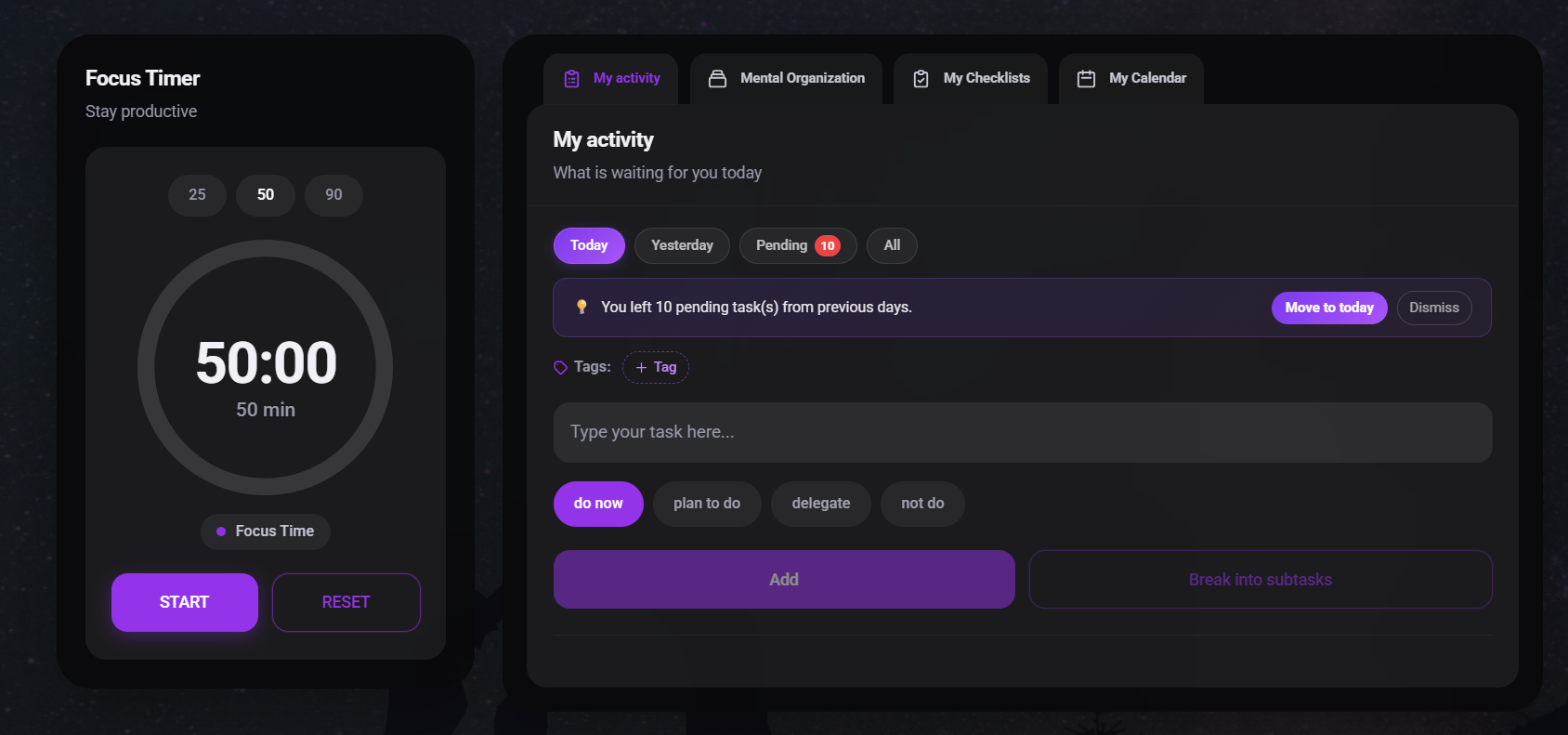
Focus Organize. It offers a Pomodoro timer, to-do lists, checklists, an Eisenhower matrix, and the 50-30-20 financial rule—all in one seamless app. Its pricing is transparent: $9.99/user/month with support for up to 2 users. That's $120 per year for a couple or two colleagues to get seriously productive. No hidden fees, no add-ons. For a full price breakdown, see
is investing in time management tools worth the hype.
The old way of managing time relied on paper planners, sticky notes, and manual tracking—free in monetary terms but incredibly expensive in time and consistency. The generic/cheap AI approach includes free or low-cost digital tools that offer basic automation but often come with ads, limited integrations, and poor support. The modern approach—embodied by Focus Organize—combines integrated features, transparent pricing, and real user support. Here's how they compare:
| Aspect | Traditional Approach (Manual) | Generic/Cheap AI Approach | Modern Approach (Focus Organize) |
|---|
| Cost | $0 upfront, but high time cost | $0–$5/month, but hidden upgrade costs | $9.99/user/month, all-inclusive |
| Features | Pen, paper, manual tracking | Limited to-do lists, ads, occasional bugs | Pomodoro, Eisenhower, to-do, checklists, finance rule |
| Collaboration | Share a physical notebook | Limited or requires paid upgrade | Supports 2 users per account, seamless sync |
| Support | None | Community forums only | Email support included, no extra charges |
| Total Cost of Ownership | High due to inefficiency | Moderate, but frustrating limitations | Low, with measurable productivity gains |
💡Key Takeaway
The modern approach not only costs less in the long run but also provides a superior user experience that saves hours each week.
The old way of managing time relied on paper planners, sticky notes, and manual tracking—free in monetary terms but incredibly expensive in time and consistency. The generic/cheap AI approach includes free or low-cost digital tools that offer basic automation but often come with ads, limited integrations, and poor support. The modern approach—embodied by Focus Organize—combines integrated features, transparent pricing, and real user support. Here's how they compare:
| Aspect | Traditional Approach (Manual) | Generic/Cheap AI Approach | Modern Approach (Focus Organize) |
|---|
| Cost | $0 upfront, but high time cost | $0–$5/month, but hidden upgrade costs | $9.99/user/month, all-inclusive |
| Features | Pen, paper, manual tracking | Limited to-do lists, ads, occasional bugs | Pomodoro, Eisenhower, to-do, checklists, finance rule |
| Collaboration | Share a physical notebook | Limited or requires paid upgrade | Supports 2 users per account, seamless sync |
| Support | None | Community forums only | Email support included, no extra charges |
| Total Cost of Ownership | High due to inefficiency | Moderate, but frustrating limitations | Low, with measurable productivity gains |
💡Key Takeaway
The modern approach not only costs less in the long run but also provides a superior user experience that saves hours each week.
Return on Investment: Calculating the Value
Instead of asking "How much does it cost?" ask "How much value will it generate?" Here's a simple formula:
ROI = (Time Saved per month × Hourly Rate × 12) / (Annual Tool Cost)
Example: If a $10/month tool saves you 2 hours per week at a $50/hour rate:
- Time saved per month: 8 hours
- Annual value: 8 × $50 × 12 = $4,800
- Annual cost: $120
- ROI: 40x (4,000%)
According to a Harvard Business Review article from 2024, companies that invest in productivity tools see an average 22% increase in employee efficiency within the first six months. That translates to roughly $11,000 in savings per employee per year for a $50,000 salary. Clearly, the right tool pays for itself many times over.
But beware of over-investing: a $50/month tool with features you never use is waste. Match the tool to your workflow, not the other way around.
Let's expand this with a deeper analysis. A study by RescueTime found that users of paid productivity apps are 30% more likely to stick with the tool for more than 3 months compared to free users. This stickiness translates directly into cumulative time savings. Additionally, according to a Forrester report on digital workplace tools, organizations that standardize on a single time management platform see a 15% reduction in overhead costs related to switching between apps.
When you calculate ROI, also factor in the reduction in decision fatigue. Having one tool that handles task management, time tracking, and financial planning eliminates the mental load of choosing which app to open. Over a year, this saved mental energy can be valued at hundreds of dollars.
| Tool | Free Version | Paid Starting Price (per user/month) | Best For |
|---|
| Focus Organize | Yes (limited tasks) | $9.99 | Individuals & small teams |
| TickTick | Yes (basic) | $2.4 | Habit & task tracking |
| Todoist | Yes (limited) | $4 | Simple task lists |
| Toggl Plan | No | $9 | Project timelines |
| Asana | Yes (limited) | $10.99 | Team collaboration |
| Notion | Yes (limited) | $10 | All-in-one workspace |
Prices approximate as of January 2026. Check each tool's website for current offers.
Real-World Examples
Case Study: The Freelance Designer Who Saved $1,000/year
Maria, a freelance graphic designer, used a free to-do list app but found herself missing deadlines because it lacked recurring tasks and a Pomodoro timer. She upgraded to Focus Organize at $9.99/month. In her first month, she completed 15% more projects and reduced overtime by 6 hours/week. At $75/hour, that's an extra $450/month in billable time—a 45x return on her $10 investment. Over a year, she saved $5,400 in additional income, minus $120 subscription = $5,280 net gain.
Case Study: The Small Tech Team That Cut Vendor Costs
A 3-person startup was using Asana ($30.99/month per user) and Toggl Track ($18/month per user). Combined: $147/month. They switched to Focus Organize ($9.99/user × 2 users = $19.98/month) and used the free time to track manually. They saved $127/month and found the integrated Eisenhower matrix improved prioritization. Total annual savings: $1,524.
Case Study: The Remote Couple Who Reclaimed 10 Hours a Week
John and Lisa, both remote workers in different time zones, were using separate tools—John with Todoist and Lisa with Google Calendar and a physical journal. They were misaligned on household tasks and project deadlines. After adopting Focus Organize for $9.99/month covering both users, they created shared task lists, used the Pomodoro timer for focused work sessions, and applied the 50-30-20 rule to their joint finances. Within one month, they reduced the time spent coordinating by 10 hours per week, translating to $500/month in combined billable time. Their ROI: 5000%.
Best Practices for Evaluating Pricing
When evaluating time management tools pricing, keep these best practices in mind:
- Focus on features, not price alone – A tool that saves you 10 hours per month is worth $50, even if it seems expensive. Use our top 10 time management tools for beginners to align features with your needs.
- Consider team size – Many tools charge per user. For teams of 2, Focus Organize’s 2-user plan is ideal. For larger teams, look for bulk discounts.
- Check for student or nonprofit discounts – Some tools offer up to 50% off for eligible users.
- Evaluate integration costs – If you rely on Zapier, Slack, or Google Calendar, ensure these are included in the base price.
- Read the fine print on data export – Some enterprise tools charge for exporting your data if you decide to switch. Avoid lock-in.
- Look for lifetime deals – Occasionally, tools like StackSocial offer lifetime licenses. These can be cost-effective if the tool is regularly updated.
- Test the mobile experience – A good time management tool must work seamlessly across devices. Poor mobile support can negate any price savings.
- Consider the learning curve – A cheap tool that takes weeks to onboard costs more in upfront time. Opt for intuitive interfaces like Focus Organize.
💡Key Takeaway
The best pricing is not necessarily the cheapest—it's the one that minimizes your total cost of ownership, including time and frustration.
Myth 1: Free is always cheaper.
See the hidden cost calculation above. If a free tool lacks recurring tasks or does not sync across devices, you'll waste time manually duplicating work. According to a University of California Irvine study, it takes an average of 23 minutes to refocus after a distraction. A free tool that doesn't integrate with your calendar will cause more distraction, not less.
Myth 2: Enterprise plans are overkill for small teams.
It depends. Some enterprise features—like admin controls, data export, and SSO—can become necessary as you grow. If you're a team of 3, focus on collaboration; you likely don't need advanced analytics. But don't dismiss enterprise tiers entirely; they sometimes include unlimited storage and priority support at a reasonable per-user price.
Myth 3: You need to pay per user for every tool.
Not true. Some tools, like Focus Organize, allow 2 users per account. Others have family plans. Always check the billing model.
Myth 4: Annual contracts lock you into bad tools.
Most reputable companies offer a 30-day money-back guarantee on annual plans. That gives you a month to decide with no risk. If you're confident, annual billing can save you 20%.
Myth 5: All-in-one tools are always more expensive.
Actually, an integrated tool like Focus Organize can be cheaper than paying separately for a task manager, timer, and finance tracker. The combined cost of three separate tools could easily exceed $30/month, while Focus Organize costs $9.99/month with all features.
Frequently Asked Questions
The average cost varies by features. For a solid freemium tool with basic functionality, expect $0–$5/month. Mid-range tools that include Pomodoro timers, project boards, and team collaboration typically cost $8–$15/user/month. Enterprise-grade solutions with compliance and analytics start at $20/user/month and go up to $50+. A 2025 Gartner survey found that the median spend on productivity software among small to medium businesses is $18/user/month. However, many businesses overpay for features they never use. The best approach is to start with a tool that matches your immediate needs, like Focus Organize at $9.99/user/month, and upgrade only when you've outgrown it.
Free tools can be worth it if your needs are extremely basic—say, a single to-do list with no reminders or integrations. But they come with trade-offs: limited storage, ads, no support, and often missing core features like habit tracking or collaboration. For many people, the time lost working around these limitations outweighs the savings. According to a study by RescueTime, users of free productivity apps are 30% more likely to abandon them within a month compared to paid users. The psychological commitment of paying also increases engagement. If you're serious about improving your time management, invest at least in a low-cost paid option.
How much does Focus Organize cost?
Focus Organize offers a straightforward pricing model: $9.99/user/month. This gives you access to all features—
Pomodoro timer, to-do lists, checklists, Eisenhower Matrix, and the 50-30-20 financial rule. The account supports up to 2 users, making it ideal for partners, roommates, or small team collaboration. There is an annual plan available that reduces the cost to about $8.33/user/month (saving 20%). No hidden fees for integrations or storage. You can try the free version first to see if it fits, then upgrade when you need unlimited tasks and collaboration. Compare this with
the pomodoro timer for beginners: boost focus in 25 minutes to see how it stacks up against other tools.
Hidden fees are the #1 complaint among users. Common ones include: (1) Storage overage charges—if you exceed the free tier's storage limit, you may be forced to upgrade or pay per extra GB. (2) Integration fees—some tools charge extra for connecting to third-party services like Zapier or Google Calendar. (3) User minimums—requiring you to pay for a minimum number of seats even if you only need one. (4) Premium support—only available with higher-tier plans. (5) Data export fees—some enterprise tools charge for exporting your data if you want to leave. Always read the fine print. With Focus Organize, there are no such surprises: all features, integrations, and support are included in the single price.
Can I get a discount for annual billing?
Yes, most
time management tools offer a discount if you pay annually rather than monthly. Typically, you save 15–20%. For example, Todoist gives 20% off annual, Asana offers 15% off, and Focus Organize offers 20% off. Additionally, some tools have student or non-profit discounts (10–50% off). It's worth checking for promotional deals, especially around New Year or back-to-school seasons. Always calculate the effective monthly cost when comparing annual vs monthly. A $10/month tool becomes $8/month annual—a savings of $24 per year.
Calculate the per-feature cost. List the features you actually use (not just have). Divide the monthly cost by the number of features that save you time. If each feature costs more than $2–$3 per month, you may be overpaying. Also, check if a cheaper alternative offers the same core features. For instance, if you only need a Pomodoro timer and to-do list, Focus Organize at $9.99 gives you both plus extras, while a simpler timer app might charge $5 for just the timer. The value lies in integration.
What is the best pricing model for a team of 2?
For a team of 2, the ideal model is either a per-user subscription that doesn't force extra seats or a flat rate for up to a certain number of users. Focus Organize's 2-user plan is perfect at $9.99/month for both. Alternatively, some tools offer a family plan for around $5–$7 per person. Avoid tools that require 5+ seats minimum, as you'll pay for unused licenses.
Conclusion
Time management tools pricing in 2026 is more transparent than ever, but navigating the options requires understanding both the sticker price and the hidden costs. Free tools can work for minimal needs, but most professionals benefit from a paid solution that includes collaboration, integrations, and reliable support. The sweet spot is $8–$15/user/month, where Focus Organize lives.
Your next step is simple: identify your must-have features, set a budget, and start a free trial with a tool that fits. I recommend beginning with Focus Organize—it's built for real-world productivity without the bloat. Visit
Focus Organize to get started today.
About the Author
Focus Organize Editorial Team is the CEO & Founder of Focus Organize. With over a decade of experience in productivity consulting and software development, the team has tested dozens of time management tools and helped hundreds of professionals optimize their workflows. They write to cut through the noise and deliver actionable, data-backed advice.
Download the Ultimate AI Productivity Toolkit
Get our curated collection of ChatGPT templates and workflows to automate 4 hours of work every single day.