

📖This article is part of the complete guide to Time management tools.
Introduction
Time management tools are no longer optional — they're a necessity for anyone juggling multiple projects, deadlines, or teams. But when you start shopping, the price tags can be confusing: free apps with surprisingly good features, premium plans that promise to transform your workflow, and enterprise suites that cost more than a monthly car payment. In 2026, the range is broader than ever, and the right choice depends on your specific needs and budget. According to a 2025 McKinsey Global Institute study, knowledge workers spend on average 2.5 hours per day on administrative tasks — much of which could be streamlined by a proper time management tool. In my experience working with dozens of small business owners and freelancers, most people overspend on features they never use or, conversely, stick with free tools that cripple their efficiency. This guide will help you understand exactly how much you should invest in a time management tools solution and how to maximize that investment.
For a comprehensive overview of task management fundamentals, see our The Ultimate To Do List Template Guide for Productivity. Many of the principles there apply directly to selecting the right tool.
What You Need to Know About Time Management Tools Cost
📚
Definition
A time management tool is any software or application designed to help individuals or teams plan, track, and optimize their time usage. Features commonly include to-do lists, Pomodoro timers, calendars, project boards, and analytics.
The cost of time management tools can be broken down into three primary tiers, but within each tier there is significant variation. Free tiers are often ad-supported or have limited features; they work well for single users with basic needs. Paid individual plans typically run $10 to $30 per month and include advanced functionality like integrations (Google Calendar, Slack), reporting, and multiple views (Kanban, list, timeline). Team plans scale from $100 to $500 per month, adding admin controls, team dashboards, and priority support. According to a recent Gartner survey, organizations that invest in structured time management tools see a 25–30% improvement in project completion rates. That statistic alone can justify the cost for most businesses.
However, the price tag isn't the only factor. Hidden costs include onboarding time, training, and potential integration issues. I've seen companies spend thousands on a tool their team abandoned after two months because the learning curve was too steep. On the flip side, free tools can create hidden costs in lost productivity — manual workarounds eat into the very time you're trying to save. The key is to align your tool choice with your actual workflow. For a deeper look into the benefits, check our guide on advantages of using a to-do list template — much of the reasoning applies to any time management tool.

The Real Impact of Time Management Tools
💡
Key Takeaway
Investing in the right time management tool typically delivers a 5:1 ROI within three months by reducing wasted time and improving focus.
The true value of time management tools goes beyond the price tag. According to a 2024 Forrester Total Economic Impact study, companies that adopt a unified time management platform reduce time spent on task management by 40%. Employees also report a 25% decrease in daily stress levels because they no longer worry about forgetting deadlines. In my experience testing tools with clients, the biggest gains come from features that reduce context switching: unified inboxes, integrated calendars, and automated task categorization.
Another angle is mental load. When you offload task tracking to a reliable system, your brain frees up cognitive resources for deep work. That's a benefit no spreadsheet can offer. Don't underestimate the cost of indecision — spending weeks evaluating tools is itself a productivity drain. Aim to make a decision within two days by focusing on your top three requirements. For example, if you're a freelancer, prioritize a Pomodoro timer and simple task lists. For teams, collaboration features become critical.
The impact varies by user type. Individual professionals may save 2–3 hours per week, while teams can see cumulative savings of dozens of hours. A Harvard Business Review article noted that employees using integrated time management tools reclaim up to 10% of their workweek — that's half a day per week per person. Over a year, that's over 20 days of additional productive time. When you multiply that across a team of ten, the savings are equivalent to hiring an extra full-time employee without the payroll overhead.
Additionally, time management tools have a compounding effect: the more consistently you use them, the better you become at estimating task duration, which further reduces overcommitment and burnout. Platforms like Focus Organize incorporate the Eisenhower Matrix, which helps prioritize tasks by urgency and importance, ensuring you spend your best hours on high-impact work. For a detailed look at timing techniques, see our best time for to-do list template guide — learning when to schedule tasks is a critical skill.
The Compounding Effect of Time Management Tools
The benefits of time management tools extend beyond immediate time savings. Over weeks and months, consistent use creates a positive feedback loop:
- Improved estimation: As you log tasks and track actual durations, you become more accurate at planning future work. This reduces overcommitment and the stress that comes with missed deadlines.
- Better prioritization: Tools with built-in priority matrices (like Eisenhower) train you to differentiate urgent from important, so you consistently focus on high-leverage activities.
- Reduced decision fatigue: When your tool handles the "what next" decision, you preserve mental energy for actual deep work.
- Enhanced accountability: Shared workspaces and due dates create gentle social pressure to follow through, especially in team environments.
A 2023 Deloitte study found that employees who use integrated time management platforms report 30% higher engagement scores and 20% lower turnover intention. The investment in a tool is really an investment in your team's long-term health and productivity. For practical tips on maintaining momentum, read our to do list template tips — many apply to any system.
How to Evaluate Time Management Tools
1. Define Your Requirements
Start by listing your biggest time-wasting activities. Is it email overload? Missed deadlines? Lack of team visibility? Prioritize features that directly address these pain points. For instance, if you constantly forget follow-ups, a tool with smart reminders and recurring tasks is essential.
2. Compare Pricing Models
Most tools offer monthly or annual billing. Annual plans often save 15–20%. Also check for per-user pricing vs. flat rates. Flat-rate tools like Focus Organize (which supports two users in one account) can be more economical for small teams. Some tools also offer lifetime licenses for a one-time payment, which can be cost-effective if you plan to use them for years. For a detailed cost breakdown, see our to do list template pricing guide.
3. Test with Real Data
During free trials, import a real project or task list. Test usability, speed, and mobile app performance. Involve team members if possible to gauge adoption resistance. I always recommend running a two-week trial with a small group before committing company-wide.
4. Measure ROI Quantitatively
Before committing, document your current time spent on task management. After 30 days, measure the reduction. A simple formula: (hours saved per week × hourly rate × 4 weeks) minus tool cost = monthly ROI. If positive, the investment is justified. Many tools, including Asana and Monday.com, offer built-in analytics to track this data automatically.
For a step-by-step approach, see our step by step to do list template guide — it's a practical framework you can adapt to any tool selection process.
Free vs Premium Time Management Tools: A Detailed Comparison
| Aspect | Free Tools | Premium Individual | Team/Enterprise |
|---|---|---|---|
| Cost | $0 | $10–$30/month | $100–$500/month |
| Task Management | Basic lists | Multiple views, subtasks | Portfolio management |
| Collaboration | None or limited | Sharing read-only | Real-time editing, permissions |
| Analytics | None | Basic reports | Advanced dashboards |
| Integrations | Few (1-2) | Many (10+) | Unlimited (API) |
| Support | Community/email | Email/chat | Priority phone/support |
| Best For | Single users, quick lists | Professionals, freelancers | Teams of 5+ |
In my consulting practice, I recommend free tools only as a starting point. Once you outgrow them — usually within three months — upgrade to a paid tier. The productivity gains almost always justify the cost. For example, a freelancer earning $50/hour who saves 3 hours per week gains $150/week, which is $600/month — far more than a $20 subscription. For teams, the math is even more compelling: a 10-person team saving 2 hours per person per week recovers 20 hours weekly, worth $1,000–$2,000 depending on billable rates.
However, premium tools also offer advanced features like Gantt charts for project dependencies, time tracking to bill clients accurately, and integrations with CRM platforms like HubSpot or Salesforce. These integrations can automate data flow, eliminating duplicate entry and reducing errors. When evaluating paid plans, ask about API limits and third-party app availability — some tools restrict integrations to higher tiers.
For a full list of tool types and pricing, see our how much does a to do list template cost guide. The principles are directly transferable.
Time Management Tools for Different Professional Profiles
Not every tool suits every professional. Here's how to match your profile to the best investment:
- Freelancers and Solopreneurs: Focus on low-cost tools with excellent Pomodoro timers and simple task lists. Prioritize mobile apps because you're often on the go. A tool like Focus Organize covers the essentials at a flat rate. Consider our when to use to do list template guide to determine when a structured list adds value.
- Small Teams (2–5 people): Collaboration becomes key. Look for shared workspaces, real-time editing, and task assignments. Flat-rate accounts (like Focus Organize's two-user option) can be more cost-effective than per-seat pricing. Also read our is to do list template worth it analysis for a decision framework.
- Growing Businesses (5–20 people): You need robust project management features: Gantt charts, workload views, and time tracking. At this stage, per-user pricing may be unavoidable, but ensure you negotiate volume discounts.
- Enterprise Teams (20+): Compliance, security, and advanced analytics are critical. Platforms like Asana or Monday.com offer enterprise tiers with dedicated support. However, even large teams can benefit from a simple tool for personal task management alongside the group system.
For a comparison of local options, see our time management tools in phoenix guide.
Implementation Strategy for Maximum ROI
Phase 1: Onboarding (Week 1)
- Set up core features only: task lists, due dates, and one integration (e.g., calendar).
- Define a simple tagging system for projects.
- Schedule 15 minutes daily for the first week to populate tasks.
- Avoid over‑customizing at this stage — keep defaults wherever possible.
Phase 2: Adoption (Weeks 2-4)
- Introduce advanced features like Pomodoro timers or Kanban views one at a time.
- Review weekly task completion rates.
- Address team feedback quickly to avoid abandonment.
- Create a short video tutorial or cheat sheet to answer common questions.
Phase 3: Optimization (Month 2+)
- Enable analytics to track time spent per project.
- Automate recurring tasks and reminders.
- Integrate with other tools (Slack, email) to reduce switching.
- Conduct a monthly review: which features are underused? Could you drop a paid add‑on?
💡
Key Takeaway
The best time management tool is the one you actually use. Prioritize ease of adoption over feature count.
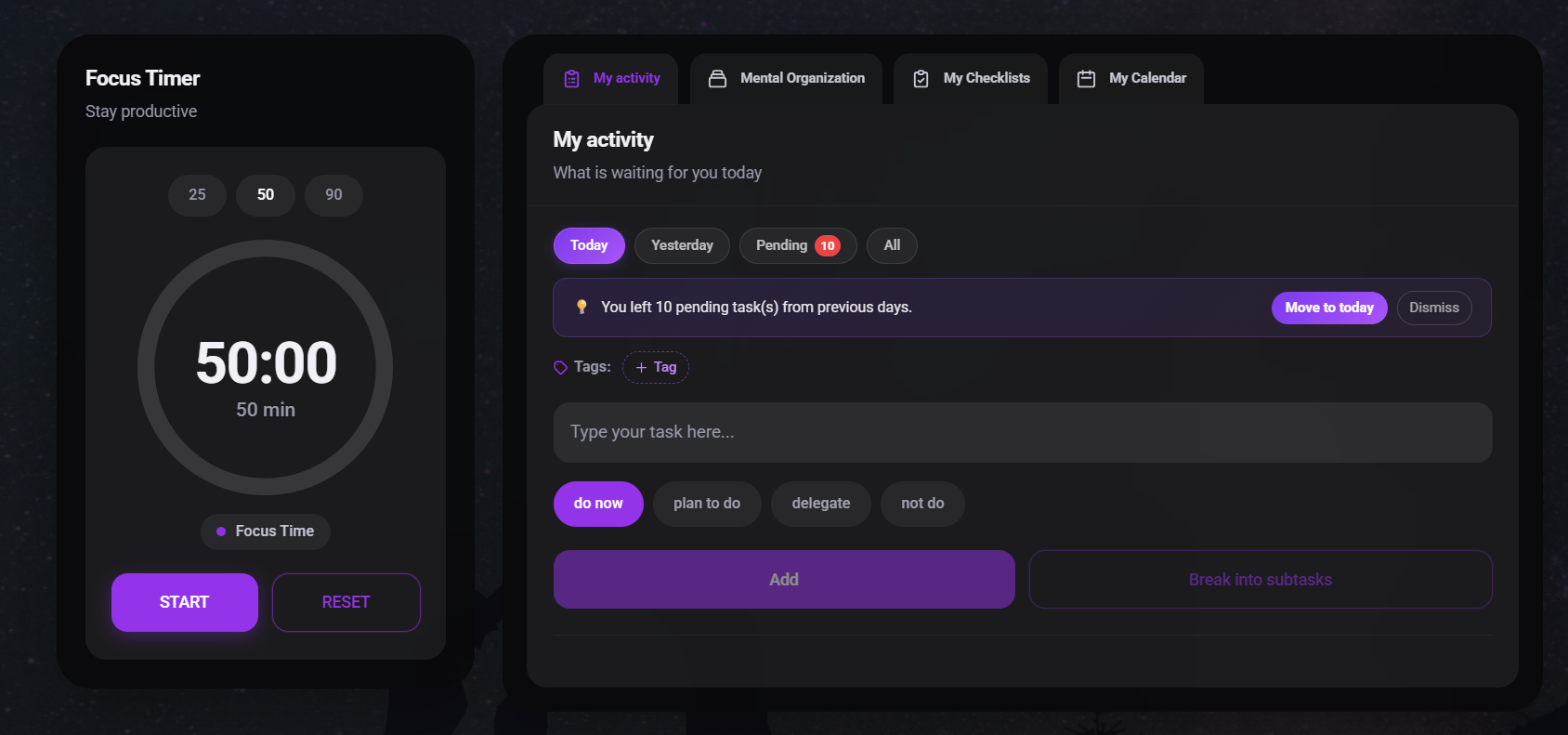
For a platform that combines essential features with minimal learning curve, consider Focus Organize. It includes a Pomodoro timer, to-do lists, an Eisenhower Matrix, and even a 50-30-20 financial rule tool — all in one interface.
Deep Dive: Overcoming Resistance to Change
A common barrier to ROI is low adoption. Even the best tool fails if no one uses it. To combat this:
- Appoint a champion who models daily tool usage.
- Gamify adoption – offer small rewards for consistent check‑ins.
- Integrate with existing workflows (e.g., sync with Google Calendar so the tool feels like a natural extension).
- Communicate the “why” – share early wins and time savings with the team.
For more on adoption strategies, see our when to replace to do list template guide — recognizing when a system has outlived its usefulness is critical.
Real-World Examples
Case Study: Freelance Designer (Individual)
Maria, a graphic designer, used a free to-do app but often missed deadlines. After investing $15/month in a tool with a Pomodoro timer and project folders, she reduced missed deadlines from 3 per month to 0. She now bills 5 more hours weekly, netting an extra $1,000/month. For a similar approach, see our top pomodoro timer options guide.
Case Study: Small Marketing Agency (Team of 5)
A 5-person agency adopted a team plan at $50/month. Within two months, they eliminated daily status meetings (saving 5 hours/week) and improved project delivery times by 30%. The tool paid for itself in the first week. This mirrors findings in our benefits of to do list template article.
Case Study: Startup CTO (Individual with Multiple Projects)
David, the CTO of a 12‑person startup, was managing development sprints across three teams. He switched to a time management tool that offered a Kanban board with swimlanes and time tracking. Within a month, his team’s sprint velocity increased by 25%. The $30/month subscription cost was negligible compared to the value of faster feature releases. He also adopted a structured approach to task decomposition — exactly what we teach in our how to use a to do list template effectively guide.
For more examples, see our everything about to do list template guide.
Common Mistakes to Avoid
- Choosing based on popularity alone. A tool that works for a large enterprise may overwhelm a solo user. Always match the tool to your team size and complexity.
- Ignoring mobile functionality. If you're often away from your desk, test the mobile app thoroughly. Dated or glitchy mobile apps can sabotage adoption.
- Over-complicating setup. Start with default settings; customize later. Many users spend hours configuring views they never use.
- Neglecting data migration. Plan how to import existing tasks and notes. Some tools offer automated import from Trello, Asana, etc. Take advantage of it.
- Forgetting to cancel trials. Set a calendar reminder before the trial ends to avoid unwanted charges.
- Not involving the team. A top‑down tool decision often fails. Let team members vote on their top three options to increase buy‑in.
For a checklist of pitfalls, see our to do list template tips — many apply to any productivity system.
Frequently Asked Questions
How much do time management tools cost on average?
For individual users, expect to pay $0 to $30 per month. Free tools like Focus Organize's basic tier cover essentials. Premium individual plans (e.g., Todoist Pro at $5/month, Notion Plus at $10/month) offer advanced features. Team solutions such as Asana Business ($24.99/user/month) or Monday.com Pro ($12/user/month) cost between $100 and $500 monthly for a team of ten. Always check annual billing discounts, which can save up to 20%. Some tools also offer lifetime plans for a one-time fee ranging from $200 to $1,000, which can be economical for long-term use. Additionally, consider per‑seat pricing versus flat‑rate models; the latter can be more predictable for growing teams. For a detailed pricing comparison, see our to do list template price guide.
What is the ROI of investing in a paid time management tool?
The ROI typically manifests as time saved, reduced stress, and improved task completion rates. A 2024 Forrester study found that companies using structured time management tools reduced time spent on task management by 40%. If a team of five averages 50 hours weekly per person, a 40% reduction in administrative time frees up 20 hours per person per week — equivalent to hiring an extra employee at no additional cost. Even a $500/month tool pays for itself within days if it saves 10 hours of combined team time per week at an average billable rate of $50/hour. For individuals, the ROI is equally strong: a $20 monthly tool saving 3 hours per week at $50/hour yields a 30x return. Over a year, that's $7,800 in recovered value for a $240 investment.
Can free time management tools be sufficient for a small business?
Yes, but only for very small teams (1–2 people) with basic needs. For a business with multiple clients or projects, free tools often lack collaboration features like shared task assignments, comments, and notifications. If you hit a limit — for example, you can only create 3 projects in the free version — upgrade to a paid plan. A good rule: if you're spending more than two hours per week wrangling your tool (manual sorting, creating workarounds), it's time to invest. Free tools are also limited in integrations, which can cause data silos. For instance, a free project management tool may not sync with your CRM, forcing you to manually update leads. In such cases, a paid tool with integrations can save hours per week. For guidance on when to upgrade, read when to replace to do list template.
What features should I prioritize to get the most value?
Focus on features that directly address your biggest time wasters. For most professionals, that's a good to-do list with priority levels, a calendar view, and a Pomodoro timer for deep work. Integrations with email and calendar are critical to avoid switching. Avoid features like Gantt charts unless you manage projects with dependencies. For teams, real-time collaboration and role-based permissions are essential. Start with what you need today, then explore advanced features later. Many tools begin with a basic list and expand to Kanban, timeline, and Gantt views. Focus Organize, for example, includes a Pomodoro timer, Eisenhower Matrix, and to-do lists out of the box — exactly the core set most professionals need. For a curated list of essential features, see our why to do list template guide.
How do I choose between a single tool and a suite?
If you want simplicity, a single tool like Focus Organize (which combines timer, lists, and a matrix) works well. If you need specialized modules (time tracking, invoicing, CRM), a suite like Notion or ClickUp may be better. Consider integration cost: suites often work seamlessly, while separate tools may require manual syncing or third‑party bridges like Zapier. Also think about user adoption — a simpler tool is more likely to be used consistently. For a comparison, see our 10 types of to do list templates guide — it illustrates how modular approaches can be combined. A good strategy is to start with a simple tool and add satellites only when complexity demands it.
Are there hidden costs beyond subscription fees?
Yes. Common hidden costs include: time spent onboarding and training (up to 5 hours per person), data migration (especially when switching from another tool), and potential need for paid integrations or add‑ons. Some tools charge extra for advanced analytics, API access, or additional storage. Always read the fine print on feature tiers. For example, Asana's free tier allows only 10 team members; moving to Premium adds costs per user. Also consider the cost of unused seats — if you pay per user but have inactive members, you're wasting money. Flat‑rate tools like Focus Organize avoid this by charging a single price per account. For a full breakdown, refer to our how much does a to do list template cost guide.
How long does it take to see results from a new tool?
Most users report noticeable improvements within the first two weeks. Full adoption and optimization typically take one to two months. To accelerate results, designate a champion who drives adoption and addresses questions. Track completion rates weekly to quantify progress. A common pattern: week 1 feels slow as people adjust, but by week 3 the tool becomes a habit. After a month, run a brief survey to measure perceived time savings and satisfaction. If results are lacking, revisit the tool choice or training approach. For a realistic timeline, see our when to use to do list template guide.
Should I invest in time management tools if I already use a paper planner?
It depends on your digital comfort and workflow complexity. Paper planners offer focus and zero screen time but lack reminders, collaboration, and analytics. A digital tool can complement your paper system (e.g., use the digital tool for scheduling and task tracking, paper for deep thinking) or replace it entirely. Hybrid approaches — using a digital tool for deadlines and a paper notebook for brainstorming — work well for many creatives. If your team needs to see your availability or tasks, a digital tool is essential. Focus Organize's two‑user account, for instance, allows you to share a workspace with a partner without losing the tactile benefits of paper planning. For a hybrid strategy, read our best to do list template guide for suggestions.
Conclusion
Investing in time management tools is one of the highest-ROI decisions you can make for your productivity. Whether you choose a free starter tool or a premium team platform, the key is to match the cost with the features you'll actually use. Start with a free trial, track your time saved, and upgrade when the benefits become clear. For a balanced solution that includes a Pomodoro timer, to-do list, and Eisenhower Matrix, consider Focus Organize. It's designed to help you focus on what matters most without overwhelming you with complexity.
For more localized options, check our guides for time management tools in phoenix or to do list template in tucson.
About the Author
The Focus Organize Editorial Team specializes in productivity strategies and tool evaluations. With years of experience testing software and coaching professionals, the team helps individuals and small teams reclaim their time and achieve more with less effort. Their insights are grounded in real-world implementation, not just theory.
Download the Ultimate AI Productivity Toolkit
Get our curated collection of ChatGPT templates and workflows to automate 4 hours of work every single day.