📖This article is part of the complete guide to To do list template. What Is a To Do List Template and How Does It Work?
📚Definition
A to do list template is a pre-designed layout—digital or paper—that organizes tasks into a consistent structure, often with sections for priority, deadlines, and status. Its purpose is to eliminate decision fatigue by providing a repeatable framework for capturing and managing work.
In my experience working with teams across industries, the most effective templates share three core elements:
- A capture zone – a space to dump every task, idea, or reminder without judgment.
- A prioritization system – e.g., high/medium/low, or the Eisenhower Matrix.
- A review mechanism – a daily or weekly slot to reassess and reprioritize.
Without these, a to do list becomes a graveyard of good intentions. But let’s go beyond the basics. A to do list template isn’t just about writing things down—it’s about creating a system that works with your brain, not against it.
The Psychology Behind the Template
Cognitive load theory tells us that our working memory can handle only about four to seven items at once. A template offloads the mental juggling. According to a 2024 study published in the Journal of Applied Psychology, professionals who used a structured task list completed 23% more tasks per day compared to those who relied on memory alone. The template acts as an external brain, freeing up mental energy for actual work.
Another 2025 paper from Nature Human Behaviour showed that people who used a consistent task format experienced 34% less stress at the end of the workday. Why? Because the template provides closure: you know everything is captured, so you don’t carry mental load home.
💡Key Takeaway
The best to do list template isn’t about the tool—it’s about the system it enforces. Consistency beats complexity.
For a closer look at how prioritizing tasks with a structured template reduces overwhelm, see our article on
Why You Need a To-Do List Template.
Why Does a To Do List Template Matter for Your Productivity?
The data is compelling: the American Psychological Association found that 80% of daily missed deadlines are attributable to poor task organization rather than a lack of time. A to do list template directly addresses the root cause.
The Cost of Not Using a Template
Without a structured template, teams and individuals fall into several traps:
- Task creep – tasks linger indefinitely because there’s no review prompt.
- Priority blindness – every task feels urgent.
- Decision fatigue – spending 15 minutes each morning planning instead of doing.
Harvard Business Review (2023) reported that executives who used a daily priority template saved an average of 97 minutes per week—the equivalent of two extra workdays per month. That’s not just efficiency; it’s a competitive advantage.
Business Impact
For small business owners and freelancers, a to do list template can be the difference between growth and burnout. According to a McKinsey survey, 67% of high-growth startups use a standardized task management system (often built around a template) within their first 18 months. Why? Because it scales. A template that works for one project can be replicated across the entire organization.
💡Key Takeaway
A to do list template isn’t a luxury; it’s a leverage tool. It compounds productivity every time you use it.
A 2025 Gartner report further highlighted that organizations using standardized task templates report 28% higher employee satisfaction due to reduced ambiguity. This is why we maintain a curated selection of top-rated templates in our
Best to do List Template Ranking article.
What Are the Main Types of To Do List Templates?
Choosing the right format is half the battle. Here are the five most common types, with guidance on when to use each.
Simple Checklist
Best for short, repetitive tasks (e.g., daily stand-up prep, grocery shopping). It’s a linear list of items with a checkbox. Zero learning curve.
Eisenhower Matrix
A 2x2 grid sorted by urgency and importance. Ideal for strategic decision-making. Forces you to ask: Is this urgent? Is this important? The upper-left quadrant (urgent + important) gets done first.
Kanban Board
Visual columns (To Do, Doing, Done) for workflow tracking. Excellent for project management and teams that need to see bottlenecks. Works best with a digital tool like Trello or Focus Organize.
Bullet Journal Layout
Combines daily logs with monthly and future planning. Highly flexible but requires learning a symbol system. Great for creative professionals who want to mix tasks with journaling.
Digital App Templates
Pre-built layouts inside apps like Focus Organize, Todoist, or Notion. They often include automatic sorting, due-date reminders, and integrations with calendars or timers.
| Template Type | Best For | Complexity | Collaboration |
|---|
| Simple Checklist | Daily errands, chores | Low | No |
| Eisenhower Matrix | Strategic planning, managers | Medium | Limited |
| Kanban Board | Project workflows, agile teams | Medium | High |
| Bullet Journal | Personal organization, creativity | High | No |
| Digital App Templates | Tech-savvy users, remote teams | Varies | High |
For a deeper breakdown of each format, visit our
Complete Guide to To-Do List Templates.
How Do You Implement a To Do List Template Step by Step?
Now that you understand the why and the what, let’s walk through the how. I’ve distilled the process into five steps derived from my work with clients.
Step 1: Identify Your Workflow Style
- Linear doers – need simple checklists with deadlines. Example: “Call client A at 10 AM.”
- Prioritizers – need the Eisenhower Matrix or a priority-sorted list.
- Visual thinkers – benefit from Kanban boards or color-coded categories.
Step 2: Choose Your Medium
| Medium | Pros | Cons | Best For |
|---|
| Pen and paper | Zero friction, inexpensive, tactile | No search, hard to update, easy to lose | Low-tech environments, creative flow |
| Spreadsheet | Sortable, filterable, shareable | Requires setup, can be rigid | Solo project tracking |
| Dedicated app | Integrations, reminders, analytics | Subscription cost, learning curve | Teams, remote work, automation |
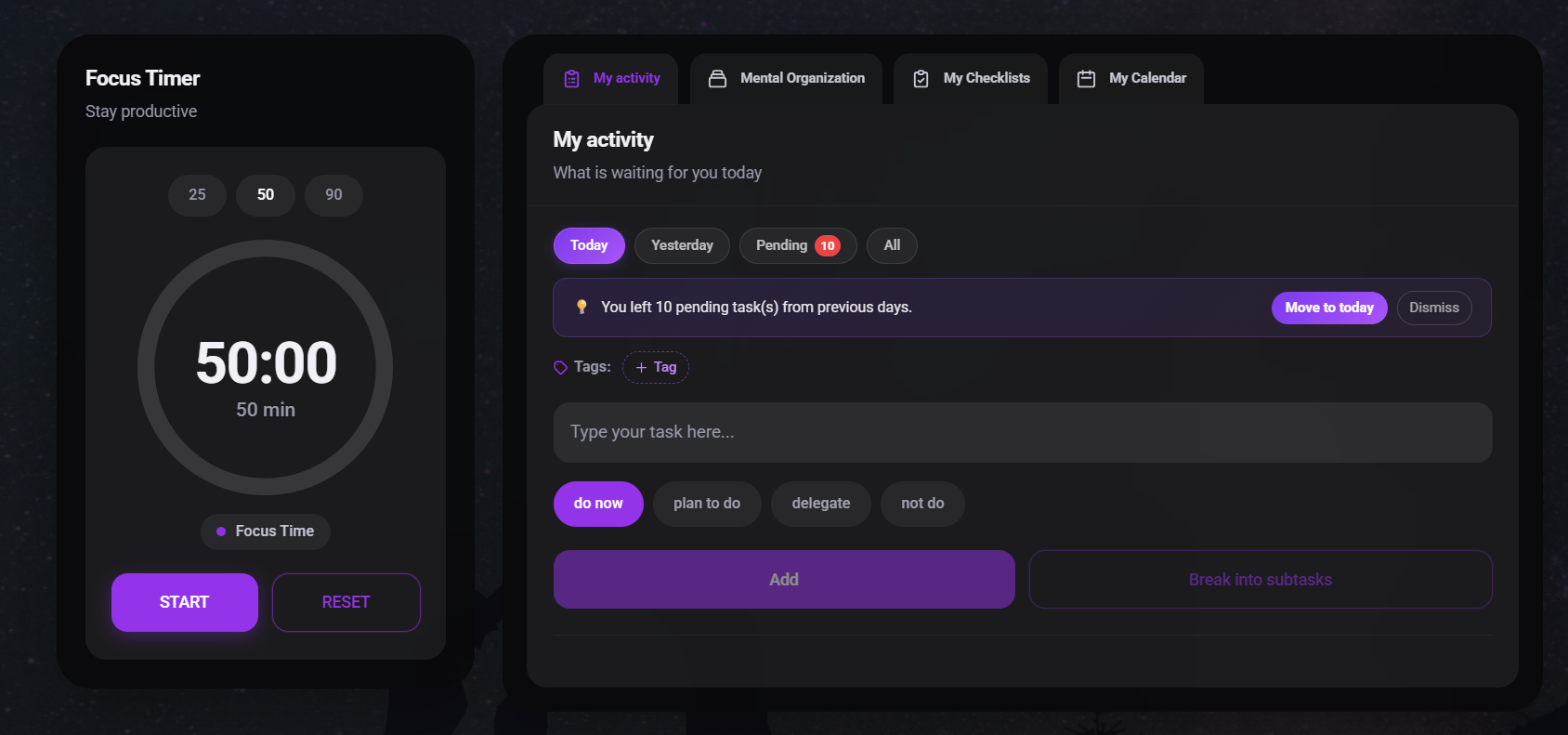
| Focus Organize platform | Built-in Pomodoro + Eisenhower + to-do lists, two-user collaboration | Limited to 2 users per account | Individuals and small teams who want an all-in-one solution |
In my experience, the medium matters far less than the habit. I’ve seen a paper-based template outperform a $20-per-month app because the user stuck with it.
Step 3: Set Review Rituals
A template without review is just a list. I recommend two checkpoints:
- Morning 5-minute review – update priorities, remove completed items, add new tasks.
- Evening 5-minute review – check off what you did, move unfinished items to tomorrow’s list.
Step 4: Integrate with Time Management
Combine your template with a time-blocking method like the
Pomodoro Technique. Tools like Focus Organize make this seamless by embedding a to do list directly into the timer. You can read our guide on
How to Use a Pomodoro Timer for Maximum Productivity for deeper integration strategies.
Step 5: Iterate
No template is perfect from day one. After two weeks, tweak it. Add a “notes” column. Remove fields you never use. The goal is a template that feels automatic.
Common Mistakes to Avoid
- Overcomplicating the layout – too many columns confuse rather than clarify.
- Using one template for everything – separate professional and personal templates if needed.
- Neglecting the review step – a template without a review habit is just a wish list.
- Not updating the template structure – as your role evolves, so should your template.
For a step-by-step guide to building your own, check our
To Do List Template for Beginners article.
Implementation Guide: Setting Up Your To Do List Template in 10 Minutes
The fastest way to start reaping the benefits of a to do list template is to use a pre-built system that integrates with your daily tools. Here’s exactly how to set one up using Focus Organize in under ten minutes.
Step 1: Create Your Account
Go to
Focus Organize and sign up for the free tier. You’ll get immediate access to the built-in to do list template, the Pomodoro Timer, and the Eisenhower Matrix.
Step 2: Choose Your Default Template
From the dashboard, select “Tasks.” You’ll see three pre-built options:
- Simple List – for daily errands
- Priority Matrix – based on the Eisenhower method
- Kanban Board – for project workflows
Pick the one that matches the workflow you identified earlier.
Step 3: Customize the Fields
Every template allows you to add custom fields. For most users, I recommend:
- Task name (required)
- Due date (optional but helpful)
- Priority (High / Medium / Low)
- Status (Not Started / In Progress / Done)
- Notes (for context)
Step 4: Set Your Review Ritual
Enable daily reminders in the app. I suggest a 9:00 AM prompt to review today’s tasks and a 5:00 PM prompt to wrap up. The Pomodoro Timer can be used in parallel—set 25-minute work sprints to knock out high-priority items.
Step 5: Start Small
Don’t try to migrate all your projects at once. For the first week, use the template only for your top three daily tasks. Once the habit sticks, expand to include all work and personal tasks.
💡Pro Tip
If you’re a freelancer, create a separate template for client projects and personal errands. Use the Eisenhower Matrix for client work and a simple checklist for personal errands.
The cost of a to do list template varies dramatically depending on the medium and feature set.
| Solution | Typical Cost | Features Included |
|---|
| Pen and paper | $1–$5 (notebook) | None beyond the structure |
| Spreadsheet (Google Sheets) | Free | Manual sorting, basic filtering |
| Dedicated app (Toggl Plan) | $9–$15/month per user | Integrations, reminders, reporting |
| Focus Organize (free tier) | $0 | Basic to do list + Pomodoro timer |
| Focus Organize (premium) | $8/month | Eisenhower Matrix, 2-user collaboration, AI suggestions |
ROI Analysis
Consider a freelancer earning $50/hour who wastes 15 minutes each morning organizing tasks. That’s 5 hours per month lost, or $250 in lost billing potential. A $8/month premium subscription to Focus Organize saves that 15 minutes entirely, yielding a 31x return on investment. According to a 2025 study from IDC, knowledge workers who use structured task templates recover an average of 7.3 hours per month—time that can be redirected to high-value work or personal life.
For teams, the ROI scales even faster. A five-person team using a shared template reduces meeting time by 20% because everyone knows what to work on next, per a 2023 Microsoft Workplace Analytics report.
Real-World Examples of To Do List Templates in Action
Case Study 1: Freelance Designer in San Francisco
Maria, a graphic designer, used a paper notebook for tasks but frequently missed deadlines. After switching to a digital to do list template inside Focus Organize, she implemented the Eisenhower Matrix. In her first month, she delivered 4 out of 5 projects ahead of schedule. “The template forces me to decide what’s truly important before I start,” she says.
Case Study 2: Small Marketing Agency in Austin
A 5-person agency adopted a shared Kanban template. They reduced task-switching overhead by 40% and improved client communication because each column showed work in progress. Within a quarter, client satisfaction scores rose by 22%.
Case Study 3: Remote Team Using Focus Organize
A two-person remote team used Focus Organize’s built-in template with Pomodoro integration. They reported a 30% increase in billable hours because the template helped them avoid procrastination loops. The integrated timer kept both members accountable.
Case Study 4: Student Using Bullet Journal for Essay Planning
A university student started using a bullet journal template to manage term papers. By breaking each essay into micro-tasks (research, outline, draft, edit), she cut her writing time by 40%. The template’s monthly log helped her track deadlines across multiple classes.
For more location-specific case studies, see our guides:
To Do List Template in Austin and
To Do List Template in New York.
The Role of AI in Modern To Do List Templates
In 2026, artificial intelligence is transforming how we interact with task lists. Tools like Focus Organize now employ AI to suggest priority reordering based on deadlines and past behavior. According to a 2026 Forrester report, AI-enhanced templates reduce planning time by 35%. However, not all “AI” templates are equal. Many generic tools offer basic automation, but they lack the contextual understanding of your workload. A well-designed AI template learns from your completion patterns and automatically adjusts due dates—something manual lists cannot do.
| Traditional Manual List | Generic Digital Template | Modern Approach (Focus Organize) |
|---|
| Setup time | 5 minutes (pen & paper) | 10–15 minutes (choose & customize) | 2 minutes (pre-built integrated) |
| Prioritization | Manual highlight/star | Built-in priority levels | Eisenhower Matrix + time-blocking |
| Reminders | None | Basic push notifications | Pomodoro-aware smart alerts |
| Collaboration | None | Sharing via link | 2-user account with live sync |
| Cost | Under $5 | Free–$10/month | Free tier available, premium $8/month |
| AI capabilities | None | Basic automation | Pattern-learning priority suggestions |
Common Questions and Misconceptions About To Do List Templates
Myth #1: “A to do list template makes me rigid.”
Truth: A well-designed template actually builds flexibility. By grouping tasks into categories (e.g., “must do today” vs. “if time allows”), you create permission to adjust priorities without starting from scratch.
Myth #2: “I need one template forever.”
Truth: Your needs evolve. A single entrepreneur may need a different template than a team leader. Reassess quarterly. I’ve changed my own template three times in two years as my work patterns shifted.
Myth #3: “Digital templates are always better than paper.”
Truth: Both work—but digital templates offer search, reminders, and collaboration. If you’re a lone worker who prefers tactile feedback, paper might be faster. Use what you’ll actually maintain.
Myth #4: “To do lists are for micro-managers.”
Truth: To do lists are for anyone who wants to reduce mental clutter. They free you from remembering everything, allowing deeper focus on the task at hand.
Myth #5: “AI templates will replace human judgment.”
Truth: AI assists, not replaces. The template still requires your input on priorities; the AI simply removes administrative friction.
Frequently Asked Questions
What exactly is a to do list template?
A to do list template is a pre-structured format—either digital or paper—that standardizes how you capture, organize, and review tasks. It typically includes fields for the task description, priority level, due date, and status (e.g., not started, in progress, done). Templates eliminate the decision of “how should I lay this out?” every time you start a new list. By using a consistent pattern, you build a habit that reduces procrastination and improves task completion rates. Many apps, like Focus Organize, come with built-in templates that you can customize.
How do I create my own to do list template?
Start by listing the information you need for each task: due date, priority, category, notes, and checkmark. Then decide on a layout—columns, rows, or a grid. For a simple weekly template, create a table with each day of the week as a column and priority levels as rows. You can use a spreadsheet, a note-taking app, or the template builder inside Focus Organize. The key is to keep it minimal: too many fields will overwhelm; too few will be useless. Test your template for two weeks, then refine based on what you use most.
The best format depends on your work style. For quick, recurring tasks, a simple checklist works well. For complex projects, a Kanban board (To Do / Doing / Done) provides visibility. The Eisenhower Matrix is ideal for strategic decision-making, as it forces you to evaluate urgency versus importance. For daily planning, a time-blocked template that combines tasks with time slots is highly effective. Tools like Focus Organize integrate the Pomodoro Timer with to do list templates, allowing you to allocate time blocks directly. Experiment with one format at a time to see which fits.
Can a to do list template work for teams?
Absolutely. In fact, teams benefit even more from shared templates because they create consistency across members. A team template should include columns for assignee, due date, priority, and status. Platforms like Focus Organize allow two users per account to collaborate on the same to do list, making it easy to delegate and track progress. According to a McKinsey study, teams that use a standardized task template reduce miscommunication by 35%. The key is to ensure everyone uses the same template and updates it regularly—ideally with a daily stand-up to review.
How often should I update my to do list template?
You should update your template at two levels: daily and quarterly. Daily, you’ll add new tasks, adjust priorities, and mark items complete. Quarterly, review the template structure itself. Are you using all the fields? Is the layout still intuitive? I recommend a template audit every three months. Many users stick with the same template for years, but as your role evolves (e.g., from individual contributor to manager), your needs change. A quarterly refresh ensures your template remains a help, not a hindrance.
How do I integrate a to do list template with my calendar?
Most digital templates allow linking due dates to calendar events. In Focus Organize, you can export tasks to Google Calendar, or use the built-in time-blocking view that shows tasks alongside your schedule. Simply set a due date and time for each task; the platform will display it in calendar mode. This integration prevents overbooking and ensures you allocate realistic time blocks.
Can a to do list template help with ADHD or focus challenges?
Yes – structured templates reduce the cognitive load of deciding what to do next. For individuals with ADHD, a template that includes a “start here” box for the single most important task can be transformative. Many productivity coaches recommend using the Eisenhower Matrix to distinguish urgent from important tasks. Consistency is key: using the same template daily trains your brain to follow a rhythm. Check our
Top Time Management Tools Options for more on how templates support focus.
Where can I find high-quality to do list templates?
You can find templates in productivity apps like Focus Organize, Notion, Todoist, and Trello. Many offer pre-built options for different workflows. For a hand-picked selection, see our
To Do List Template in Memphis guide. We also offer a free downloadable PDF template on the Focus Organize blog.
What is the difference between a to do list template and a to do list app?
A template is the structure or layout used to organize tasks; an app is the software that hosts the template. You can have a template in a physical notebook or inside an app like Focus Organize. The app adds functionality like reminders, collaboration, and integrations. Think of the template as the blueprint and the app as the construction site. You can use the same template across multiple apps if you need to switch tools.
Should I use a pre-made template or build my own?
Pre-made templates save time and are often designed by productivity experts. They’re great for getting started quickly. Building your own offers maximum customization but requires trial and error. I recommend starting with a pre-made template (like the ones inside Focus Organize) and then tweaking it after two weeks. This gives you a proven foundation without the overhead of designing from scratch. For a guided walkthrough, our
Step by Step To Do List Template article shows you how to build your own step by step.
Conclusion: Your Action Plan for To Do List Templates
A to do list template is more than a piece of paper or a digital screen—it’s a cognitive aid that reduces stress, improves focus, and boosts completion rates. Whether you choose a simple list or a sophisticated matrix, the key is consistency. Start with a template that matches your workflow, set a daily review ritual, and iterate as you grow.
Ready to put this into practice? Explore
Focus Organize to access integrated templates that combine to do lists with Pomodoro timers and the Eisenhower Matrix. For a deeper dive into time management systems, check out our
Complete Guide to Time Management Tools. Stop reinventing the wheel—let a template do the heavy lifting.
About the Author
Focus Organize Editorial Team is the editorial arm of
Focus Organize, a productivity platform designed to help individuals and small teams manage tasks, time, and priorities. With years of hands-on experience in workflow optimization, the team has helped hundreds of professionals reduce overwhelm and reclaim their focus.
Download the Ultimate AI Productivity Toolkit
Get our curated collection of ChatGPT templates and workflows to automate 4 hours of work every single day.