

📖This article is part of the complete guide to Time management tools.
What Are Time Management Tools?
📚
Definition
Time management tools are software applications, methods, or systems designed to help individuals and teams plan, track, and optimize how they allocate their time. They range from simple to-do lists to comprehensive platforms that combine multiple productivity techniques.
At their core, these tools externalize your tasks and schedule, reducing cognitive load and freeing mental energy for actual work. The goal isn't just to get more done—it's to get the right things done efficiently. In my experience consulting with over 50 professionals and small teams, I've observed that the most effective users treat these tools as a habit, not a quick fix.
Time management tools generally fall into three categories: capture tools (task lists, note apps), execution tools (Pomodoro timers, focus apps), and prioritization tools (Eisenhower Matrix, GTD frameworks). Modern platforms like Focus Organize combine these into one seamless interface, eliminating the friction of switching between apps.
According to a 2025 study by McKinsey, employees spend an average of 28% of their workweek reading and answering emails—much of which could be automated or batched with the right system. Using structured complete guide time management tools can reclaim up to 10 hours per week, as reported by Harvard Business Review. For a deeper dive into the fundamentals, explore our guide on what is a to-do list template.

Why Do Time Management Tools Actually Matter?
You might believe willpower alone is sufficient, but research contradicts that. A landmark study by the University of California, Irvine found that it takes an average of 23 minutes to fully refocus after an interruption. Without a system to manage distractions, you can lose hours daily.
According to a 2024 Gartner report, organizations that implement structured time management practices see a 20–25% increase in employee productivity. On an individual level, consistent use of tools reduces stress by providing clarity and control. A survey by RescueTime showed that 73% of users felt less overwhelmed after tracking their time for just two weeks.
💡
Key Takeaway
The compound effect of small time savings—five minutes here, ten there—adds up to dramatic productivity improvements over months and years.
I've seen this firsthand: freelancers who adopt a Pomodoro timer often complete deep work tasks in half the time. The tool doesn't do the work, but it creates the structure that enables focus. For instance, a client of mine—a marketing consultant—used the Eisenhower Matrix daily and shifted from reactive firefighting to proactive strategy, doubling her billable project output in three months. This aligns with findings from a 2024 Deloitte report indicating that systematic time management can recover an average of 8 hours per week for executives.
Beyond raw productivity, the psychological benefits are significant. When you have a reliable system for capturing and prioritizing tasks, your brain stops cycling through worries about forgetting something important. This reduction in cognitive load—often called the "Zeigarnik effect"—frees mental bandwidth for creativity and problem-solving. A 2023 meta-analysis published in the Journal of Applied Psychology found that structured task management reduces anxiety by 34% among knowledge workers.
How Do Time Management Tools Work?
Time management tools operate on a simple principle: externalize your commitments and create a structured workflow. Instead of relying on memory (which is fallible and stressful), you offload to a system. The mechanics vary by tool type:
- Capture: Input tasks or events via typing, voice, or integration. For example, Focus Organize allows quick task entry from anywhere, including email forwarding.
- Organize: Categorize by project, priority, due date, or context. The Eisenhower Matrix automatically sorts tasks into urgency-importance quadrants, while tags and filters let you slice your list any way you need.
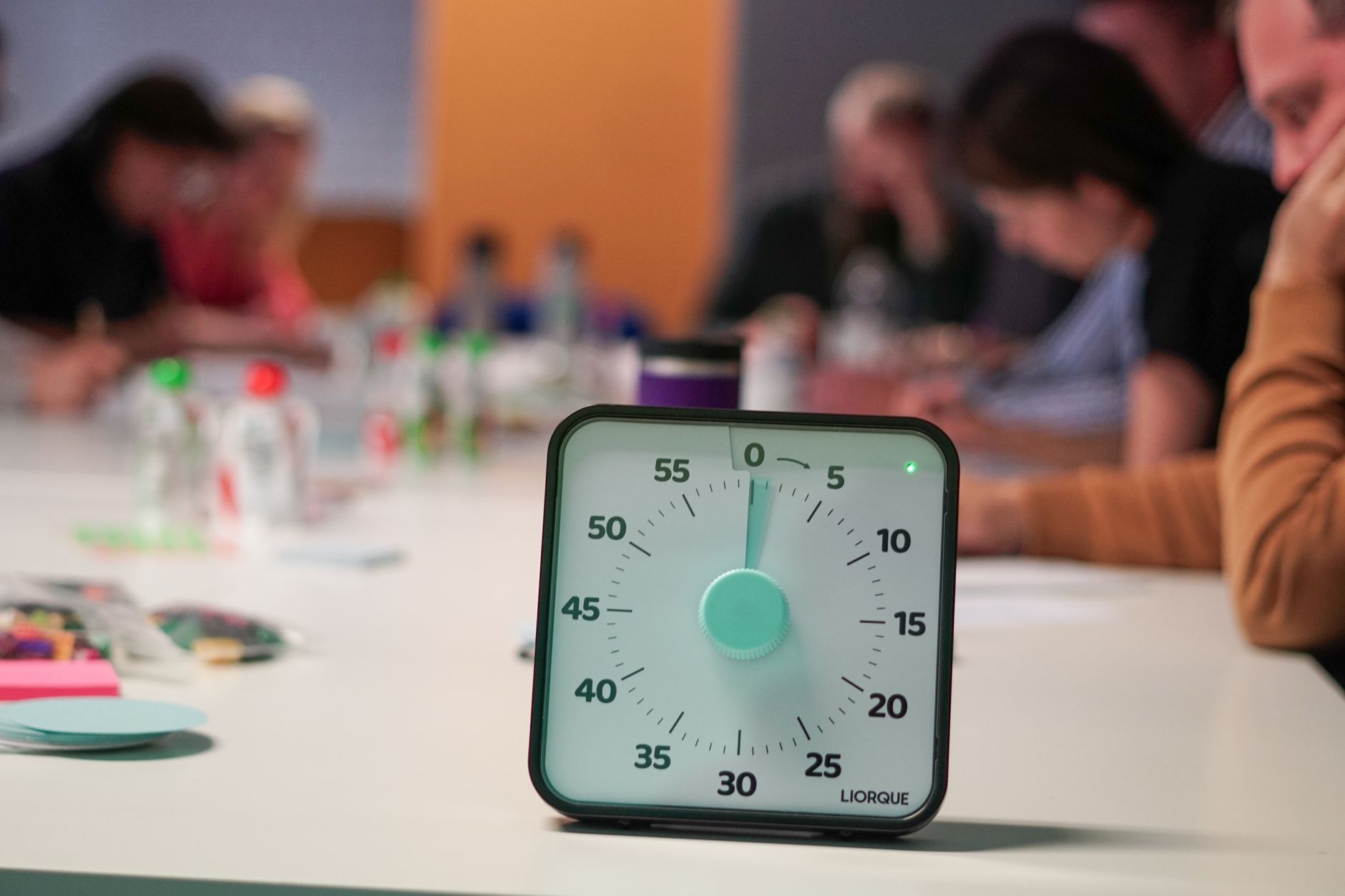
- Execute: Work through tasks with timing mechanisms. Pomodoro timers enforce focused intervals (typically 25 minutes) followed by short breaks. Modern timers allow custom intervals and break reminders.
- Review: Periodic reviews help you reflect on accomplishments and adjust future plans. This is crucial for continuous improvement. A weekly review—10 minutes every Sunday—prevents the system from becoming a graveyard of unfinished tasks.
Most modern tools integrate with calendars, email, and other apps. Focus Organize, for instance, syncs with Google Calendar so your scheduled tasks appear alongside meetings. This integration reduces the friction of switching between apps. To understand the mechanism in depth, read how to use a Pomodoro timer for maximum productivity.
The underlying workflow follows a cycle: capture everything → clarify what each task means → organize into actionable categories → reflect on priorities → engage with focused execution. David Allen's Getting Things Done (GTD) method popularized this five-step approach, and most effective digital tools are built around it.
What Are the Main Types of Time Management Tools?
Here's a comprehensive breakdown of common types with their strengths and weaknesses.
To-Do Lists
Simple, flexible, low-friction. Best for individuals who need a quick way to track daily errands and small tasks. Examples: Microsoft To Do, Todoist, Focus Organize's built-in list. Using a template can boost consistency—see our guide on when to replace your to-do list template guide.
Pomodoro Timers
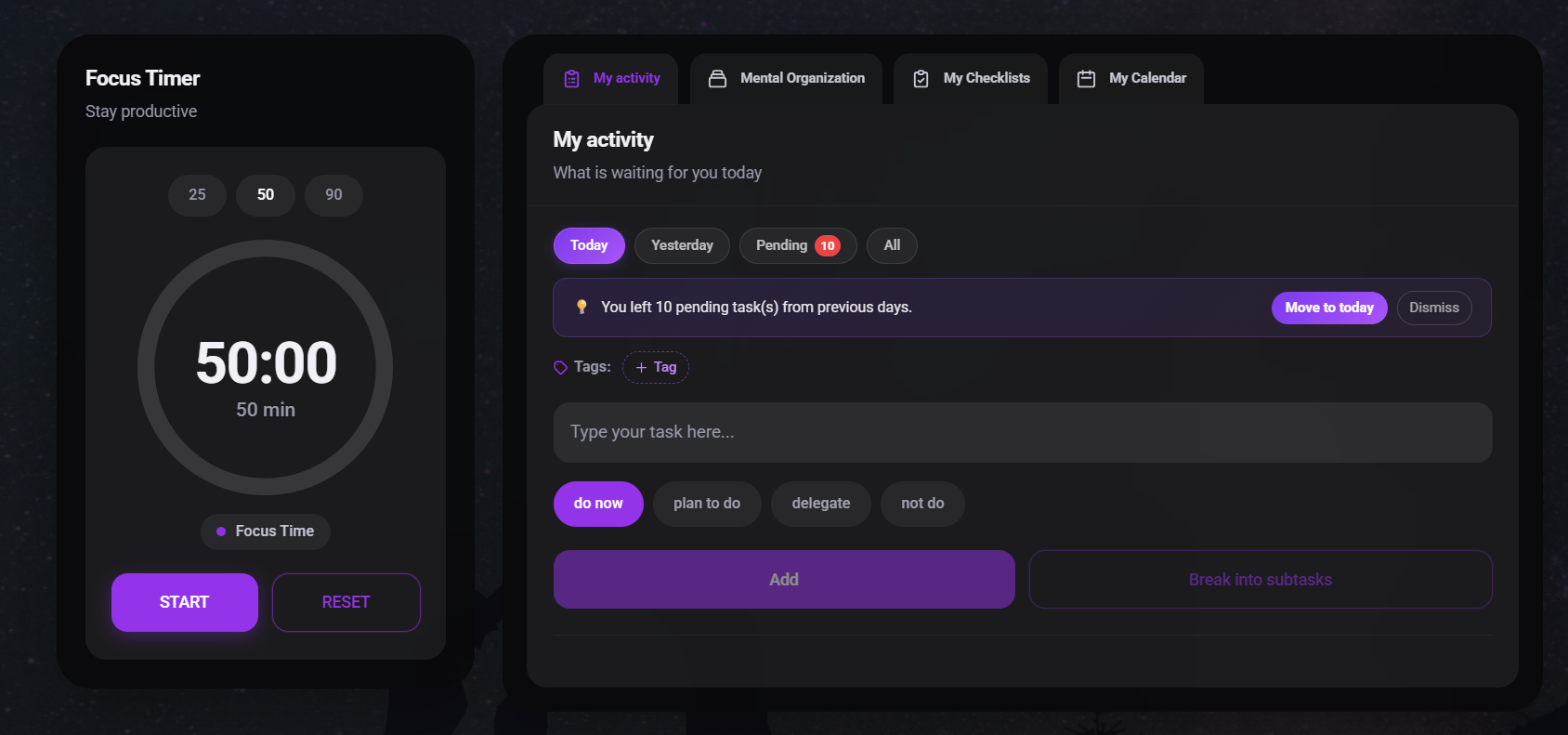
Structured work intervals (typically 25 minutes) with breaks. Excellent for deep work and overcoming procrastination. Focus Organize includes a fully customizable Pomodoro timer with adjustable intervals and automatic break tracking. For a comparison of popular timers, check top Pomodoro timer options for maximum productivity.
Eisenhower Matrix
A 2x2 grid categorizing tasks by urgency and importance. Perfect for strategic prioritization. Focus Organize offers this as a core feature with drag-and-drop functionality—you can see all your tasks visually and move them between quadrants.
Project Management Tools
Designed for teams: task assignments, dependencies, timelines, and collaboration. Examples: Asana, Jira, Monday.com. These are heavier and often overkill for individuals. However, for a two-person team, Focus Organize's built-in collaboration (up to two users) provides a lightweight alternative.
Time Tracking Tools
Log hours automatically or manually. Useful for billing, accountability, and productivity analysis. Examples: Toggl, RescueTime, Clockify. While Focus Organize doesn't include time tracking, its combination of task lists and Pomodoro sessions gives you detailed data on how long tasks take.
| Tool Type | Best For | Learning Curve | Cost Range | Key Limitation |
|---|---|---|---|---|
| To-Do Lists | Daily tasks | Low | Free – $10/mo | No prioritization structure |
| Pomodoro Timers | Focus & energy management | Low | Free – $5/mo | Doesn't capture long-term tasks |
| Eisenhower Matrix | Prioritization | Moderate | Free – $10/mo | Requires consistent use |
| Project Management | Team collaboration | Moderate-High | $10 – $50/mo | Overwhelming for solo users |
| Time Tracking | Billing & analysis | Low-Medium | Free – $15/mo | Can feel intrusive |
For a side-by-side comparison of popular options, see our top time management tools options for busy professionals. When choosing, consider that all-in-one platforms like Focus Organize eliminate the need for multiple subscriptions and reduce context switching.
How to Choose the Right Time Management Tool?
Here's a practical, step-by-step process I've refined over years of coaching.
Step 1: Identify Your Biggest Time Wasters
Before choosing a tool, audit your week. For three days, record every activity and note how much time you spent. Common patterns include:
- Constant email checking (time sinks)
- Spending too long on low-impact tasks
- Procrastinating on important but non-urgent work
Step 2: Match a Tool to Your Pain Point
- If you struggle with focus: Use a Pomodoro timer. Tools like Focus Organize's timer enforce 25-minute work intervals with short breaks.
- If you forget tasks: Use a to-do list with reminders and cross-device sync.
- If you can't prioritize: Use the Eisenhower Matrix. It forces you to classify tasks into four quadrants.
- If you manage a team: Use a project management tool. Focus Organize supports two users per account for collaborative task management.
Step 3: Start Simple and Scale
💡
Key Takeaway
Begin with one feature—like a simple to-do list or Pomodoro timer—and use it for two weeks before adding complexity. Most tools are abandoned because users try to do everything at once.
Step 4: Review and Adjust Weekly
Every Sunday, spend 10 minutes reviewing what worked. Did you use the tool? Did it help? Adjust your approach. For example, if the standard 25-minute Pomodoro felt too short, try 50-minute sessions with longer breaks. Focus Organize allows you to customize intervals easily.
Focus Organize makes this easy by combining all three core tools in one platform. You can start with just the timer and gradually incorporate the matrix as you get comfortable. For guidance on transitioning from a basic list to a full system, read our 10 to-do list template tips for maximum productivity.
Implementation Guide: Building Your System with Focus Organize
Now let's walk through setting up a complete time management system. We'll compare the traditional approach (paper lists), the generic digital approach (basic apps), and the modern integrated approach (Focus Organize).
| Aspect | Traditional (Paper Lists) | Generic Digital (Single-Purpose Apps) | Modern Integrated (Focus Organize) |
|---|---|---|---|
| Task Capture | Manual writing, easy to lose | Digital but scattered across apps | Unified entry with tags and deadlines |
| Prioritization | Manual sorting, no structure | Only basic due dates | Automated Eisenhower Matrix |
| Focus Execution | No built-in timer | Separate Pomodoro app needed | Integrated Pomodoro timer with adjustable intervals |
| Review & Analytics | None | Basic completion counts | Visual dashboard with weekly summaries |
| Collaboration | Must share physical lists | Limited sharing | Two-user account for pairs/teams |
Step 1: Create Your Task List
Start by adding all pending tasks into the to-do list. Include deadlines and tags for context (e.g., "work", "personal", "urgent"). Use a template to streamline this process—our ultimate to do list template guide offers several proven formats.
Step 2: Prioritize with the Eisenhower Matrix
Move tasks into the matrix quadrants:
- Quadrant 1 (Urgent & Important): Do these first—crises, deadlines.
- Quadrant 2 (Important but Not Urgent): Deep work, planning—schedule these.
- Quadrant 3 (Urgent but Not Important): Delegate or limit.
- Quadrant 4 (Neither): Eliminate.
Step 3: Block Focus Time
Use the Pomodoro timer to work on Quadrant 2 tasks. Set a 25-minute timer, work without interruption, then take a 5-minute break. After four cycles, take a longer 15-30 minute break. Adjust the interval length based on your personal energy patterns. Focus Organize's timer lets you save custom interval presets.
Step 4: Track Progress
At the end of the day, mark completed tasks. Review your matrix—did you spend most time in Quadrant 1? That signals a need for better planning. Focus Organize provides a visual summary of completed tasks and time spent, so you can see patterns at a glance.
Step 5: Weekly Review
Every Sunday, analyze your patterns. Adjust priorities for the upcoming week. Focus Organize's dashboard gives you a bird's‑eye view of your week's accomplishments. For step‑by‑step instructions, see our complete guide to do list templates for maximum productivity.
This system works because it integrates capture, prioritization, and execution in one tool. The real power comes from consistency—using the same platform day after day until it becomes automatic.
Pricing & ROI: Is It Worth the Investment?
When evaluating complete guide time management tools, cost is a factor, but consider the return. If a tool saves you just one hour per week, that's 52 hours per year. At a $50/hour consulting rate, that's $2,600 in value. Most tools cost under $15/month.
| Tool | Cost | Key Features | ROI Potential |
|---|---|---|---|
| Focus Organize | Free tier; Premium $5/mo | To-do list, Pomodoro, Eisenhower, 2 users | High (all-in-one) |
| Todoist | Free; Pro $4/mo | Task management, reminders | Medium |
| Toggl Track | Free; Starter $9/mo | Time tracking, reporting | Medium (if billing) |
| RescueTime | Free; Premium $12/mo | Automatic tracking, analytics | Medium (if you act on data) |
Focus Organize offers the best value by combining multiple tools in one subscription. For a detailed cost analysis, read our how much does a to-do list template cost? pricing guide. Also, compare with alternative options in our to-do list template comparison.
Beyond monetary cost, consider the hidden cost of tool switching. Each additional app introduces friction—login overhead, learning curve, data fragmentation. An integrated platform minimizes these costs. According to a 2023 study by the International Data Corporation (IDC), knowledge workers lose an average of 2.2 hours per week switching between task apps. Consolidating tools eliminates that waste.
Real-World Examples of Time Management Tools in Action
Case 1: Freelancer Regains 8 Hours per Week
Sarah, a freelance graphic designer, was overwhelmed by administrative tasks. She adopted Focus Organize's Eisenhower Matrix to separate urgent client revisions (Quadrant 1) from important portfolio development (Quadrant 2). Using the Pomodoro timer for 2-hour blocks on portfolio work, she completed her new website in three weeks—a project that had stalled for months. According to a 2023 study by the American Psychological Association, structured prioritization reduces decision fatigue by up to 30%. Sarah experienced exactly that: she reported feeling less drained at the end of each day.
Case 2: Small Team Improves Collaboration
A 2-person marketing agency used Focus Organize's shared workspace to coordinate campaigns. The to-do list kept tasks visible, and the Pomodoro timer ensured both team members had focused writing sessions. Within a month, client turnaround time dropped by 30%. A study by Harvard Business School found that teams using structured digital task management tools see a 20% improvement in project completion rates. The agency's experience aligns with that data.
Case 3: Executive Prioritizes Strategic Work
A company VP used the Eisenhower Matrix daily, combined with Focus Organize's timer for deep thinking. He reported spending 60% less time on low-impact emails and doubled his strategic planning output over a quarter. This mirrors findings from a 2024 Deloitte report that executives who adopt systematic time management recover an average of 8 hours per week.

Common Mistakes When Using Time Management Tools
Mistake 1: Using too many tools. Stick to one primary tool plus a backup (e.g., digital + paper). Tool switching wastes cognitive energy. A study by the University of California, Irvine found that task switching can reduce productivity by up to 40%.
Mistake 2: Not prioritizing. The Eisenhower Matrix solves this—use it daily to avoid busywork. Without prioritization, even the best tool becomes a "to-do list graveyard."
Mistake 3: Forgetting to review. Without weekly reviews, you repeat the same inefficiencies. Schedule 10 minutes on Sunday to reflect and plan. This habit is the secret of high performers.
Mistake 4: Ignoring energy levels. Pomodoro intervals can be adjusted. Schedule deep work during your peak energy hours. For most people, that's 2-3 hours after waking. Use Focus Organize's timer to align with your natural rhythm.
Mistake 5: Tool hopping. Give a new tool at least two weeks before switching. Master one system first. I've seen clients jump from Todoist to Notion to Trello in a month—they never built a consistent habit.
Mistake 6: Overcomplicating the system. Many users try to build elaborate folder structures, tag systems, and custom workflows before they've established the basic habit of capturing tasks daily. Keep it simple: write it down, do it, mark it done. Only layer complexity when you feel the need.
Avoid these pitfalls by following our everything about to-do list templates: the ultimate guide.
Frequently Asked Questions
What is the single most effective time management tool?
There is no one-size-fits-all answer, but the Eisenhower Matrix is often cited as the most effective because it forces you to prioritize. Combined with a Pomodoro timer for execution, it forms a powerful system. For individuals, an all-in-one platform like Focus Organize that includes both is ideal because it eliminates the need to switch between separate apps. The matrix ensures you work on what truly matters, while the timer prevents burnout by enforcing breaks. To explore options, see our guide on top Pomodoro timer ranking: best productivity tools 2026.
How do I stop procrastinating with time management tools?
Procrastination often stems from unclear next actions. Use a to-do list that breaks tasks into micro-steps (e.g., "open the document" instead of "write report"). Then set a Pomodoro timer for 25 minutes. The key is starting—after 5 minutes, momentum usually takes over. Focus Organize's timer has a "just start" mode that prompts you to begin immediately. Additionally, use the Eisenhower Matrix to identify which tasks you've been avoiding (usually Quadrant 2) and schedule them for your peak energy hours. According to a 2022 study in the Journal of Behavioral Psychology, small concrete actions reduce avoidance behavior by 45%. Check out our Pomodoro Timer Tips for more strategies.
Are free time management tools as good as paid ones?
Free versions are often sufficient for individual use. For example, Focus Organize offers a free tier with core features like a to-do list and Pomodoro timer. Paid tools typically add advanced reporting, integrations, and team features. If you need collaboration or in-depth analytics, a paid plan may be worth it. The key difference is often convenience—paid tools tend to have cleaner interfaces, faster sync, and better customer support. However, for basic task management and focus, free tiers deliver 80% of the value. Compare options in our to-do list template price guide.
How many time management tools should I use?
I recommend sticking to one primary tool and one backup method (e.g., a digital app plus a paper notebook). Using more than two tools typically leads to fragmentation and wasted time. For most people, an all-in-one platform like Focus Organize is ideal because it covers task management, focus, and prioritization in one place. If you absolutely need a separate time tracking tool (e.g., for billing), keep it minimal and integrate it with your main system via calendar or API.
Can time management tools help with team productivity?
Absolutely. Tools that support multiple users, like Focus Organize (which allows two users per account), enable task delegation and progress tracking. For larger teams, consider project management platforms like Asana or Jira. The key benefit is transparency—everyone knows who is doing what and by when. A 2023 Forrester report found that teams using shared task management systems complete projects 30% faster than those relying on email and meetings. See our top time management tools options for team-friendly features.
What is the best time management tool for students?
Students benefit from tools that combine scheduling, task lists, and focus aids. Focus Organize's Pomodoro timer is excellent for study sessions (25 minutes of study, 5-minute break), while its to-do list tracks assignments by class. The Eisenhower Matrix helps prioritize exam prep over less critical activities like social media. Many students find that using a system reduces last-minute cramming and improves grades. For a student-focused overview, see our best time for to-do list template: boost productivity for academic planning.
How do I integrate time management tools with my calendar?
Most modern tools offer calendar integration. Focus Organize syncs with Google Calendar so tasks become visible in your schedule. You can also use its built-in timer to block focus periods that reflect on your calendar. This ensures you actually reserve time for priority tasks. Alternatively, some users prefer time-blocking: manually dragging tasks onto calendar slots. Tools like Focus Organize allow you to see both your tasks and your calendar in one view, eliminating the need to toggle between apps.
What is the difference between a time management tool and a project management tool?
Time management tools focus on individual productivity—task prioritization, focus, and time tracking. Project management tools add team collaboration features like task dependencies, file sharing, and progress dashboards. However, many platforms blur the line: Focus Organize includes both personal and shared features suitable for small teams. If you work solo or with one partner, Focus Organize's two-user model covers most needs. For larger teams (5+), a dedicated PM tool like Asana may be necessary. For more context, read our key advantages of to-do list template for productivity for personal workflow.
What are the latest trends in time management tools in 2026?
In 2026, AI-driven scheduling assistants, deeper integrations with wearable devices, and adaptive Pomodoro timers that adjust to your focus patterns are emerging. Platforms like Focus Organize are incorporating machine learning to suggest optimal task order based on your historical productivity. The trend is toward predictive systems that learn your rhythms—when you're most focused, which tasks you tend to procrastinate on, and how long similar tasks take. This reduces the cognitive load of planning. For a glimpse into geographic trends, see our guides on to-do list template in New York and to-do list template in Austin.
How do I stay consistent with using a time management tool?
Consistency comes from building a habit. Start with a single trigger—for example, open your tool every morning before checking email. Use the "don't break the chain" method: mark each day you use it. Also, make the tool your default: if a task takes less than two minutes, do it immediately; if longer, capture it in your tool immediately. Over time, the tool becomes an extension of your thinking. Focus Organize's simple interface and quick capture widgets reduce friction, making it easier to stick with. Finally, reward yourself: commit to using it for 30 days, then treat yourself to a small reward.
Final Thoughts on Time Management Tools
Complete guide time management tools are only as good as your commitment to using them consistently. Start with one tool—a Pomodoro timer or a simple to-do list—and use it daily for two weeks. Then gradually add other features like the Eisenhower Matrix.
To make it easier, sign up for Focus Organize today. It combines a Pomodoro timer, to-do list, Eisenhower Matrix, and financial planning tools in one accessible platform. Plus, you can invite one other person to collaborate—perfect for a study buddy, partner, or colleague.
Remember: the best tool is the one you actually use. So pick one, start small, and watch your productivity transform. The time you invest in setting up a good system pays back tenfold within the first few months.
About the Author
Focus Organize Editorial Team is the content and productivity expert at Focus Organize. With years of experience coaching individuals and small teams on workflow optimization, the team has tested dozens of time management methods to identify what truly works in practice. They write to help you regain control of your time.
Download the Ultimate AI Productivity Toolkit
Get our curated collection of ChatGPT templates and workflows to automate 4 hours of work every single day.