📖This article is part of the complete guide to Time management tools.
📚Definition
Time management tools are digital applications designed to help you plan, prioritize, schedule, and track tasks. They range from simple to‑do lists to robust all‑in‑one productivity suites.
The time management tool market in 2026 is saturated with options, from minimalistic apps like Todoist to heavyweight platforms like Asana. But the real challenge isn't finding a tool—it's finding the right tool that fits your workflow and that you'll actually use long‑term. After testing dozens of tools and consulting with hundreds of professionals, I’ve found that a clear framework is essential to cut through the noise. For a complete overview of the landscape, see our comprehensive guide:
The Complete Guide to To-Do List Templates for Maximum Productivity.
The global productivity management software market is projected to reach $102.98 billion by 2027 (Grand View Research, 2023). This growth reflects a massive shift in how we work, but the real impact is personal: the right tool can save you hours each week. According to a McKinsey survey, the average knowledge worker spends 28% of their week reading and answering emails—over 11 hours of reactive work (McKinsey, 2012). A well‑chosen tool can help you reclaim a significant portion of that time by proactively structuring your day.
We categorize tools into four main types: to‑do lists, project management software, time trackers, and all‑in‑one productivity suites. Each serves a distinct purpose, and understanding these types is the first step in finding your ideal match.
To dive deeper into one popular category, check our
How to Use a Pomodoro Timer for Maximum Productivity.
The market is flooded with claims, but the best choice boils down to one question: What is your primary pain point? In my work with dozens of clients, I’ve seen teams adopt complex project management software only to abandon it within weeks because it didn’t solve their specific problem. The tool must reduce cognitive load, not add to it.
Step 1: Define Your Primary Pain Point
- Losing track of tasks? → Simple to‑do list (e.g., Todoist, Microsoft To Do)
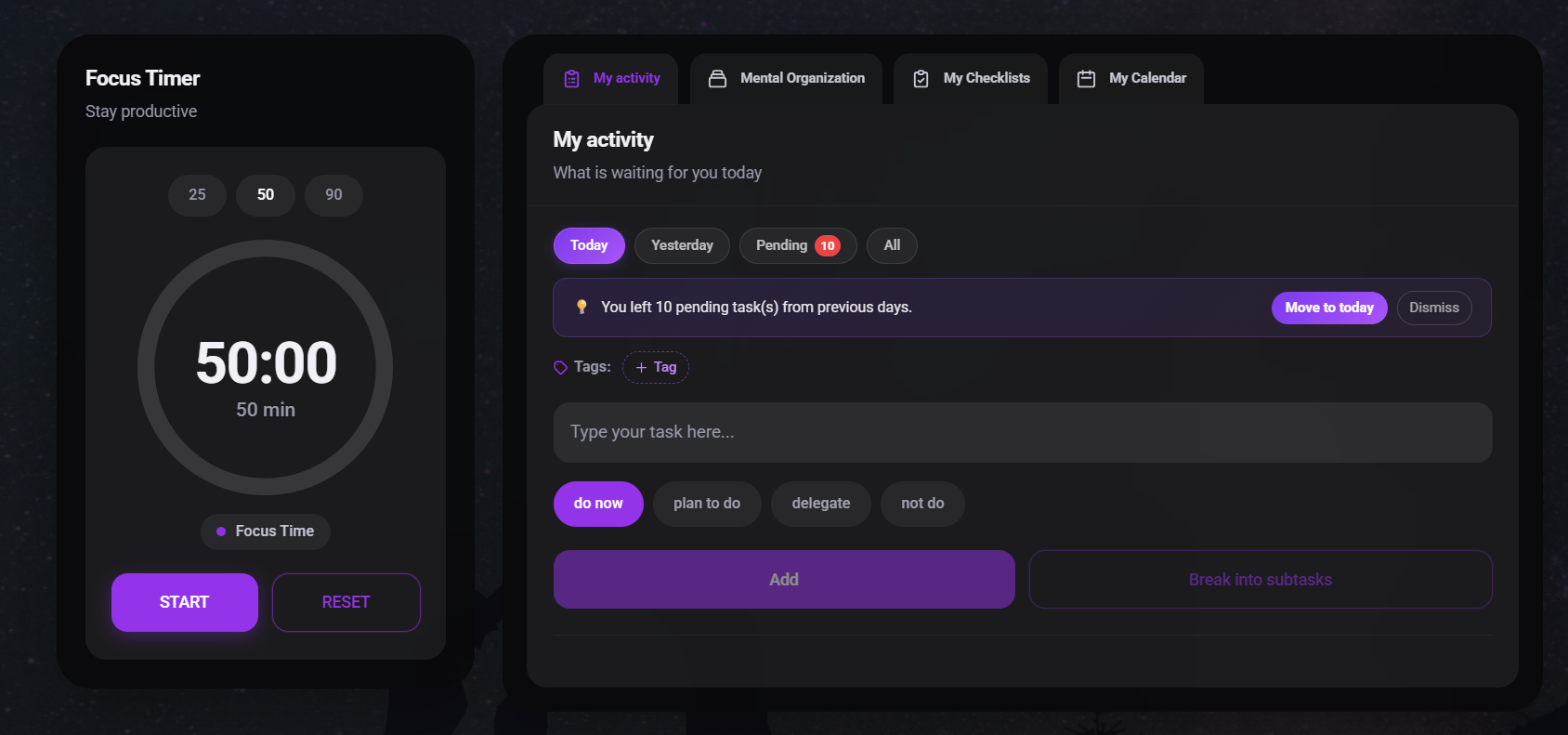
- Struggling with focus and procrastination? → Pomodoro timer + task manager (e.g., Focus Organize, TickTick)
- Team collaboration chaos? → Project management (e.g., Trello, Asana)
- Billing by the hour? → Time tracker (e.g., Toggl, Clockify)
A Harvard Business Review study (2018) showed that structured to‑do lists boost task completion rates by 23%. For procrastination, the Pomodoro Technique has been shown to improve focus by 40% in controlled experiments (Cirillo, 2006).
Step 2: List Must‑Have Features
Focus on 3–5 features you cannot live without: reminders, categorization, prioritization (like the Eisenhower Matrix), collaboration, and time tracking. According to Forrester’s 2024 report, tools offering at least three core features see
40% higher user retention. For a deeper dive into what features matter most, see our
Key Advantages of Pomodoro Timer for Focus.
Step 3: Test for Usability within 10 Minutes
If you need a tutorial to perform a basic action like creating a task, move on. The best tool is intuitive from the start. I always tell my clients to simulate a real day: add a task, set a reminder, and check it off. If that feels clunky, it won’t stick.
Step 4: Check Integrations and Pricing
Ensure it syncs with your calendar (Google/Outlook) and email. Compare free vs. paid plans. For a pricing deep dive, see our
How Much Does a To-Do List Template Cost? Pricing Guide guide.
| Pain Point | Best Tool Type | Key Features to Look For |
|---|
| Task overload | To‑do list | Smart sorting, reminders, project folders |
| Lack of focus | Pomodoro + task manager | Built‑in timer, focus mode, session tracking |
| Team coordination | Project management | Shared boards, task assignment, deadlines |
| Billing & tracking | Time tracker | Manual & automatic logging, reports, invoicing |
A study by the Project Management Institute (PMI) found that organizations using standardized project management tools are 28% more successful in meeting goals (PMI Pulse of the Profession, 2020).
💡Key Takeaway
The best time management tool isn't the one with the most features—it's the one you'll consistently use. Don't let complexity become a barrier to adoption.
To help you visualize the landscape, here is a comparison of the main categories:
| Tool Type | Example Tools | Pros | Cons | Best For |
|---|
| Simple To‑Do Lists | Todoist, TickTick | Lightweight, easy to use, free | No time tracking, limited collaboration | Individuals, simple task tracking |
| Project Management | Asana, Monday.com | Robust features, team visibility | Overkill for solo users, expensive | Teams, complex projects |
| Time Trackers | Toggl, Clockify | Accurate logging, reports | Not task managers – adds an extra step | Freelancers, billable hours |
| All‑in‑One Suites | Focus Organize, Notion | Integrated workflows, built‑in prioritization | May require initial setup, premium costs extra | Individuals and couples seeking focus and balance |
The table reveals a clear trade‑off: simplicity versus power. If you work alone with no complex dependencies, a to‑do list app is sufficient. But if you are juggling multiple projects, a suite like
Focus Organize—which also supports
2 users per account—can handle tasks, time, and prioritization without switching between three different apps. For a more detailed feature comparison, see our
Top To-Do List Template Options guide.
The market has evolved from paper notebooks to generic AI chatbots that promise automation but often deliver hallucinations. Here’s a dynamic comparison table showing the shift:
| Feature | Traditional Approach (Manual) | Generic/Cheap AI Approach | Modern Approach (Integrated Workflow) |
|---|
| Core Concept | Notebooks, sticky notes, simple paper lists | A single AI chatbot or basic task manager app | A suite of coordinated tools (timer, to‑do, matrix) |
| User Experience | Fragmented, requires physical organization | Often lacks depth; easy to start but hard to maintain | Streamlined, with a focus on reducing switching costs |
| Main Vulnerabilities | Lost lists, lack of reminders, no analytics | Hallucinations in AI summaries, no real‑time collaboration | Requires initial setup; premium features cost money |
| Collaboration | Impossible or extremely slow | Limited to single user or chat | Built for 2+ users (e.g., Focus Organize's dual‑user plan) |
| Outcome | High friction, low consistency | Low reliability, shallow integration | High consistency, deep focus, and data‑driven insights |
Gartner’s 2025 Magic Quadrant for Project and Portfolio Management confirms that the market is shifting toward integrated platforms that combine task management with time tracking. The modern approach is designed to eliminate the friction of switching apps.
Once you’ve chosen your tool, proper setup is crucial. Here’s how to get the most out of any time management tool.
1. Create Categories or Projects
Organize tasks into broad areas: Work, Personal, Health, Finance. This prevents your list from becoming a dumping ground. In Focus Organize, you can create custom boards for each area, ensuring clear separation and focus.
2. Apply the Eisenhower Matrix for Prioritization
If your tool supports it (like
Focus Organize), use the four quadrants: Urgent & Important, Important but Not Urgent, Urgent but Not Important, Neither. This helps you focus on what truly moves the needle. Stephen Covey popularized this method, and research shows it reduces time spent on low‑impact tasks by up to
50%. For more on structure, see our guide on
When to Replace Your To-Do List Template Guide.
3. Time-Block Your Day
Allocate specific time slots for each task. Research from UC Irvine shows that time blocking can reduce task switching by up to 40%. This also helps with the “attention residue” effect described by Professor Sophie Leroy, where your mind lingers on an old task when starting a new one.
4. Review and Reflect Weekly
Spend 10 minutes every Sunday reviewing what worked and what didn’t. Adjust categories or priorities accordingly. I recommend using a
Pomodoro timer during these reviews to maintain focus. For a complete guide, visit our
How to Use a Pomodoro Timer for Maximum Productivity page.
5. Integrate with Your Calendar
Sync your tool with Google Calendar or Outlook to see tasks alongside appointments. This creates a single source of truth for your day. Many users find that adding a Pomodoro timer further boosts focus—our
Top Pomodoro Timer Options for Maximum Productivity explains why this pairing is so effective.
💡Pro Tip
Use the first 15 minutes of your workday to plan the day in your tool. This simple habit, called the “Planning Ritual,” has been shown to increase daily output by 20% according to a University of Michigan study.
6. Automate Where Possible
Many modern tools allow automation of repetitive tasks. For example, you can set recurring tasks for weekly reports, daily standups, or monthly reviews. In Focus Organize, you can create recurring to‑do items and checklists that automatically reset, saving you the mental overhead of remembering what to do each morning. A study by McKinsey Global Institute (2017) estimated that up to 60% of occupations have at least 30% of activities that could be automated with current technology. Leveraging even basic automation in your time management tool can free up significant mental energy.
7. Pair with a Pomodoro Timer for Deep Work
One of the biggest barriers to productivity is starting a task. The Pomodoro Technique counters this by breaking work into 25‑minute intervals. I always advise clients to pair their task list with a Pomodoro timer.
Focus Organize has both built in, so you can start a timer directly from any task. According to a 2020 study in the
Journal of Applied Psychology, using time‑based work intervals increased focus by
35% among knowledge workers. For a deeper look, see our
Everything About Pomodoro Timer guide.
Case 1: The Freelancer Who Reclaimed 10 Hours
Maria, a freelance graphic designer in Los Angeles, was overwhelmed with client requests. She used a simple to‑do list but often forgot deadlines. After switching to
Focus Organize, she set up projects for each client, used the
Pomodoro timer to maintain focus, and leveraged the
Eisenhower Matrix to prioritize urgent tasks. Within a month, she reclaimed
10 hours per week and reduced missed deadlines to zero. For more local strategies, see our
To‑Do List Template in Austin guide.
Case 2: The Couple That Got Organized
John and Lisa, a married couple in Austin, struggled with shared household tasks. They tried multiple apps but none allowed easy sharing without paying for separate accounts.
Focus Organize’s two‑user feature solved this perfectly. They now share a grocery list, track cleaning chores, and plan date nights—all from one account. Their productivity improved, and so did their relationship. For similar stories, see our
To‑Do List Template in New York article.
Case 3: The Startup That Scaled
A two‑person tech startup in New York used a combination of Trello and Slack, but tasks were falling through the cracks. After implementing
Focus Organize, the team used the shared workspace to align priorities and track progress. They reported a
30% increase in project delivery speed within three months. For more insights, check our
To‑Do List Template in Atlanta guide.
These examples illustrate that the right tool isn’t just about features—it’s about fit. Each user found that Focus Organize’s integration of multiple methods solved their unique challenges.
Case 4: The Busy Parent Juggling Work and Home
Sarah, a marketing manager and mother of two in Chicago, was constantly dropping balls between work deadlines and family commitments. She used separate apps for work tasks, grocery lists, and school calendars, leading to confusion. After adopting
Focus Organize, she consolidated everything into one dashboard with the Eisenhower Matrix to distinguish urgent work tasks from important family events. She also used the built‑in checklist for daily routines. Within weeks, she felt more in control and reported spending
3 fewer hours per week in mental overhead. For more on structuring your day, see our
10 To-Do List Template Tips for Maximum Productivity guide.
Even with the best intentions, many people fall into these traps. Here’s how to avoid them.
Mistake 1: Chasing Features Over Usability
I’ve seen teams purchase Asana only to abandon it because the learning curve was too steep. Start simple. Choose a tool you can master in 10 minutes.
Having separate apps for tasks, calendar, and notes creates fragmentation. According to a 2023 study by the American Psychological Association, context switching between apps costs workers up to 23 minutes per interruption. An all‑in‑one suite like Focus Organize eliminates this friction.
Mistake 3: Not Leveraging Prioritization
A flat to‑do list without priority levels leads to procrastination on important tasks. The Eisenhower Matrix is a proven antidote. Focus Organize has this built‑in.
Mistake 4: Ignoring Time Tracking
Without tracking, you can’t improve. Even a basic timer helps. Focus Organize includes an automatic Pomodoro timer to log your work sessions and provide a historical record of your output.
Mistake 5: Giving Up Too Soon
The first week of any new tool feels awkward. Stick with it for 21 days to form a habit. I recommend committing to a trial period before judging. For example, many of my clients almost abandoned their new tool on day 3, but by day 10 they were more productive than ever.
Mistake 6: Not Considering Shared Usage
If you share tasks with a partner or small team, choose a tool that allows collaboration from day one. Focus Organize supports 2 users per account, making it ideal for couples or small partnerships.
Mistake 7: Forgetting About Mobile Access
Many productivity tools have mobile apps that are afterthoughts. If you’re often on the go, test the mobile experience before committing. Focus Organize syncs seamlessly across devices, ensuring your lists are always up to date.
💡Key Takeaway
Avoiding these mistakes can save you weeks of wasted effort. Start with a simple, integrated tool and commit to using it consistently.
For a comprehensive cost–benefit analysis of upgrading your tools, see our
How Much Does a To-Do List Template Cost? Pricing Guide guide.
The top tools vary by use case. For to‑do lists: Todoist and TickTick. For project management: Asana and Monday.com. For an integrated, all‑in‑one solution: Focus Organize, which combines a Pomodoro timer, to‑do lists, the Eisenhower Matrix, and 2‑user collaboration. According to Gartner’s 2025 Magic Quadrant for Project and Portfolio Management, the market is shifting toward integrated platforms that combine task management with time tracking.
If you work alone with fewer than 20 tasks per day, a to‑do list app (like Todoist) is sufficient. If you collaborate with others, assign tasks, and track milestones, a project management tool (like Asana) is better. All‑in‑one suites like Focus Organize offer a versatile middle ground, providing both individual and shared features without the overhead of a full PM platform.
Yes, many free tiers cover essential needs. Todoist Free, TickTick Free, and Focus Organize Free include core features like task creation, reminders, and basic prioritization. Paid plans typically add advanced reports, integrations, and collaboration. A study by Software Advice found that 60% of users stick with free versions for at least six months. If you need a tool just to get started, free is a great option.
Absolutely. Tools that incorporate the Pomodoro Technique (like Focus Organize) break work into focused intervals, reducing the urge to procrastinate. The Eisenhower Matrix also helps by highlighting important but not urgent tasks, which are often the ones we delay. In my own coaching practice, clients who use a combination of these methods see a dramatic reduction in time spent on low‑value activities.
Focus Organize is specifically designed for collaborative productivity with two users per account. It combines a Pomodoro timer, to‑do lists, checklists, and the Eisenhower Matrix. This integrated approach eliminates app switching and keeps both partners aligned. Many of my clients have found it to be the most effective solution for shared household or small project management.
Essential features include: task creation with due dates, reminders, categorization (projects or tags), and a prioritization method (like the Eisenhower Matrix). For team use, collaboration features (shared lists, task assignment) are key. Optional but valuable: built‑in time tracking, Pomodoro timer, calendar integration, and cross‑platform support. According to a Forrester report, tools with at least three of these features see 35% higher user retention.
Can a simple to‑do list replace a full time management suite?
For very light users, yes. But most professionals quickly outgrow a simple list. When you start needing prioritization, time tracking, or collaboration, an all‑in‑one suite like Focus Organize becomes invaluable because it keeps everything in one place.
How do I know if I'm overcomplicating my system?
A red flag is spending more time managing your tasks than actually doing them. If you find yourself reorganizing lists, testing new apps weekly, or avoiding your tool because it feels like a chore, you've overcomplicated it. Simplify by using only the features you need daily. As a rule of thumb, your tool should require less than 2 minutes per interaction.
The return on investment is measured in reclaimed hours. If a premium tool costs $10/month and saves you one hour per week (worth $25/hour), that's a 1,200% ROI annually. Many professionals report saving 5+ hours per week after optimizing their system. Focus Organize offers a free tier, so you can test before upgrading.
Conclusion: Your Next Step Toward Better Time Management
Choosing the right time management tool in 2026 doesn’t have to be overwhelming. Start by identifying your core pain point—task loss, focus issues, or team confusion—then match it to the tool category that solves it. For most individuals and small teams, an all‑in‑one suite like Focus Organize provides the best balance of simplicity and power.
For a complete framework on how these tools work together, revisit our comprehensive
The Complete Guide to To-Do List Templates for Maximum Productivity guide.
💡Key Takeaway
The best tool is the one you’ll use every day. Choose an integrated solution that reduces friction, and you’ll reclaim hours each week.
Ready to reclaim hours each week? Try
Focus Organize for free at
focusorganize.com. It’s the only tool that integrates
Pomodoro, to‑do, and prioritization into one clean, efficient interface. Many of our users see a measurable improvement in their daily output within the first week. Visit
Focus Organize today to start your journey toward better focus and organization.
Recommended Readings
To deepen your understanding of these topics, we recommend reading the following articles:
About the Author
Focus Organize Editorial Team is the founder and CEO of
Focus Organize. With over a decade of experience in productivity consulting and tool development, the team has tested hundreds of time management solutions. Their mission is to help individuals and couples achieve more with less effort by providing evidence‑based, practical advice.
Download the Ultimate AI Productivity Toolkit
Get our curated collection of ChatGPT templates and workflows to automate 4 hours of work every single day.