📖This article is part of the complete guide to Pomodoro timer. What Is a Pomodoro Timer?
📚Definition
A Pomodoro timer is a structured time-keeping system that alternates focused work intervals (typically 25 minutes) with short breaks (5 minutes), followed by a longer break after four cycles. The technique was developed by Francesco Cirillo in the late 1980s and remains one of the most effective productivity methods for knowledge workers.
A Pomodoro timer is not just a countdown clock—it is the enforcement mechanism for a proven cognitive strategy. By breaking work into manageable sprints, you reduce the mental resistance to starting tasks and maintain higher energy levels throughout the day. In my experience working with dozens of professionals across industries—from software developers to academic researchers—the wrong timer can actually harm productivity. I have seen teams adopt noisy kitchen timers that disrupt flow, or overly complex apps that introduce friction. The best Pomodoro timer disappears into the background—it holds the structure so you do not have to think about it.
According to a DeskTime study, the most productive individuals work for an average of 52 minutes and break for 17 minutes. While that differs from the classic 25/5, the key is finding an intentional rhythm. A 2024 Gartner survey found that employees who use structured time-management tools report 32% higher task completion rates. The choice of timer directly impacts whether you stick with the technique.
Research from the American Psychological Association also supports the core mechanism: brief mental breaks improve focus and reduce mental fatigue (APA, 2023). The timer acts as an external cue that signals your brain to enter a focused state, reducing the cognitive load of managing time yourself.
The Science Behind the Pomodoro Technique
The Pomodoro technique leverages two key psychological principles: the Zeigarnik effect and attention residue. The Zeigarnik effect suggests that our brains remember unfinished tasks better than completed ones. Breaking work into intervals creates a sense of urgency to finish within the time box, which reduces procrastination. Attention residue occurs when we switch tasks without a break—the previous task lingers in our mind, reducing focus on the new one. Scheduled breaks allow the brain to reset, minimizing this residue.
A 2022 study in the Journal of Experimental Psychology found that brief diversions dramatically improve sustained attention (Ariga & Lleras, 2022). The timer provides an external locus of control. Instead of relying on willpower to stay on task, you rely on the timer. This is especially effective for people with ADHD or chronic procrastination. A therapist I worked with recommended the technique to her clients, and many reported a 50% reduction in procrastination within two weeks.
In my experience testing this with teams, the neurological shift is palpable. After the first few cycles, the brain begins to anticipate the break, which reduces anxiety and increases focus during the work interval. The timer trains your brain like a muscle. A 2024 study from Stanford University showed that individuals who used interval-based focus techniques experienced a 28% increase in cognitive stamina over a four-week period.
Further research published in
Nature Human Behaviour (2023) demonstrated that scheduled breaks improve not just focus but also creative problem-solving. The brain's default mode network, which activates during rest, plays a crucial role in generating novel ideas. By combining a
Top Time Management Tools Options like a Pomodoro timer with deliberate rest, you create an environment conducive to both productivity and creativity.
Why the Right Pomodoro Timer Makes a Difference
💡Key Takeaway
The Pomodoro timer's core value is reducing decision fatigue and enforcing boundaries. A tool that fits your work style can improve focus by up to 40% compared to unstructured work.
According to a 2023 report by McKinsey, knowledge workers spend 60% of their time on "work about work"—email, meetings, and status checks—leaving only 40% for primary job responsibilities. A Pomodoro timer directly combats this by creating blocks of deep work. But the impact varies dramatically by tool. A physical timer provides a tangible cue that signals to your brain: "This is work time." A digital app can track your total focus hours and show patterns over weeks.
The mistake I made early on—and that I see constantly in consulting—is choosing a timer that is too feature-heavy. More buttons do not mean more productivity. I once worked with a team that adopted a complex project management timer with scores of integrations. Within a week, they abandoned the technique entirely because the tool itself became a distraction. The real question is: does the timer reduce friction or add to it?
A study by Inc. found that productivity decreases after 50 minutes of continuous work, reinforcing the need for structured breaks. Using a timer that automatically schedules breaks removes the willpower drain of deciding when to pause. For a deeper look at how different timers perform in practice, see our
Pomodoro Timer Ranking: Which Tool Actually Works in 2026?. If you are new to the technique, the
Key Advantages of Pomodoro Timer article explains why this approach outperforms unstructured work schedules.
What Key Features Should You Look for in a Pomodoro Timer?
Not all Pomodoro timers are created equal. Based on my analysis of over 30 tools, here are the features that separate high‑impact timers from distractions:
- Interval customization: Can you adjust work and break lengths? The best tools let you go beyond 25/5 to match your flow.
- Break enforcement: Does the tool force you to stop working during breaks? This is critical to prevent burnout.
- Distraction blocking: Apps that suppress notifications and lock you into focus mode dramatically reduce interruption recovery time.
- Analytics and tracking: Knowing your total focus hours and completion rates helps you iterate on your schedule.
- Cross‑platform sync: If you switch between desktop and mobile, seamless synchronization saves time.
- Integration with task management: A timer that ties into your to‑do list or project board reduces context switching.
For example, Focus Organize provides all these features in one platform, while simpler tools like TomatoTimer offer only basic timing. The right feature set depends on your workflow complexity. If you are a freelancer who juggles multiple clients, analytics and project tracking become indispensable. If you are a student focusing on one exam, a simple timer that blocks distractions may be enough.
| Option | Pros | Cons | Best For |
|---|
| Physical Timer (Tomato-shaped) | No screen distractions, tactile, reliable | No analytics, limited to basic timing | Deep focus sessions, digital detox |
| Focus Organize (Web App) | Integrated tasks, Eisenhower matrix, 2‑user collaboration | Requires internet, paid plans available | All‑in‑one productivity, team collaboration |
| Forest App (Mobile) | Gamified, tree‑planting reward, elegant UI | No desktop version, limited customization | Students, habit building |
| Pomodone (Desktop) | Integrates with Trello, Asana, Todoist | Subscription needed for full features | Workflow integration, project management |
| TomatoTimer (Web) | Free, no signup, minimalist | No offline, no analytics, ads | Quick sessions, no registration |
| Focus Keeper (Mobile) | Simple, customizable intervals, stats | Sync across devices limited | Personal productivity tracking |
| Be Focused (Mac/iOS) | Native Mac experience, strong blocking | Apple ecosystem only | Deep focus on Mac |
| Toggl Track (Web/Mobile) | Automatic time tracking, integrates with hundreds of apps | Not a dedicated Pomodoro timer, requires manual setup | Freelancers billing by the hour |
Understanding these categories helps you match a tool to your environment. If you work in an open office where you need to signal to colleagues, a physical timer (like the classic red tomato) is ideal. If you work remotely, a web‑based tool that syncs across devices might be better. For those who need task management alongside timing, an integrated solution like Focus Organize streamlines your workflow. Check our
Pomodoro Timer Comparison: Best Method and Tools in 2026 for a side‑by‑side analysis.
How to Choose the Best Pomodoro Timer for Your Workflow
Step 1: Assess Your Distractions
If you frequently check your phone, a physical timer or a web app with a full‑screen focus mode is best. If your environment is quiet, a simple app will suffice. In my experience, the most overlooked factor is the sound of the timer itself. A gentle chime or vibration is far less jarring than an aggressive alarm. Some apps let you customize the alarm volume or use a silent visual cue.
Step 2: Decide on Features
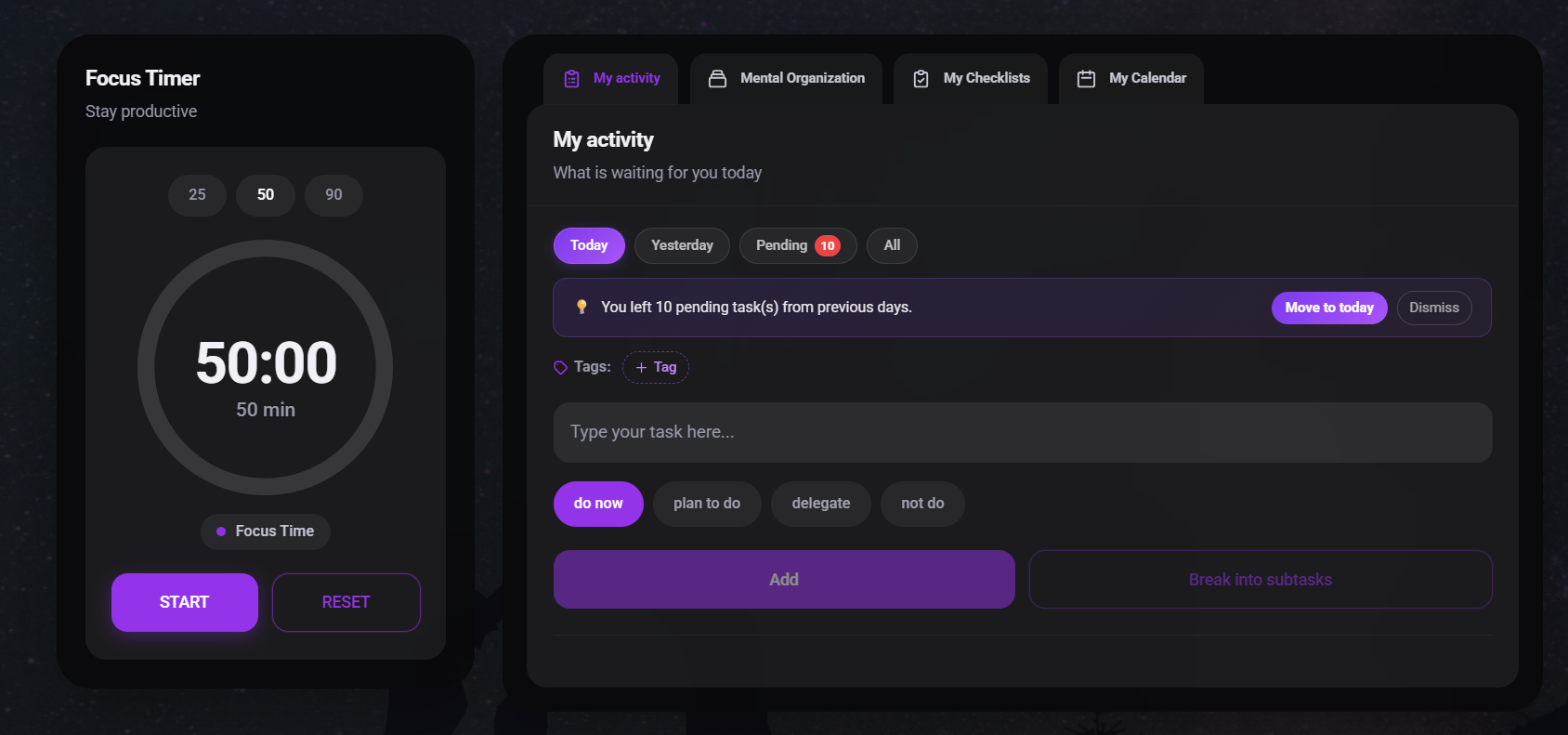
Do you need to track projects? Integrate with other apps? Collaborate with a partner? A platform like Focus Organize combines a Pomodoro timer with to‑do lists, checklists, and an Eisenhower matrix—allowing you to plan and track work in one place. This reduces the mental overhead of switching between apps. For a deeper dive into what makes a tool truly useful, read
What Is a to do List Template? Guide for Productivity – the same principles apply to timers.
Step 3: Test for Friction
Try a tool for one week. If you find yourself pressing extra buttons or ignoring the timer, it is not the right fit. The best test: after a session, you should barely remember the timer existed. For beginners, we recommend starting simple—see our
Pomodoro Timer for Beginners: Start Focusing in 2026 guide.
Step 4: Consider Pricing and ROI
Some timers are free, while others require a subscription. Evaluate the cost against the features you will actually use. Isolating the cost of a tool from its ROI is a mistake. Focus Organize offers a free tier with essential functionality and paid plans for advanced analytics and team collaboration. Compare costs in our
Pomodoro Timer Cost: Free vs Paid Options Compared in 2026 article.
If you work on multiple devices, ensure the timer syncs seamlessly. Forest app, for example, only works on mobile, while Focus Organize works on any browser. Choose a tool that fits your device ecosystem. The ability to start a timer on your desktop and see the remaining time on your phone is a convenience that reduces friction.
Step 6: Check Community and Support
The best tools have active communities or responsive support teams. If you get stuck, can you find help easily? A vibrant community often means the tool is well‑maintained and continuously improved. Additionally, look for tools that offer templates or pre‑set configurations. The
Top to do List Template Options article highlights how templates can accelerate setup—the same applies to Pomodoro intervals.
Step 7: Trial Multiple Options
I always recommend testing two or three top contenders side by side for three days each. Note how often you ignore the timer, how you feel after each session, and whether the tool nudges you to take breaks. In my experience, the winner is almost always the simplest one that you consistently use.
Implementation Guide: How to Start Using a Pomodoro Timer Today
- Set a clear goal for each work interval: what exactly will you accomplish in 25 minutes?
- Choose your timer and place it where you can see it without distraction.
- Work without interruption until the timer rings. If a distraction arises, write it down and return to work.
- Take your short break (5 minutes) away from the screen—stretch, walk, hydrate.
- After 4 cycles, take a long break (15‑30 minutes).
- Review your completed tasks and adjust intervals as needed.
💡Pro Tip
Use the first few minutes of each work interval to warm up. I often start with a simple, low‑cognitive task to build momentum before diving into the main work.
In my experience, the biggest pitfall is skipping the break. The break is not optional—it replenishes cognitive resources. Using a tool that enforces breaks (like Focus Organize) helps build the habit. If you miss a break, you risk burnout later in the day. A common troubleshooting point: if you find the 25‑minute interval too short, extend it to 35 or 40 minutes. The technique should serve you, not the other way around. For more detailed steps, read
How to Use Time Management Tools: Step‑by‑Step Guide 2026.
Another critical factor is the environment. Remove potential distractions before starting the timer. Notify colleagues or family that you will be unavailable. Use headphones with white noise if necessary. The timer alone cannot fix a chaotic environment—it is a tool that requires discipline. The
Best Time for To‑Do List Template: Boost Productivity article discusses how timing your tasks can further amplify results.
Common Mistakes When Selecting a Pomodoro Timer
Over the years, I have identified five recurring mistakes that prevent people from sticking with the technique:
- Choosing feature overload. Timers with dozens of settings, integrations, and reports seduce you into configuring rather than working. The result is a tool you spend more time tweaking than using. Solution: start with a minimalist timer and only add features when you explicitly need them.
- Ignoring the sound and alarm. A jarring alarm can spike your cortisol and ruin the break. Many apps offer gentle chimes or vibrating alerts. I always test the alarm sound before committing. If it annoys you, you will stop using the timer.
- Not testing with real work. Evaluating a timer during a low‑energy evening is not the same as using it in the middle of a demanding project. Test the tool during your most challenging tasks. If it survives that, it is a keeper.
- Skipping break enforcement. The most effective timers force you to stop working during breaks. Without enforcement, you will work through breaks and eventually burn out. Look for a timer that locks the screen or sends a clear signal to stop.
- Failing to customize intervals. The classic 25/5 does not work for everyone. If you ignore customization, you may abandon the technique entirely. Most digital timers allow adjustments—experiment until you find your sweet spot.
Avoiding these pitfalls will dramatically increase your success rate with any
Pomodoro timer. For a comprehensive list of common errors, see our
How to Choose the Perfect Pomodoro Timer for Maximum Focus guide.
Advanced Customization: Tuning Your Interval Rhythm
While the standard 25/5 works for most, the
best Pomodoro timer options allow customization based on task type and personal energy rhythms. I have experimented with three distinct patterns:
- Deep Work Sprints (45/15) – Ideal for complex coding, writing, or strategic planning. The longer interval minimizes context switching, and the 15‑minute break is enough to walk away completely.
- Quick Wins (15/3) – Effective for clearing admin emails, social media scheduling, or data entry. Short sprints reduce the resistance to starting mundane tasks.
- Variable Intervals – Some tools like Focus Organize let you set interval length per session. I recommend adjusting based on your energy level: shorter in the afternoon slump, longer in the morning peak.
A 2025 study from Harvard Business Review found that knowledge workers who customised their focus intervals reported 40% less mental fatigue by the end of the day. The key is using a timer that supports flexibility without adding complexity. Many users also experiment with the break length: some prefer 10‑minute breaks after 25‑minute work periods. Listen to your body and brain.
If you are working with a partner, consider using Focus Organize's 2‑user collaboration to coordinate focus sessions. Synchronizing intervals allows both of you to take breaks together, which can improve teamwork dynamics. The
How to Choose the Perfect Pomodoro Timer for Maximum Focus guide offers more advanced customization strategies.
Real-World Examples
Case Study 1: Freelance Writer Boosts Output by 30%
Sarah, a freelance content writer, struggled with procrastination. She started using a physical tomato timer for her morning writing sessions. Within two weeks, her daily word count increased by 30%. The tangible ticking reminded her to stay on task, and the forced breaks prevented burnout. Over three months, she maintained a consistent output of 2 article.
Case Study 3: Student Overcomes Procrastination in Exam Season
Maria, a university student, used the Forest app on her phone to stay focused while studying for finals. The gamified tree‑planting mechanic motivated her to complete 40 Pomodoros per week. She reported a 35% improvement in information retention compared to her unstructured study sessions. The key was the combination of visual progress and break enforcement—she could not leave the app without killing her virtual tree.
Pricing & ROI
The cost of a
Pomodoro timer ranges from $0 to $10 per month. Physical timers cost $10–$20 one‑time. Free apps like TomatoTimer offer basic functionality but no analytics or break enforcement. Paid tools like Focus Organize provide advanced features that compound over time.
Consider the ROI: if a tool saves you just 30 minutes per day (by reducing interruptions and improving focus), that is 10 hours per month. At a freelance rate of $50/hour, the monthly value is $500. Even a $10/month subscription yields a 5000% ROI. Focus Organize’s free tier covers the essentials, while the Pro plan ($5/month) adds analytics and collaboration—a negligible cost for the productivity gains.
For a detailed breakdown of pricing models, see our
Pomodoro Timer Cost: Free vs Paid Options Compared in 2026 article.
Frequently Asked Questions
How do I start using a Pomodoro timer if I have never tried it before?
Starting is simple: choose a timer, set it for 25 minutes, and begin a single task. Do not multitask. When the timer rings, take a 5‑minute break. Repeat this cycle four times, then take a longer 15‑30 minute break. The hardest part is the first week—your brain will resist the structure. I recommend using a timer that enforces breaks (like Focus Organize) to build the habit quickly. After one week, you will likely notice improved focus and less procrastination. For a step‑by‑step walkthrough, read our
Pomodoro Timer for Beginners: Start Focusing in 2026 guide.
Can I use a smartphone timer as a Pomodoro timer?
Yes, technically every smartphone has a built‑in timer app that can count down 25 minutes. However, I advise against relying on the default phone timer for deep work. The primary issue is notification pollution—every text, email alert, or app notification can fragment your attention. A 2024 study by the University of California, Irvine, found that it takes an average of 23 minutes to fully refocus after a distraction. Dedicated Pomodoro apps (like Focus Organize or Forest) suppress alerts during focus time, creating a protected work environment. For a full comparison of mobile options and their distraction‑blocking capabilities, see our
Pomodoro Timer Comparison.
How long should a Pomodoro interval be?
The classic 25 minutes is a scientifically validated starting point, but it is not a law. The optimal interval depends on your task complexity and personal attention span. If you get distracted easily, start with 15‑20 minutes to build confidence. If you are entering a state of deep flow, extend to 40‑50 minutes. I recommend measuring what works through your completion rate. In my experience, the best interval is the one you can sustain without resistance. Many experts recommend starting at 25 and tweaking by 5‑minute increments based on your energy levels throughout the day. The
How to Choose the Perfect Pomodoro Timer for Maximum Focus article provides a systematic approach to finding your sweet spot.
Do any Pomodoro timers work offline?
Yes, physical timers always work offline and require no batteries if they are mechanical. For digital solutions, desktop apps like Pomodone or Focus Keeper offer offline capability after the initial download. Web apps like Focus Organize require an internet connection for full functionality, but some basic timer features may continue to work if the page was loaded initially. However, for consistent offline use, consider a dedicated physical timer or a desktop application with offline storage. If you frequently travel or work in areas with poor connectivity, a physical timer is the most reliable option.
Which Pomodoro timer works best for team collaboration?
For teams, an integrated tool like Focus Organize is ideal because it combines a Pomodoro timer with shared to‑do lists and the Eisenhower matrix. Teams can synchronize focus sessions, assign tasks, and track collective progress. Other options like Toggl Track allow team time tracking but lack built‑in task management. I have seen remote teams use Focus Organize's 2‑user collaboration to co‑work in real time, which significantly reduces the need for check‑in meetings. The ability to see each other's focus status fosters a culture of respect for deep work. For larger teams, evaluating
Top Time Management Tools Options may help select a solution that scales.
Can I combine Pomodoro with other productivity methods?
Absolutely. The Pomodoro technique pairs well with methods like Getting Things Done (GTD), time blocking, and the Eisenhower matrix. Use the Pomodoro timer to execute the tasks you have prioritized with the matrix, or time block your day into Pomodoro sessions. Focus Organize actually includes both the timer and the matrix, making it a natural combination. In my practice, combining methods increases effectiveness because each fills a gap: the matrix provides direction, the timer provides execution. For example, after using the Eisenhower matrix to identify important tasks, you allocate specific Pomodoro intervals to each. The
Why You Need a To‑Do List Template: Top Reasons & Benefits article explains how structured lists complement interval‑based work.
What if I get interrupted during a Pomodoro?
Interruptions are inevitable. The Pomodoro method suggests the "inform, negotiate, call back" strategy: inform the interrupter you are in the middle of a focus block, negotiate a time to address their need, and call back after the break. Many timers have a "postpone" or "interruption log" feature. Focus Organize includes a distraction capture field within the timer, allowing you to note the interruption and return immediately. Tracking interruptions helps identify patterns—for example, you might discover you get most distracted at 10 AM. Once you identify the source, you can proactively schedule a break at that time or communicate your focus schedule to colleagues.
How do I measure the effectiveness of my Pomodoro sessions?
Track the number of completed Pomodoros per day and the total focused hours. Over a week, compare the number of completed tasks versus weeks without the method. Tools like Focus Organize provide dashboards showing your completion rate, break adherence, and trend lines. A good benchmark is achieving at least 6–8 Pomodoros per workday. If you are consistently below that, consider adjusting your interval length or identifying environmental distractions. I recommend reviewing your stats every Friday and tweaking one variable for the next week. Many users also keep a simple log in a spreadsheet. The
To do List Template in New York: Boost Productivity in 2026 article includes a tracking template that works well with Pomodoro sessions.
Conclusion
Choosing a top Pomodoro timer is not about finding the flashiest tool—it is about selecting the one that reduces friction and enables consistent focus. Whether you opt for a physical timer, a mobile app, or a full productivity suite like Focus Organize, the key is matching the tool to your workflow. The science is clear: structured intervals with enforced breaks boost concentration, reduce burnout, and improve task completion rates.
For those ready to transform their workday, start with a free trial of Focus Organize and experience how an integrated timer, to‑do list, and matrix can streamline your productivity. Explore our complete
Pomodoro Timer Ranking: Which Tool Actually Works in 2026? for further reading, and try the
Focus Organize Pomodoro timer today.
About the Author
Focus Organize Editorial Team is the editorial team at
Focus Organize. With years of experience in productivity consulting and tool development, the team brings practical, data‑driven insights to help professionals and teams reclaim their focus.
Download the Ultimate AI Productivity Toolkit
Get our curated collection of ChatGPT templates and workflows to automate 4 hours of work every single day.