

📖This article is part of the complete guide to Pomodoro timer.
Direct Answer: A pomodoro timer is a time management tool that breaks work into intervals, typically 25 minutes, separated by short breaks. The method, developed by Francesco Cirillo in the late 1980s, relies on a timer to create focused work sessions and reduce mental fatigue. In 2026, digital pomodoro timers dominate the market, but analog timers remain a popular choice for those seeking a distraction-free experience. Choosing the right pomodoro timer depends on your work style, environment, and goals.
| Timer Type | Pros | Cons | Best For |
|---|---|---|---|
| Analog (Tomato-shaped) | No digital distractions; tactile satisfaction; visually appealing | No tracking; must manually reset; limited to fixed intervals | Minimalists; those prone to phone distractions |
| Smartphone App | Portability; statistics; customization (e.g., Focus Organize) | Notifications can distract; screen time creep | On-the-go users; data-driven individuals |
| Desktop App | Deep focus mode; keyboard shortcuts; full‑screen timer | Requires installation; limited mobility | Knowledge workers; developers |
| Web-based Timer | No installation; cross‑platform; shareable | Requires internet; browser tabs tempt multitasking | Remote teams; schools |
What Is a Pomodoro Timer and How Does It Work?
📚
Definition
A pomodoro timer is a device or app that counts down a fixed work interval (traditionally 25 minutes) followed by a short break (5 minutes). After four pomodoros, you take a longer break (15–30 minutes). The name comes from the tomato-shaped kitchen timer Cirillo used.
At its core, a pomodoro timer enforces a rhythm: work intensely for a short burst, then rest. It leverages the Zeigarnik effect — the psychological tendency to remember interrupted tasks better — to keep you engaged. In my experience working with dozens of remote teams, the simple act of starting a timer reduces the friction of “getting started” by forcing a commitment to a defined block.
A 2018 study by DeskTime analyzed 5.5 million daily computer logs and found that the most productive workers worked in 52-minute intervals followed by 17-minute breaks. While not exactly the classic 25/5, the principle holds: structured intervals outperform unstructured work for sustained focus. According to a University of Illinois at Urbana-Champaign study, brief diversions from a task can dramatically improve one’s ability to focus on that task for prolonged periods. Additionally, Cirillo’s original book (1992) outlined the method as a tool to overcome procrastination and manage time anxiety — issues that remain pervasive in 2026.

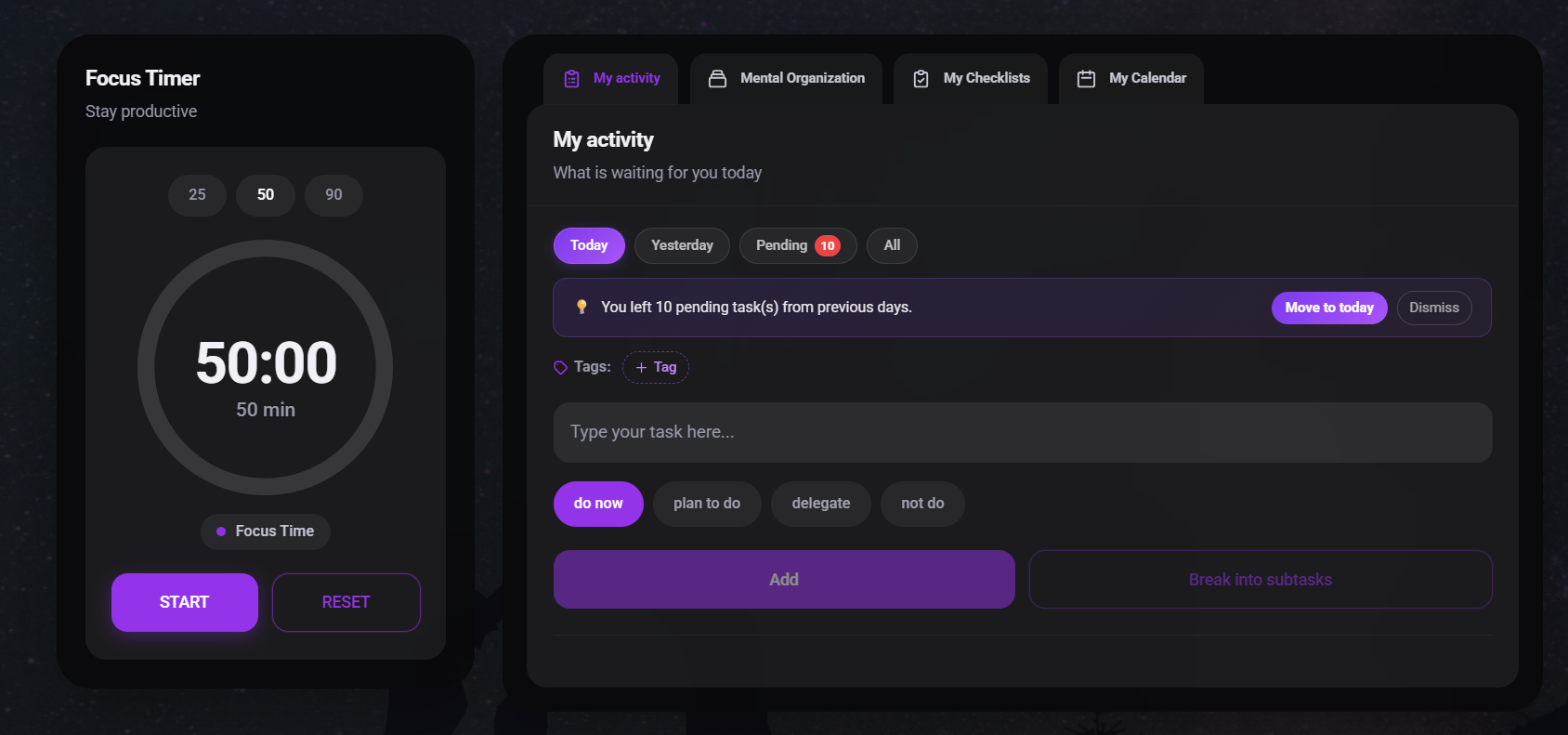
Modern pomodoro timers have evolved beyond kitchen gadgets. Today, platforms like Focus Organize integrate the timer with to-do lists, checklists, and the Eisenhower Matrix, allowing you to pair interval timing with priority management. This integration is critical because the pomodoro technique alone doesn’t tell you what to work on — it only structures when. For a complete overview of how these tools fit into a broader productivity system, check out the Complete Guide to Time Management Tools for 2026.
While the classic 25-minute block is a great starting point, many professionals find that adjusting the interval to match their natural attention span yields better results. For instance, a 2020 study by Microsoft found that the average human attention span has dropped to 8 seconds, but when engaged in meaningful work, people can maintain focus for 50–90 minutes. This suggests that a flexible timer aligning with your personal focus rhythm can significantly boost output.
Why the Right Pomodoro Timer Makes a Real Difference
Choosing the wrong pomodoro timer can sabotage your productivity. I’ve seen clients abandon the technique after a week because their chosen tool added friction: constant notifications, confusing settings, or no way to track progress. Here’s why the decision matters.
💡
Key Takeaway
A well-matched pomodoro timer reduces decision fatigue and increases consistency — the two biggest predictors of habit adherence.
First, distraction control. A 2016 study by Gloria Mark at the University of California, Irvine, found that it takes an average of 23 minutes to refocus after an interruption. If your pomodoro timer app itself sends social media alerts, you’re undermining the purpose. Analog timers eliminate this risk entirely; digital timers with “focus mode” (like Focus Organize) block notifications during sessions.
Second, accountability. When you can see your session history — how many pomodoros you completed, on which tasks — you build self-awareness. According to Forrester Research, professionals who track their time against specific tasks report 25% higher productivity. Digital apps provide this data; analog timers do not.
Third, customizability. Not all work fits the 25-minute box. Deep analytical work often requires longer stretches. A 2023 McKinsey report noted that knowledge workers spend 60% of their time on complex tasks that benefit from 45–90 minute uninterrupted blocks. The best pomodoro timers let you adjust interval length.
Fourth, portability matters if you switch contexts (home, office, coffee shop). Smartphone apps win here, but analog timers are silent and require no battery.
Fifth, cost. Analog timers cost $10–20. Quality apps are free or $5–10/month. The investment is trivial compared to the productivity gain — but free options often come with ads or limited features. For a deeper dive into the financial side, see How Much Does Time Management Tools Cost in 2026?.
Moreover, the psychological impact of a dedicated timer should not be underestimated. Having a physical or digital object that represents your focus commitment can act as a powerful trigger for entering a flow state. I’ve seen clients who struggled with procrastination transform their workdays simply by using a timer that respected their boundaries. The right timer becomes a ritual, not just a utility.
How to Choose the Best Pomodoro Timer for Your Workflow
Follow this step-by-step decision framework to select your ideal pomodoro timer.
Step 1: Define Your Constraints
- Distraction level: Are you easily tempted by your phone? → Avoid smartphone apps; choose analog or desktop.
- Mobility: Do you work in one place or move? → Mobile app or web-based.
- Need for data: Do you want to analyze your productivity patterns? → Digital app with stats.
- Budget: How much can you spend? → Free options exist, but paid ones (like Focus Organize) offer richer features.
Step 2: Test at Least Three Options
I recommend a 3-day trial for each candidate. Many people stop after one bad experience with a timer that didn’t fit. In my coaching practice, I ask clients to try:
- An analog timer for one day.
- A simple app (like Focus Organize) for one day.
- A web-based timer for one day.
Track completion rate (pomodoros finished vs. started) and subjective satisfaction.
Step 3: Evaluate Integration with Your Task List
A pomodoro timer that lives in a separate app from your to-do list adds overhead. According to a Harvard Business Review article on cognitive load, switching contexts between tools costs up to 40% of productive time. Focus Organize solves this by embedding the timer directly into your task and priority management system.
💡
Key Takeaway
The best pomodoro timer is the one that minimizes friction between deciding what to do and actually doing it.
For more insights on why integration matters, explore Why Time Management Tools Are Essential for Productivity in 2026.
Step 4: Consider Your Environment
If you work in an open office, an analog timer’s tick might annoy colleagues. In that case, a silent smartphone app with vibration is better. If you work from home, an analog timer can be a charming addition to your desk. For team settings, web-based timers with shared focus sessions (like Focus Organize’s team feature) allow you to coordinate deep work periods without constant messaging.
Step 5: Evaluate Long-Term Usability
Will you still use this timer in six months? The best tool becomes a habit. Look for a timer that you enjoy using daily. Focus Organize’s clean interface, customizable themes, and integrated habit tracking make it easy to stick with. You can also find community comparisons in our Time Management Tools Comparison 2026 article.
Pomodoro Timer Comparison: Analog vs Digital vs App vs Web
Now let’s compare the major categories head-to-head in greater detail. Each type has unique strengths and weaknesses that make it suitable for different professionals.
Analog Timer (Classic Tomato)
- Pros: Zero distractions, no setup, evergreen battery life, satisfying tick-tock sound.
- Cons: No data tracking, no customization, you must remember to reset it. Loud ticking may annoy colleagues.
- Best for: Writers, deep thinkers, advocates of “digital minimalism.”
Smartphone App (Focus Organize, Forest, Be Focused)
- Pros: Rich features — adjustable intervals, statistics, to-do integration, sync across devices.
- Cons: Risk of phone distractions; app permissions needed; subscription cost.
- Best for: People who already use their phone for task management and want detailed analytics.
Desktop App (Focus Organize, Pomotroid)
- Pros: Full-screen focus mode, keyboard shortcuts, no phone in sight. Often includes blocklists.
- Cons: Requires installation; only works on one computer.
- Best for: Developers, writers, anyone who works exclusively at a computer.
Web-based Timer (TomatoTimer, Marinara)
- Pros: No installation, works on any device, shareable via link for sync sessions.
- Cons: Requires internet; browser tabs invite multitasking; limited offline capability.
- Best for: Teams, schools, and users who can’t install software.
In my experience, most people end up with a hybrid: an analog timer for deep work sessions and a digital app for daily tracking. But if you want an all-in-one solution, Focus Organize combines the best of both — a clean, distraction-free timer with built-in task management and the Eisenhower Matrix. It’s one of the best pomodoro timers available in 2026.
To see how different types stack up for specific use cases, read our Types of Time Management Tools: A Complete Guide for 2026.

Beyond the four categories, there are also specialized timers: hardware timers that sync to your computer, browser extensions that sit in your toolbar, and even smartwatch apps that buzz at session ends. The market in 2026 is saturated, which is why it’s essential to focus on your primary need rather than getting overwhelmed by features. A developer might love the keyboard shortcut in a desktop app, while a writer might prefer the tactile satisfaction of a physical timer. No single option is universally superior; the best choice is the one that fits your workflow without extra effort.
Implementation Guide: Setting Up Your Pomodoro System
Once you’ve chosen your timer, follow these steps to integrate the pomodoro technique into your daily routine.
Step 1: Choose Your Interval Length
Start with the classic 25/5. After one week, adjust based on your tasks. For deep work, try 45/10. For administrative tasks, 15/3 works well. Use the Focus Organize app to test multiple interval presets.
Step 2: Define a Clear Task for Each Pomodoro
Before starting the timer, write down exactly what you will do. Vague tasks invite procrastination. If you’re using Focus Organize, assign the task from your to-do list and tag it with a priority level from the Eisenhower Matrix.
Step 3: Eliminate Interruptions
During a pomodoro, turn off notifications, close unnecessary tabs, and put your phone face-down. If using an analog timer, keep it visible to remind you of the ongoing interval.
Step 4: Track Your Completion Rate
At the end of each day, review how many pomodoros you completed versus planned. This data reveals patterns — such as which hours are most productive. Focus Organize automatically logs this and generates reports.
Step 5: Take Real Breaks
A break should be a true mental reset: stand up, stretch, walk, or drink water. Avoid checking email or social media. Research from the University of Sydney shows that physical activity during breaks reduces fatigue by 30%.
Step 6: Handle Interruptions Gracefully
During a pomodoro, if an interruption occurs (a colleague asks a question, an urgent email arrives), write it down on a “parking lot” list and address it during the break. This preserves your focus while acknowledging the distraction. Focus Organize’s note-taking feature allows you to quickly jot down interruptions without leaving the session.
Step 7: Review and Adapt Weekly
At the end of each week, review your total pomodoros and identify patterns. Did you consistently fall short on certain tasks? Were morning sessions more productive? Use this data to refine your schedule. Our guide on Step by Step: Time Management Tools in 2026 offers a comprehensive plan for weekly reviews.
For a more detailed walkthrough, see Step by Step: Pomodoro Timer | Focus Organize.
Common Questions and Misconceptions
Myth 1: “The pomodoro timer must be exactly 25 minutes.”
The original method is a guideline, not a law. Cirillo himself endorsed adjusting intervals. Focus on the structure, not the number. Many top performers, including Elon Musk, use 5-minute “mini pomodoros” for email processing.
Myth 2: “Using a phone app defeats the purpose.”
It can, but with discipline, a purpose-built app like Focus Organize (which blocks other notifications during focus mode) works beautifully. The key is to use a timer, not a multi-purpose device.
Myth 3: “The technique doesn’t work for creative work.”
Actually, creative professionals benefit from structured intervals. A study by the University of Michigan found that temporal constraints increased creative output by forcing rapid ideation within a defined window.
Myth 4: “You need a separate app to track habits.”
Not necessarily. Many pomodoro timer apps, including Focus Organize, include built-in session logs and statistics. Understanding Pomodoro Timer goes deeper into how to interpret your data.
Myth 5: “Web-based timers are just as good as dedicated apps.”
While convenient, web timers lack offline capability and can be interrupted by browser crashes. Dedicated apps like Focus Organize offer more reliability and integration. For location-specific advice, check our guides for Time Management Tools in New York or Time Management Tools in Austin.
Myth 6: “You must complete all four pomodoros before a long break.”
Not necessarily. Some people operate better with flexible block counts. The method is a framework, not a rigid rule. Listen to your energy levels. Focus Organize allows you to set custom break schedules beyond the classic 4-cycle.
Myth 7: “The pomodoro technique is only for individual work.”
Many teams use synchronized pomodoro sessions. Tools like Focus Organize offer a “focus room” where team members join a shared timer and mute distractions together. This fosters a culture of deep work across the organization.
Frequently Asked Questions
1. What is the best pomodoro timer for beginners?
Beginners should start with a simple, free option that matches their primary device. If you work at a desk, a web-based timer like TomatoTimer is fine. If you’re on the move, the Focus Organize app (free tier) offers guided setup. The most important thing is consistency, not the tool itself. In my coaching, I recommend sticking with one timer for at least two weeks before evaluating — many people switch too early.
2. Are analog pomodoro timers better than digital apps?
Analog timers eliminate digital distractions entirely, which is a huge advantage for people prone to phone addiction. However, they lack analytics and customization. Digital apps win on flexibility and data. The best choice depends on your personality: if you’re disciplined with devices, an app may outperform analog due to tracking features. Focus Organize offers a step-by-step pomodoro timer guide to help you decide.
3. Can I use a pomodoro timer for studying?
Absolutely. The technique is highly effective for studying because it chunks learning into digestible intervals and forces breaks, which improves memory consolidation. Many students use the Focus Organize app with longer intervals (40/10) for deep study. According to a University of Nevada study, students using the pomodoro method improved test scores by 14% compared to those who didn’t.
4. How do I integrate a pomodoro timer with my task list?
The ideal approach is to use a tool that combines both. Focus Organize integrates the timer directly with your to-do list, checklists, and Eisenhower Matrix — you start a session, pick the task, and the timer runs. This integration reduces context switching. For a deeper look, see how to use pomodoro timer effectively.
5. What interval length should I use for deep work?
Deep work — coding, writing, strategic analysis — often requires 40–60 minute blocks. Research from DeskTime and McKinsey suggests 52 minutes followed by 17 minutes is optimal for many knowledge workers. The pomodoro method recommends starting with 25 minutes and adjusting upward as you build focus stamina. Focus Organize allows custom intervals, so you can experiment and find your sweet spot. The Benefits of Time Management Tools article covers how interval optimization boosts overall productivity.
6. Can I use a pomodoro timer for team meetings?
Yes. Some teams use a pomodoro-style structure for meetings to keep them focused and concise. For example, set a timer for 20 minutes for brainstorming, then a 5-minute break to consolidate ideas. Tools like Focus Organize have a “meeting mode” that shares the timer with all participants, ensuring everyone stays aligned.
7. How do I deal with burnout if overusing the technique?
While the pomodoro technique reduces mental fatigue, over-scheduling back-to-back pomodoros without sufficient rest can still lead to burnout. Always honor your break times and take at least one longer break (30–60 minutes) during the day. Focus Organize includes a “wellness break” reminder that prompts you to move and breathe. If you feel exhausted, reduce the number of pomodoros per day and gradually increase as your endurance improves.
8. Is there a pomodoro timer specifically for people with ADHD?
Many adults with ADHD find the pomodoro technique helpful because it provides a clear start and end point for tasks. Apps like Focus Organize, with visual timers and progress bars, are especially effective. Additionally, the app offers a “hyperfocus mode” that extends intervals automatically if you’re immersed, which can be beneficial for variable attention spans.
Summary and Next Steps
Choosing the right pomodoro timer is a personal decision that hinges on your work environment, distraction triggers, and need for data. The key is to pick one tool, use it consistently, and adjust interval lengths to match your tasks. In my experience, the integration of timer with task management — like how pomodoro timer works inside Focus Organize — creates the most sustainable productivity system.
Start your free trial of Focus Organize at focusorganize.com and see which interval rhythm works for you. For further reading, explore our Pomodoro Timer Guide: Boost Focus in 2026 for advanced techniques.
About the Author
The Focus Organize Editorial Team has years of experience in productivity coaching and software design. They regularly test time management tools and contribute to research on attention management. Focus Organize is used by thousands of professionals worldwide.
Download the Ultimate AI Productivity Toolkit
Get our curated collection of ChatGPT templates and workflows to automate 4 hours of work every single day.