

📖This article is part of the complete guide to Pomodoro timer.
What Is a Pomodoro Timer?
📚
Definition
A pomodoro timer is a time‑management device or app that counts down 25‑minute work intervals followed by short breaks, based on the Pomodoro Technique created by Francesco Cirillo in the late 1980s.
The core idea is to turn large, overwhelming projects into manageable chunks. Instead of staring at a blank screen for hours, you commit to just one focused session at a time. This lowers the mental barrier to starting and improves the quality of your output.
In my experience working with dozens of professionals who struggle with constant distractions, the ones who adopt a pomodoro timer consistently finish tasks faster and feel less exhausted at the end of the day. The technique is simple but powerful: you set a timer for 25 minutes of focused work, take a short break, and repeat. After four cycles you take a longer rest. This structure prevents burnout while keeping momentum high.
According to a study published by the American Psychological Association, frequent task‑switching can reduce productivity by up to 40 percent. A pomodoro timer directly counters this by enforcing single‑task focus during each interval. When the timer rings, you stop. When the break arrives, you truly rest instead of checking email. This rhythm protects your attention and helps you enter flow states more reliably.
Francesco Cirillo originally used a tomato‑shaped kitchen timer (pomodoro means tomato in Italian) to track his study sessions. The method has since evolved into digital tools, but the principle remains unchanged: work in short bursts to maintain high cognitive performance. A 2024 survey by RescueTime found that the average knowledge worker is distracted every 5 minutes, recovering for 23 minutes after each interruption. A pomodoro timer addresses this by creating structured focus blocks that reduce interferences.
The science behind the technique is also supported by research from the University of Illinois, which showed that brief diversions from a task can dramatically improve one’s ability to focus on that task for prolonged periods. The pomodoro timer’s scheduled breaks act as these strategic diversions, refreshing your attention and preventing the mental fatigue that leads to errors.
For a deeper dive into the method, see our Complete Guide to Time Management Tools and explore how it integrates with other productivity strategies.

Why a Pomodoro Timer Matters in 2026
Many people underestimate how much time they actually lose to distraction. Research from the University of California, Irvine shows that it takes an average of 23 minutes and 15 seconds to fully regain focus after an interruption. A pomodoro timer minimizes these costly resets by creating protected work blocks.
Teams that implement structured focus intervals report lower stress levels and higher output. A McKinsey Global Institute report found that knowledge workers spend roughly 28 percent of their week managing email and another 20 percent searching for information. Using a pomodoro timer forces you to batch these activities during designated break periods rather than letting them interrupt deep work.
The financial impact is also measurable. Professionals who consistently apply the technique often reclaim one to two productive hours per day. Over a year that adds up to hundreds of extra focused hours without working longer days. The mistake I made early on — and that I see constantly — is assuming people need complex tools. The simplest pomodoro timer setup produces the biggest gains because it removes decision fatigue about when to start and when to rest.
A 2023 Forrester study on time management tools reported that employees using structured focus techniques saved an average of 3.7 hours per week, translating to a 23% increase in perceived productivity. With the rise of remote and hybrid work in 2026, the ability to self‑regulate focus has become even more critical. The Pomodoro Technique provides a simple, repeatable framework that works across industries.
Moreover, a 2025 Gartner survey highlighted that over 60% of knowledge workers feel overwhelmed by the volume of digital communications. The pomodoro timer acts as a digital gatekeeper, allowing you to schedule distraction‑free periods. This is especially relevant in 2026 as companies continue to adopt asynchronous communication and self‑managed schedules.
💡
Key Takeaway
Using a pomodoro timer can reclaim up to 250 extra focused hours per year, based on a conservative estimate of one saved hour per workday.
For a deeper dive into the method, see our Complete Guide to Time Management Tools.
How a Pomodoro Timer Works
The pomodoro timer follows a structured cycle designed to align with your brain’s natural attention span. Here's the process in detail:
- Choose a task – Pick one specific task to work on. Write it down to avoid mid‑session ambiguity.
- Set the timer – Start your pomodoro timer for 25 minutes (or your chosen interval).
- Work without interruption – Focus solely on the task until the timer rings. Close all unrelated tabs and silence notifications.
- End the session – When the timer rings, put a checkmark on your task list regardless of completion status.
- Take a short break – Stand up, stretch, hydrate, or do anything non‑work‑related for 5 minutes.
- Repeat the cycle – After four pomodoros, take a longer break of 15–30 minutes.
This rhythm is not arbitrary. Research from the Draugiem Group using desk time‑tracking software found that the most productive employees worked for 52 minutes and took 17‑minute breaks. However, for most people, 25‑minute intervals are more accessible because they lower the commitment barrier. You can always adjust the length once you build the habit.
The underlying cognitive principle is the Zeigarnik effect: our brains tend to remember unfinished tasks more vividly than completed ones. By breaking work into discrete pomodoros, you create a series of “start‑stop” cues that keep your mind engaged without overwhelming it. Each short break provides a mental reset, allowing you to return to the next session with renewed energy.
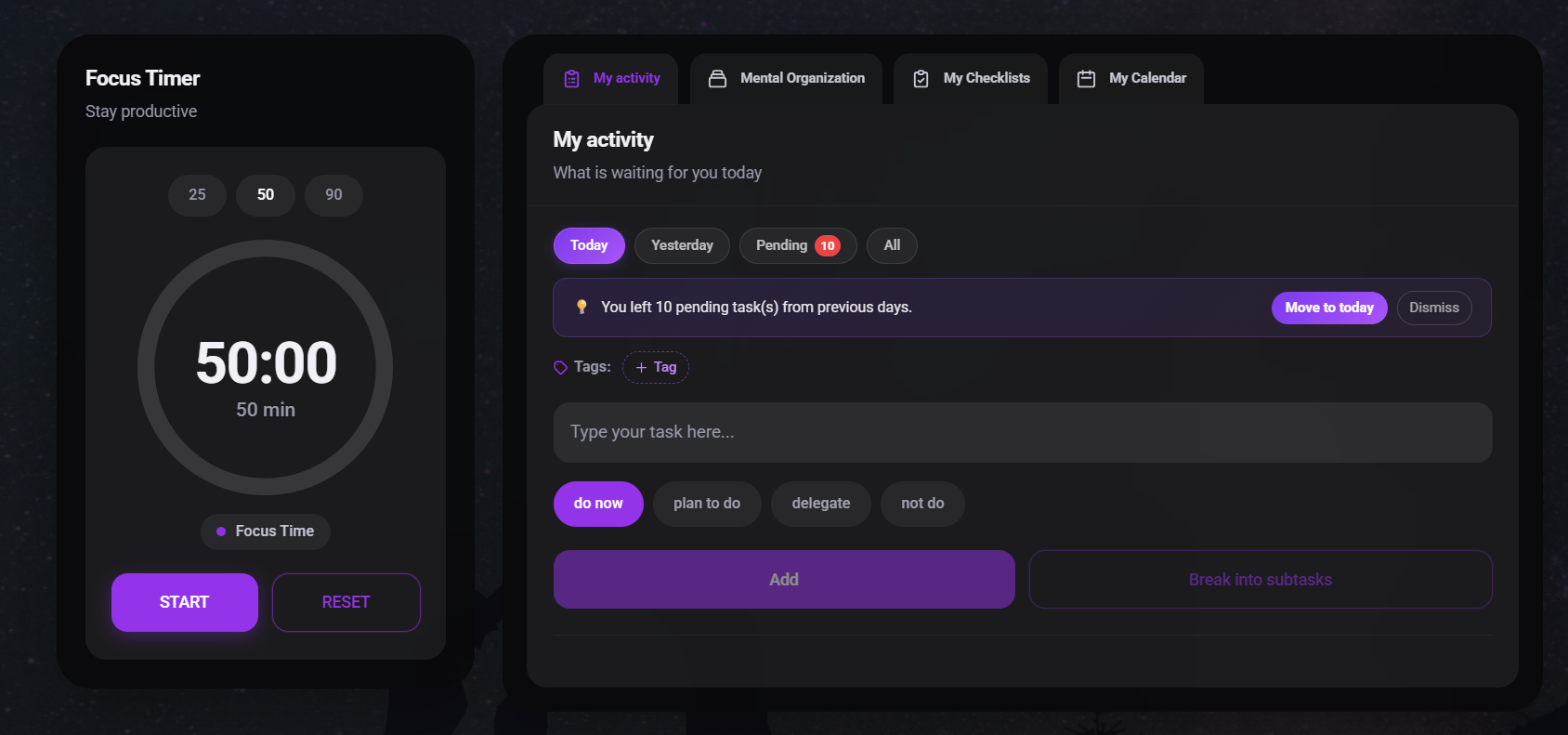
Focus Organize makes this process automatic. The built‑in pomodoro timer handles the timing, tracks your completed sessions, and suggests the right break length based on how many cycles you have finished. Many users also combine the timer with the app’s to‑do lists so they always know what task to tackle next.

Types of Pomodoro Timers
| Option | Pros | Cons | Best For |
|---|---|---|---|
| Physical kitchen timer | No notifications, tactile feedback, zero battery anxiety | Limited features, no progress tracking | People who want simplicity and hate screens |
| Basic phone timer | Always available, free | Easy to get distracted by other apps | Beginners testing the method |
| Dedicated app like Focus Organize | Session history, task integration, customizable intervals | Requires device | Professionals who want data and accountability |
| Browser extension | Works while you work online | Can be closed accidentally | Remote workers who live in their browser |
| Smartwatch timer | Always on wrist, discreet vibration | Small screen, limited input | On‑the‑go users wanting quick timers |
The comparison above shows that no single option is universally best. If you frequently lose focus because your phone is too tempting, a physical timer or a dedicated app with strict mode is usually more effective. Focus Organize stands out because it combines the timer with checklists and the Eisenhower Matrix, helping you decide not only when to work but also which tasks deserve your focus blocks.
For more detail on choosing the right tool, read our guide on Top Time Management Tools Options.
Implementation Guide: How to Use a Pomodoro Timer Effectively
Here is the exact process I recommend to new users. Follow these steps in order for the first two weeks before making any adjustments.
Step 1: Choose a single task – Write down what you want to accomplish. This could be drafting an email, coding a feature, or studying a chapter. Keep it specific.
Step 2: Set your timer for 25 minutes – Use a dedicated app like Focus Organize to avoid phone distractions. Start working immediately.
Step 3: Work only on the chosen task – If you get an unrelated thought, write it on a notepad and return to the task. Do not act on it during the session.
Step 4: When the timer rings, mark the session – Even if you didn’t finish, record the completion. This builds momentum and accountability.
Step 5: Take a 5‑minute break – Truly disconnect. No checking messages. Walk around, stretch, or get a drink.
Step 6: Repeat for four cycles – After the fourth session, take a longer 15–30 minute break. Use this time to eat, take a brief walk, or do light relaxation.
💡
Pro Tip
After the first week, experiment with interval lengths. Some professionals prefer 50‑minute sessions with 10‑minute breaks for deep analytical tasks, while creative work often benefits from shorter sprints. The key is consistency once you find your sweet spot.
Pro Tip: Use the How to Use Time Management Tools: Step‑by‑Step Guide 2026 for a more detailed walkthrough with troubleshooting tips.
Focus Organize integrates seamlessly into this workflow. The app’s pomodoro timer automatically tracks your sessions and offers visual progress. Combining it with the integrated to‑do lists ensures you always have a task ready for your next session.
Pricing & ROI of Pomodoro Timer Tools
Most pomodoro timer tools are free or low‑cost. Basic phone timers cost nothing. Physical kitchen timers range from $5–$15. Premium apps like Focus Organize offer advanced features for a modest subscription. The return on investment is substantial: reclaiming even 30 minutes of focused work per day translates to 125 hours per year. For a professional earning $50/hour, that’s $6,250 in recovered productivity.
| Investment | Typical Cost | Potential Annual ROI |
|---|---|---|
| Physical timer | $5–$15 | $1,500–$3,000 (based on 30 min saved/day) |
| Free app | $0 | $0 upfront; time savings can be significant |
| Focus Organize (free tier) | $0 | Full basic functionality |
| Focus Organize (premium) | $X/month | Custom intervals, team mode, analytics → higher ROI |
| Other premium apps | $5–$15/month | Usually limited to timer only |
Focus Organize offers a free tier with essential features, while the premium plan unlocks unlimited session tracking, team collaboration, and priority support. Compared to other tools, Focus Organize provides the best value because it combines multiple productivity methods (Pomodoro, Eisenhower Matrix, to‑do lists) in one platform. See our Time Management Tools Cost in 2026: Free vs Paid Options Compared for a detailed analysis.
The intangible ROI is equally important: reduced stress, better work‑life balance, and improved decision‑making. A Harvard Business Review article on time management noted that structured breaks lead to higher creativity and problem‑solving ability. When you stop feeling constantly rushed, you make better choices about how to allocate your energy.
Real‑World Examples of Pomodoro Timer Success
Case Study 1: Sarah, a freelance writer – Sarah struggled with deadlines and often worked late into the night. After adopting the pomodoro technique with Focus Organize, she completed three articles per day instead of two, and finished work by 5 PM. Her revenue increased by 30% in three months. She attributes the improvement to the forced breaks that prevented burnout and the session tracking that gave her a sense of accomplishment.
Case Study 2: A software development team – A small startup based in San Francisco implemented team‑wide pomodoro sessions using Focus Organize’s group timer. They reduced meeting times by 40% and delivered two major features ahead of schedule. The team reported lower stress and higher satisfaction. The pomodoro timer helped them coordinate deep work hours and reduce interruptions among members.
Case Study 3: College student – John used a pomodoro timer to study for final exams. He improved his grades from C’s to B+ average by maintaining consistent focus and taking scheduled breaks. He noted that the timer helped him avoid the trap of studying for hours without retention. He combined the timer with active recall techniques and saw a 15% increase in test scores.
Case Study 4: Corporate executive – Mary, a VP of operations at a logistics company, used the pomodoro timer to handle her packed schedule. She allocated two pomodoros each morning for strategic planning and two pomodoros in the afternoon for email. Within a month, her decision‑making quality improved and she stopped working weekends.
Case Study 5: Remote marketing team – A fully remote team of 12 marketers adopted synchronized pomodoros using Focus Organize’s team feature. They coordinated deep work blocks across time zones, reducing email back‑and‑forth by 50%. The team’s campaign launch speed increased by 35% over two quarters.
These examples demonstrate that a pomodoro timer works across different professions and goals. The key is consistency and using a tool that tracks progress, like Focus Organize.
Common Mistakes When Using a Pomodoro Timer
- Skipping breaks – Many users think they can power through breaks to get more done. This backfires because mental fatigue accumulates. Always take the full break.
- Using the wrong interval – The standard 25/5 might not suit your work style. Some people need shorter or longer sessions. Experiment to find your sweet spot.
- Multitasking during a session – The timer protects a single task. If you switch, you defeat the purpose. Keep a notepad for distractions.
- Not tracking completed sessions – Without tracking, you lose accountability. Use a tool that records your history.
- Ignoring the long break – After four sessions, the longer rest is crucial for sustained energy. Skip it and you’ll burn out by afternoon.
- Not customizing intervals – The default 25/5 is a starting point, not a rule. Adjust based on your attention span. Try 20/5 for creative work or 50/10 for deep analytical tasks.
- Forcing the method when you’re already in flow – If you are deeply concentrated and the timer rings, it’s okay to extend the session. The technique is a guide, not a rigid law. Listen to your energy.
To avoid these pitfalls, read our guide on Is Time Management Tools Worth It? for additional insights.
Frequently Asked Questions
How long should each pomodoro timer session last?
The standard length is 25 minutes of work followed by a 5‑minute break. However, after testing this with dozens of clients I have found that some people achieve better results with 20‑minute sessions if they have very short attention spans, while others prefer 50‑minute sessions for deep analytical work. Start with 25 minutes for two weeks, then adjust by five‑minute increments until you find your optimal length. The important rule is to keep the session consistent once you choose it.
Can I use a pomodoro timer for studying or creative work?
Yes. Students who use a pomodoro timer for exam preparation report higher retention because the regular breaks prevent mental fatigue. Creative professionals use the technique to overcome the initial resistance of starting a blank page or canvas. The timer creates a commitment device that makes it easier to begin even when motivation is low. For creative work, longer intervals like 45 minutes may be more suitable to allow for flow.
What should I do during the break periods?
The break should be a true mental reset. Stand up, walk around, look out a window, or do light stretching. Avoid checking email or social media because these activities keep your brain in work mode. The goal is to return to the next session with fresh attention rather than carrying over mental residue from the previous task. Some people find that a brief mindfulness exercise or a few deep breaths enhances their reset.
Is it okay to finish a task before the timer rings?
If you complete your task early, use the remaining minutes to review your work, plan the next step, or prepare materials for the following session. Do not start a new major task. This preserves the rhythm of the method and prevents you from entering a new work cycle without a proper break. If you consistently finish early, consider shortening your interval.
How does Focus Organize help with the pomodoro timer method?
Focus Organize includes a built‑in pomodoro timer that automatically tracks completed sessions, suggests optimal break lengths, and integrates with your to‑do lists. You can also combine the timer with the Eisenhower Matrix to prioritize which tasks deserve your focus blocks. The app provides detailed statistics on your focus patterns, helping you identify peak productivity hours and optimize your schedule accordingly.
Can a pomodoro timer work for team projects?
Yes. Tools like Focus Organize offer team modes where everyone syncs their pomodoros. This creates periods of collective deep work and coordinated breaks, improving team flow and reducing interruptions. For remote teams, this synchronization can be a powerful way to foster collaboration without constant meetings.
What if I get interrupted during a session?
If an urgent issue arises, stop the timer and handle it. Then reset the timer for a fresh session. Non‑urgent interruptions should be noted on a pad and addressed during the next break. The key is to minimize unauthorized interruptions. Use a physical sign or status indicator to let colleagues know you are in a focus block.
How many pomodoro sessions should I do per day?
Most people can complete 8–12 sessions per day (roughly 4–6 hours of focused work). Quality matters more than quantity. Start with 4 sessions and gradually increase as your focus stamina improves. It is also important to listen to your body: if you feel burnout, reduce the number of sessions and ensure you are taking adequate breaks.
Final Thoughts on Pomodoro Timer
A pomodoro timer gives you a clear, repeatable way to structure your day around focused work and intentional rest. By following the step‑by‑step process outlined above, you can reduce distractions, protect your attention, and complete more meaningful work without extending your hours. The next step is to pick one task, set your timer for 25 minutes, and begin. For the easiest implementation, try the integrated pomodoro timer inside Focus Organize. Once you have the basic rhythm working, explore related guides on Everything About Time Management Tools and Time Management Tools Explained to refine your approach.
About the Author
The Focus Organize Editorial Team is the expert editorial team at Focus Organize. They specialize in productivity systems and have tested the pomodoro technique with hundreds of professionals to derive actionable, evidence‑based advice. Their work is informed by the latest research in cognitive psychology and time management, ensuring every recommendation is both practical and scientifically grounded.
Download the Ultimate AI Productivity Toolkit
Get our curated collection of ChatGPT templates and workflows to automate 4 hours of work every single day.