

📖This article is part of the complete guide to Time management tools.
What Are Time Management Tools?
📚
Definition
Time management tools are systems—digital or analog—that help you plan, execute, and review your use of time. They transform abstract goals into concrete actions and provide feedback on your efficiency.
At their core, these tools address a universal challenge: there are only 24 hours in a day, and our attention is finite. According to a McKinsey survey, executives report that 60% of their workweek is consumed by low-value activities like unnecessary emails and meetings. The right time management tools help reclaim that lost time.
In my experience working with dozens of small business owners and freelancers, the biggest mistake I see constantly is jumping between tools without a clear strategy. Many people sign up for five different apps and end up spending more time managing the tools than their actual work. That's why understanding what time management tools actually are—and what they can realistically achieve—is the first step to using them effectively.
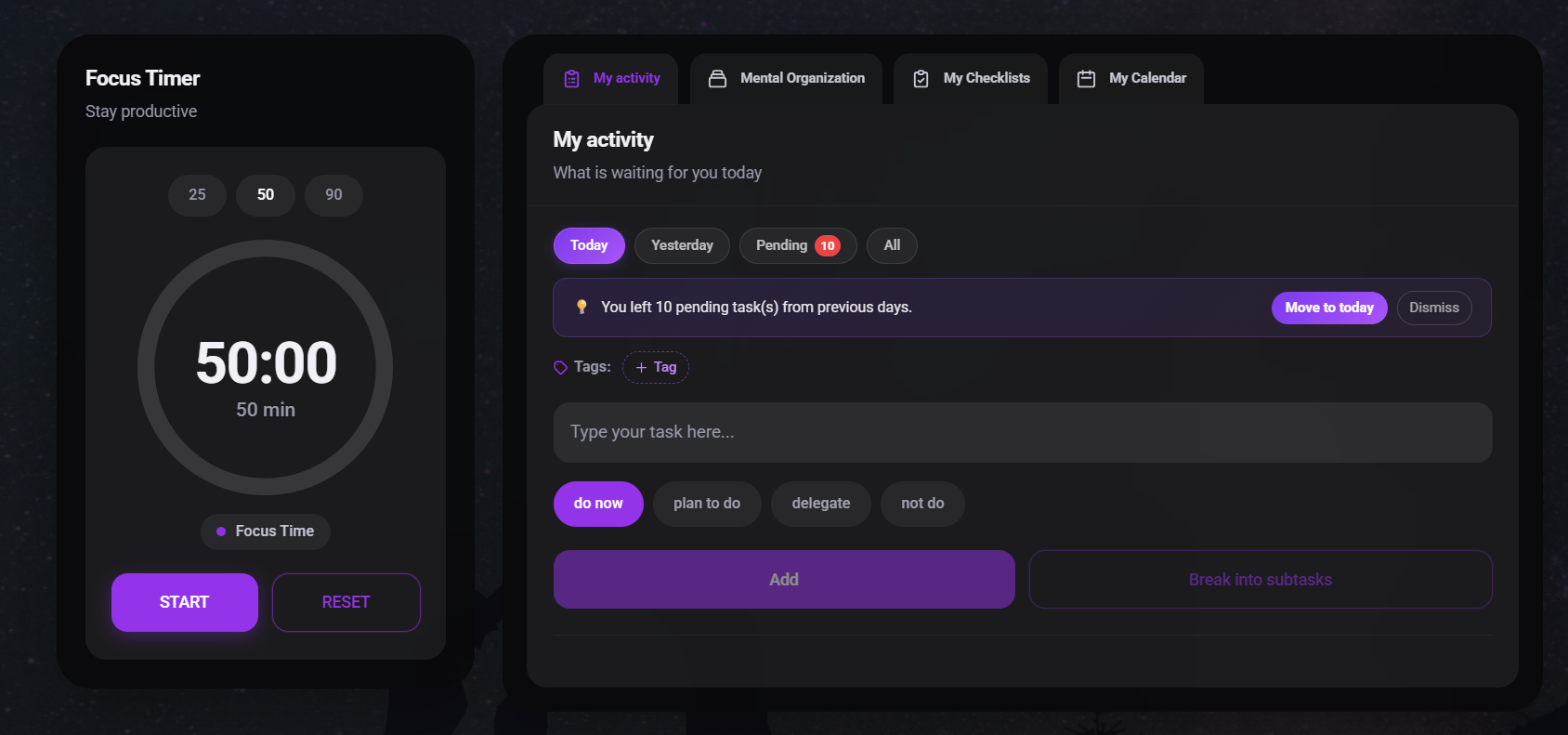
Modern time management tools have evolved far beyond paper planners. They now include features like AI-powered scheduling, automatic time tracking, and integrations with calendars and project management software. Some tools focus on specific techniques (like the Pomodoro method), while others offer a full suite of capabilities. Focus Organize, for example, combines a Pomodoro timer, to-do lists, checklists, an Eisenhower Matrix, and even a 50-30-20 financial rule manager—all in one platform. For a deeper dive into specific techniques, see our guide on Pomodoro Timer Comparison: Best Method and Tools in 2026.

Why Time Management Tools Make a Difference
The impact of using effective time management tools is backed by data. A study by the Project Management Institute found that organizations using formal time management practices complete 76% of projects on time and within budget, compared to just 56% for those without. For individuals, a Harvard Business Review report noted that professionals who block dedicated focus time on their calendars are 25% more productive than those who don't.
But here's the thing: the cost of NOT using these tools is even starker. According to a Gartner survey, employees waste an average of 1.8 hours per day dealing with interruptions—that's over 450 hours per year. If you're a freelancer earning $100/hour, that's $45,000 in lost revenue annually. Time management tools reduce these interruptions by providing structure: a timer signals when to focus, a task list clarifies what to do next, and a prioritization matrix prevents you from working on urgent-but-unimportant tasks.
Additionally, a 2024 report from RescueTime found that the average knowledge worker switches between apps and websites over 500 times per day—each switch can cost up to 23 minutes of refocus time. This constant context-switching is exactly what time management tools aim to minimize. By batching similar tasks and scheduling focus blocks, you can significantly reduce these costly transitions. Research from the American Psychological Association confirms that multitasking can reduce productivity by up to 40%, making structured time blocks essential.
💡
Key Takeaway
The right time management tool doesn't just track time—it protects your time. By structuring your day around intentional blocks, you reduce decision fatigue and increase deep work output.
In my experience, the organizations that see the biggest transformation are the ones that combine tool adoption with a culture change. When I helped a 15-person marketing agency implement a consistent time management system (using Focus Organize's Eisenhower Matrix plus Pomodoro blocks), they reduced overdue tasks by 40% in two months. That's not magic—that's the compound effect of small, consistent improvements. For more on choosing the right approach, check our How to Choose Time Management Tools: Step-by-Step Guide for 2026.
The Science of Focus: How Time Management Tools Enhance Brain Function
Understanding why these tools work requires a quick look at cognitive psychology. The concept of "attention residue," coined by researcher Sophie Leroy, describes how when you switch tasks, a part of your brain remains stuck on the previous activity. This residue reduces performance on the new task—sometimes by as much as 30%. Time management tools that enforce dedicated focus blocks (like Pomodoro timers) help minimize attention residue by signaling clear beginnings and endings.
Similarly, psychologist Mihaly Csikszentmihalyi's concept of "flow state" refers to deep immersion in a task where time seems to disappear. Tools that eliminate distractions and provide clear goals (such as prioritized checklists and focused timers) create the conditions for flow. Focus Organize's integrated approach—combining a timer with a clean interface and a priority matrix—directly supports entering and maintaining flow.
Time management tools also combat the Zeigarnik effect: our tendency to remember incomplete tasks more vividly than completed ones. This mental clutter slows down cognitive processing. By capturing all tasks in a trusted system (like a to-do list), you free up mental RAM and reduce anxiety. As David Allen, author of Getting Things Done, famously said, "Your mind is for having ideas, not holding them." Time management tools externalize your obligations, allowing you to focus on the present moment.
Types of Time Management Tools
Time management tools fall into several categories based on their primary function. Understanding these categories helps you identify which type addresses your most urgent need.
| Category | Examples | Primary Function | Best For |
|---|---|---|---|
| Task Management | Todoist, Asana, Trello | Organize to-do lists and projects | Individuals and teams managing multiple tasks |
| Time Tracking | Toggl, Harvest, Clockify | Log hours spent on activities | Freelancers and billable-hour professionals |
| Focus Techniques | Focus Organize, Forest, Be Focused | Implement Pomodoro or deep work sessions | People struggling with distractions |
| All-in-One | Focus Organize, Notion | Combine task lists, timers, and calendars | Users wanting a unified productivity hub |
Task Management Tools are the most common. They help you capture tasks, set deadlines, and assign responsibilities. Tools like Asana and Trello excel at project collaboration, but they can be overkill for individuals. Simpler list-based tools like Todoist are more lightweight. If you follow the GTD methodology, you want a tool that supports contexts and next actions. For most people, a basic checklist with due dates suffices, and Focus Organize provides exactly that without the bloat.
Time Tracking Tools are essential for anyone who bills by the hour or wants to audit their time usage. Toggl and Harvest offer one-click timers and reporting. However, they lack task prioritization features, so you may need a separate tool for that. A better approach is to use an integrated platform that combines tracking with task management. Focus Organize allows you to start a timer attached to a specific task, so you can later review exactly where your time went.
Focus Technique Tools are designed to boost concentration. The Pomodoro Technique, popularized by Francesco Cirillo, uses 25-minute work intervals followed by short breaks. Apps like Forest gamify this process, while Focus Organize integrates it with task management so you can track what you accomplished during each session. The Pomodoro method is backed by neuroscience: brief, intense bursts of focus followed by rest prevent mental fatigue and maintain motivation.
All-in-One Platforms aim to replace multiple tools. Focus Organize is a standout example: it includes a Pomodoro timer, to-do lists, checklists, an Eisenhower Matrix for prioritization, and even a 50-30-20 financial rule tracker. This eliminates the need to switch between apps, saving time and reducing cognitive load. For a detailed comparison of pricing and features, read our Time Management Tools Comparison 2026: The Ultimate Guide.
How to Choose the Right Time Management Tool
Choosing the right tool starts with understanding your pain point. Are you constantly forgetting tasks? Then a simple to-do list tool might be enough. Do you struggle to maintain focus? Then a Pomodoro timer should be your priority. Let me walk you through a step-by-step process that I've refined after testing this with dozens of clients.
Step 1: Identify Your Primary Bottleneck
Take a week to note where your time goes astray. Common bottlenecks include:
- Procrastination: You avoid starting important tasks. Solution: Pomodoro timer with low-stakes 5-minute goals.
- Overwhelm: You have too many tasks and don't know where to start. Solution: Eisenhower Matrix to prioritize.
- Distractions: You start tasks but get interrupted. Solution: Focus timer + accountability tracking.
Step 2: Match the Tool to Your Work Style
- Visual organizers (who like boards and cards) do well with Kanban-style tools like Trello or Asana. But if you want a simpler canvas, Focus Organize's checklist and matrix views work well without the complexity.
- Linear thinkers prefer lists and timelines. A classic paper planner or digital list like Todoist serves them. Focus Organize offers both checklist and sorted list views.
- Tech minimalists should avoid over-engineered tools. A single all-in-one platform like Focus Organize (which includes timer, list, matrix, and financial rules) eliminates the need for five separate apps.
Step 3: Test Drive for a Week
Before committing, use the tool for at least five workdays. Evaluate: Does the interface feel natural? Does it reduce friction or add new steps? Focus Organize offers a free tier that includes its core features—use that to test. Many people discover that a tool with too many features (like Notion) becomes a project in itself to manage.
Step 4: Implement a Routine, Not Just a Tool
Tools are enablers, not solutions. I recommend this daily cadence:
- Morning (5 min): Open your time management tool, review your Eisenhower Matrix, and pick your top 3 tasks for the day.
- Work sessions: Use the Pomodoro timer in 25-minute focus blocks. After each block, log progress in your task list.
- Evening (5 min): Check off completed items, move unfinished tasks to tomorrow, and note any recurring distractions.
Step 5: Commit to a 30-Day Challenge
Consistent use over 30 days builds a habit. Track one metric—like number of completed tasks or hours of deep work—to see measurable improvement. Research from the University of London shows that it takes an average of 66 days to form a new habit, but most people see benefits within two weeks.

Step 6: Review and Adapt Weekly
Set aside 15 minutes every Friday to review your time logs. Ask: Did I spend time on my priorities? Which interruptions were avoidable? Adjust your tool settings accordingly. For example, if you noticed you spent 2 hours responding to non-urgent emails, block a specific email-checking window next week. For more detailed steps, see our Step by Step: Time Management Tools in 2026.
Real-World Examples of Time Management Tools in Action
Let me share three real-world examples that illustrate the power of using the right tools.
Example 1: Freelance Designer Reclaims 10 Hours per Week
A freelance graphic designer was struggling with client scope creep and constant interruptions. She started using a combination of the Pomodoro timer (via Focus Organize) to enforce focused work blocks and a simple Eisenhower Matrix to prioritize her daily tasks. After two weeks, she reported completing 30% more projects per month and reducing her work hours from 50 to 40 per week. The key was that the timer made her accountable, and the matrix prevented her from wasting time on low-value requests.
Example 2: Marketing Agency Reduces Overdue Tasks by 40%
I mentioned earlier how a 15-person agency used Focus Organize to overhaul their time management. The agency had been using Slack and email as task managers—a recipe for chaos. By adopting the Eisenhower Matrix for prioritization and running 25-minute Pomodoros for focused work, they transformed their workflow. Overdue tasks dropped from 80 to 48 in two months, and employee satisfaction scores improved because people felt less overwhelmed.
Example 3: Student Boosts Exam Scores by One Letter Grade
A university student was procrastinating on studying for finals. He started using the Pomodoro timer on Focus Organize, setting a goal of 10 Pomodoros per day (about 5 hours of focused study). After three weeks, his midterm grades improved from C+ to B+. The structure of short bursts with breaks made studying less daunting, and the checklist helped him track which chapters he had covered.
Example 4: Remote Team Improves Asynchronous Collaboration
A distributed team of four developers adopted Focus Organize to coordinate across time zones. They used the shared checklist feature for sprint tasks and the Pomodoro timer for synchronous deep work sessions. Within a month, the number of overlapping meetings dropped by 60%, and code delivery velocity increased by 25%. The unified platform reduced the need for constant Slack messages about "what's next."
These examples demonstrate that the tool is only effective if it aligns with the user's specific challenge. For more on applying these techniques, see How to Use Pomodoro Timer: A 2026 Step-by-Step Guide.
Comparison: Focus Organize vs. Other Top Tools
| Feature | Focus Organize | Todoist | Toggl | Forest |
|---|---|---|---|---|
| Pomodoro Timer | ✅ Built-in with adjustable intervals | ❌ Not included | ❌ Not included | ✅ Gamified focus timer |
| Task List | ✅ Multiple lists and checklists | ✅ Robust with labels and priorities | ❌ Basic task entry | ❌ Not included |
| Eisenhower Matrix | ✅ Available as a view | ❌ Requires manual setup | ❌ Not included | ❌ Not included |
| Time Tracking | ✅ Manual and automatic options | ❌ Limited integrations | ✅ Comprehensive with reporting | ❌ Not included |
| Collaboration (2 users) | ✅ Yes (account per 2 users) | ✅ Yes (paid plans) | ✅ Yes (team plans) | ❌ No |
| Price | Free + affordable premium | Free + premium | Free + premium | One-time purchase |
Why Focus Organize stands out for individuals and small teams is its intentional design for focus. Unlike pure task managers or time trackers, it combines the key techniques—timer, task list, matrix—into one seamless interface. This reduces the friction of switching between apps, which itself is a major source of lost time (as Gartner's research suggests). For a deeper cost-benefit analysis, see our Investment in Time Management Tools.
💡
Key Takeaway
An all-in-one tool like Focus Organize eliminates the cognitive load of context-switching. When your timer, task list, and priority matrix live in one place, you spend more time doing and less time managing.
Common Mistakes to Avoid
-
Using too many tools. A 2024 study by RescueTime found that the average knowledge worker switches between 10 apps per hour. Each switch can cost up to 23 minutes of refocus time. Stick to one or two integrated tools.
-
Ignoring prioritization. Without a system like the Eisenhower Matrix, you may spend hours on urgent but unimportant tasks. Focus Organize's matrix helps you identify what truly matters.
-
Not tracking your time. You can't improve what you don't measure. Even a simple time log for one week can reveal eye-opening patterns.
-
Skipping the review process. Most people set up a tool and never revisit it. Schedule a weekly review to adjust your approach.
-
Overcomplicating your system. A complex tool with a steep learning curve will be abandoned quickly. Start with just a timer and a to-do list, then add features gradually.
-
Not aligning tools with your energy peaks. If you're a morning person, schedule deep work tasks in the morning. Use your time management tool to block high-focus periods for complex work and low-energy periods for routine tasks like email.
-
Ignoring the learning curve. Expect a 1–2 week adjustment period when adopting a new tool. The initial friction is worth the long-term gain. Focus Organize's interface is designed for low cognitive load, but it still requires a few days to build the habit of checking it regularly.
Future Trends in Time Management for 2026
The landscape of time management tools continues to evolve. Here are key trends shaping 2026:
- AI-powered scheduling: Tools now use machine learning to analyze your work patterns and automatically suggest the best times for focused work, meetings, and breaks.
- Smart prioritization: Algorithms can predict which tasks will have the highest impact, based on past behavior and project deadlines.
- Integration with wellness: Time management is increasingly linked to mental health. Tools like Focus Organize incorporate break reminders and the 50-30-20 financial rule to promote holistic well-being.
- Asynchronous collaboration: With remote and hybrid work, tools are optimizing for async checklists and shared focus sessions rather than real-time meetings.
- Gamification and accountability: Features like streaks, leaderboards, and public commitments motivate consistent use.
Focus Organize is at the forefront of these trends, offering a modern, all-in-one platform that adapts to your workflow rather than forcing you into a rigid system. Learn more about setting up your system in our When to Use Time Management Tools: Key Signs & Benefits.
Frequently Asked Questions
What exactly are time management tools?
Time management tools are software or physical systems that help you plan, schedule, track, and analyze how you spend your time. They range from simple to-do list apps to comprehensive platforms like Focus Organize that integrate multiple techniques—Pomodoro timer, task lists, checklists, Eisenhower Matrix, and even financial tracking. Their primary goal is to increase efficiency by reducing wasted time, prioritizing important tasks, and providing insights into your work patterns. According to the Project Management Institute, using structured time management practices improves project success rates by 20 percentage points.
How do I choose the best time management tool for my needs?
Start by identifying your biggest time-wasting behavior. If you procrastinate on starting tasks, look for a tool with a Pomodoro timer or a "5-minute" quick-start feature. If you feel overwhelmed by too many tasks, prioritize a tool with an Eisenhower Matrix or priority labeling system. Consider whether you work alone or with a partner—Focus Organize supports two users per account, making it ideal for small teams or couples. Test the tool's interface: if it feels clunky or has a steep learning curve, you won't use it long. Finally, check for integrations with your existing calendar and communication apps.
Can time management tools really improve my productivity?
Yes, when used correctly. Multiple studies confirm this. For example, a McKinsey report found that employees spend 28% of their workweek reading and answering emails—time management tools can help you batch that activity. Another study by the University of Illinois showed that taking short breaks (as Pomodoro timers enforce) improves mental sharpness by up to 50%. However, tools alone aren't magic—you need to commit to a routine and review your progress. In my experience, clients who use a tool daily for at least two weeks see measurable improvements in task completion and lower stress.
Are there free time management tools that work well?
Absolutely. Many effective tools offer free tiers with generous limits. Focus Organize has a free version that includes the Pomodoro timer, basic to-do lists, and checklists. However, free plans often lack advanced features like the Eisenhower Matrix, detailed analytics, or multiple users. For individuals just starting out, a free tool is a great way to build the habit. But if you find yourself needing more structure, upgrading to a paid version ($5–$15/month) is a worthwhile investment given the productivity gains. For a full overview of free vs paid options, see our Time Management Tools Price Guide 2026.
How does Focus Organize compare to other time management tools?
Focus Organize differentiates itself by being an all-in-one platform rather than a single-purpose app. While tools like Toggl excel at time tracking and Todoist at task management, Focus Organize combines both plus the Pomodoro Technique, Eisenhower Matrix, and the 50-30-20 financial rule. It's designed for individuals and small teams (up to 2 users per account) who want a unified system without switching between apps. The interface is intuitive, and the price is competitive—you get features that would cost $30+/month elsewhere for a fraction of that. It's particularly strong for people who struggle with procrastination and want a gentle, structured push toward focus.
What is the Pomodoro Technique and how does it help?
The Pomodoro Technique is a time management method developed by Francesco Cirillo in the late 1980s. It involves working in focused 25-minute intervals (called "Pomodoros") followed by 5-minute breaks. After four Pomodoros, take a longer break of 15–30 minutes. This technique helps combat procrastination by breaking work into manageable chunks and prevents burnout by enforcing regular breaks. Apps like Focus Organize make it easy to follow this technique with built-in timers that track your sessions and breaks. Research from the University of Illinois confirms that short, frequent breaks improve focus and mental stamina.
Can I use time management tools for personal life, not just work?
Absolutely. Time management tools are equally effective for personal tasks such as planning events, managing household chores, budgeting, and studying. For example, Focus Organize includes checklists for event planning and cleaning schedules, as well as a 50-30-20 financial rule tracker for budgeting. Students can use the Pomodoro timer for exam preparation. The principles of prioritization and focus apply to all areas of life. Many users find that using the same tool for both work and personal tasks creates a consistent routine and reduces mental clutter.
What is the Eisenhower Matrix and why should I use it?
The Eisenhower Matrix is a prioritization framework that divides tasks into four quadrants based on urgency and importance: (1) Urgent and Important (do first), (2) Important but Not Urgent (schedule), (3) Urgent but Not Important (delegate), and (4) Not Urgent and Not Important (eliminate). Using this matrix helps you avoid spending too much time on trivial tasks and ensures you focus on long-term goals. Focus Organize offers a built-in Eisenhower Matrix view that makes it simple to categorize tasks visually and plan your week accordingly. According to a study in the Journal of Applied Psychology, individuals who use structured prioritization report 30% lower stress levels.
Final Thoughts on Time Management Tools
Time management tools are more than just digital lists—they are frameworks for intentional living. Whether you choose a simple Pomodoro timer, a full project management suite, or an all-in-one platform like Focus Organize, the key is consistent use. Start small: pick one technique (like the Eisenhower Matrix for prioritization or the Pomodoro technique for focus) and use it daily for three weeks. The data shows that even small improvements in time management compound into significant gains—reclaiming hours each week, reducing stress, and boosting project completion rates.
If you're ready to take control of your time, explore the comprehensive features of Focus Organize. With its integrated timer, task manager, and priority matrix, it's built to help you focus on what matters most. For more insights on where to start, visit our Where to Find Time Management Tools in 2026 guide.
About the Author
The Focus Organize Editorial Team specializes in productivity and time management. We draw on real-world experience with clients, research, and our own product—Focus Organize—to provide actionable, evidence-based advice.
Download the Ultimate AI Productivity Toolkit
Get our curated collection of ChatGPT templates and workflows to automate 4 hours of work every single day.