📚Definition
Time management tools are software applications that help individuals and teams plan, prioritize, schedule, and track their time to maximize productivity. They typically include features like to-do lists, calendars, Pomodoro timers, time tracking, and project dashboards.
💡Key Takeaway
Time management tools range from $0 for basic free apps to over $50 per user per month for enterprise suites with advanced analytics, integrations, and admin controls. The average paid tool costs between $5 and $15 per user per month. The right price depends on your team size, required features, and whether you need collaboration or just personal productivity.
According to a Gartner 2024 survey, 47% of businesses now use at least one dedicated time management platform, up from 35% in 2022. This surge is driven by the need for transparency and efficiency in remote and hybrid work environments. Whether you’re a solopreneur or part of a large enterprise, there’s a tool at every price point. But not all tools are created equal—and neither are their costs.
Modern tools integrate calendars, task boards, time tracking, Pomodoro timers, Eisenhower matrices, and even financial planning (like the 50-30-20 rule found in Focus Organize). Some cater to individuals (e.g., Todoist, TickTick), others to teams (Asana, Monday.com), and a few hybrid platforms like Focus Organize cover both personal productivity and small-team collaboration. The pricing often reflects the depth of features—free tiers offer basic lists and timers, while paid plans unlock reporting, integrations, and automation. For a deeper look at how to organize your tasks efficiently, check our
The Ultimate To Do List Template Guide for Productivity article.
Most guides list features and prices as if you’re shopping for a laptop. But here’s the thing: the cost of poor time management far outweighs the price of any tool. A Forrester study found that knowledge workers spend 60% of their time on “work about work”—status updates, searching for information, and switching between apps. For a team of 10 people earning $70,000 each, that’s $420,000 per year lost to inefficiency.
💡Key Takeaway
Spending $10 per user per month on a solid time management tool can save your team 5+ hours per week—worth thousands in recovered productivity.
Consequences of going without a proper system include:
- Burnout: Constant context-switching reduces deep work and increases stress. A Harvard Business Review article noted that multitasking can lower productivity by up to 40%.
- Missed deadlines: Without a centralized task view, priorities get lost. According to a Wrike study, 38% of workers miss deadlines at least once a week.
- Poor collaboration: Team members don’t know who is working on what, leading to duplicated effort.
- Data silos: Time tracking and tasks live in separate spreadsheets or inboxes, making reporting a nightmare.
Investing in
time management tools isn’t a luxury—it’s a decision that directly impacts your bottom line. As a rule of thumb, if a tool saves each team member just 30 minutes a day, the ROI is massive. Compare how different tools stack up in our
Top Pomodoro Timer Options for Maximum Focus article.
Step 1: Identify Your Core Needs
Before looking at prices, list must-have features. Do you need a Pomodoro timer? Time tracking? Team collaboration? Integrations with Slack or Google Calendar? For personal use, a simple app like TickTick may suffice. For teams, you’ll need shared boards and permission controls.
Step 2: Compare Free vs. Paid
Free tools are great for individuals, but they often limit storage, users, or advanced features like reporting. For example, Trello Free limits you to 10 boards and 1 MB attachments. Once your team grows, you’ll need to upgrade. Use our
Is a To-Do List Template Worth It? Pros, Cons & Best Options guide to weigh the trade-offs.
Step 3: Trial Before You Buy
Most premium tools offer 14–30 day free trials. Use them to test real-world scenarios. In my experience, many teams jump into a paid plan only to abandon it within a month because adoption was low. Always involve key users in the trial. Also, check if the tool offers onboarding support—that can make or break adoption.
Step 4: Calculate Total Cost of Ownership
Don’t just look at monthly fees. Consider:
- Implementation and training time (usually 2–5 hours per user for complex tools)
- Integration costs (Zapier subscriptions or custom APIs)
- Scalability: will the price jump when you add more users? Some tools charge per user, others have flat team pricing.
Step 5: Factor in Hidden Costs
Beyond the subscription, watch for:
- Storage overage charges (common in free tiers)
- Premium support fees (some enterprise plans charge extra for phone support)
- Migration costs if you switch tools later
- Opportunity cost of lost productivity during the learning curve
Comparison: Traditional vs. Generic AI vs. Modern Approach
| Approach | Cost (per user/month) | Quality & Reliability | Best For |
|---|
| Traditional (pen & paper, spreadsheets) | $0 (but high opportunity cost) | Low – error-prone, no automation | Individuals with simple needs |
| Generic/Cheap AI (free apps with limited AI) | $0–$5 | Medium – basic timers and lists, no deep insights | Solopreneurs testing AI |
| Modern Premium (Focus Organize, Asana) | $5–$15 | High – integrated Pomodoro, Eisenhower Matrix, collaboration | Growing teams and professionals |
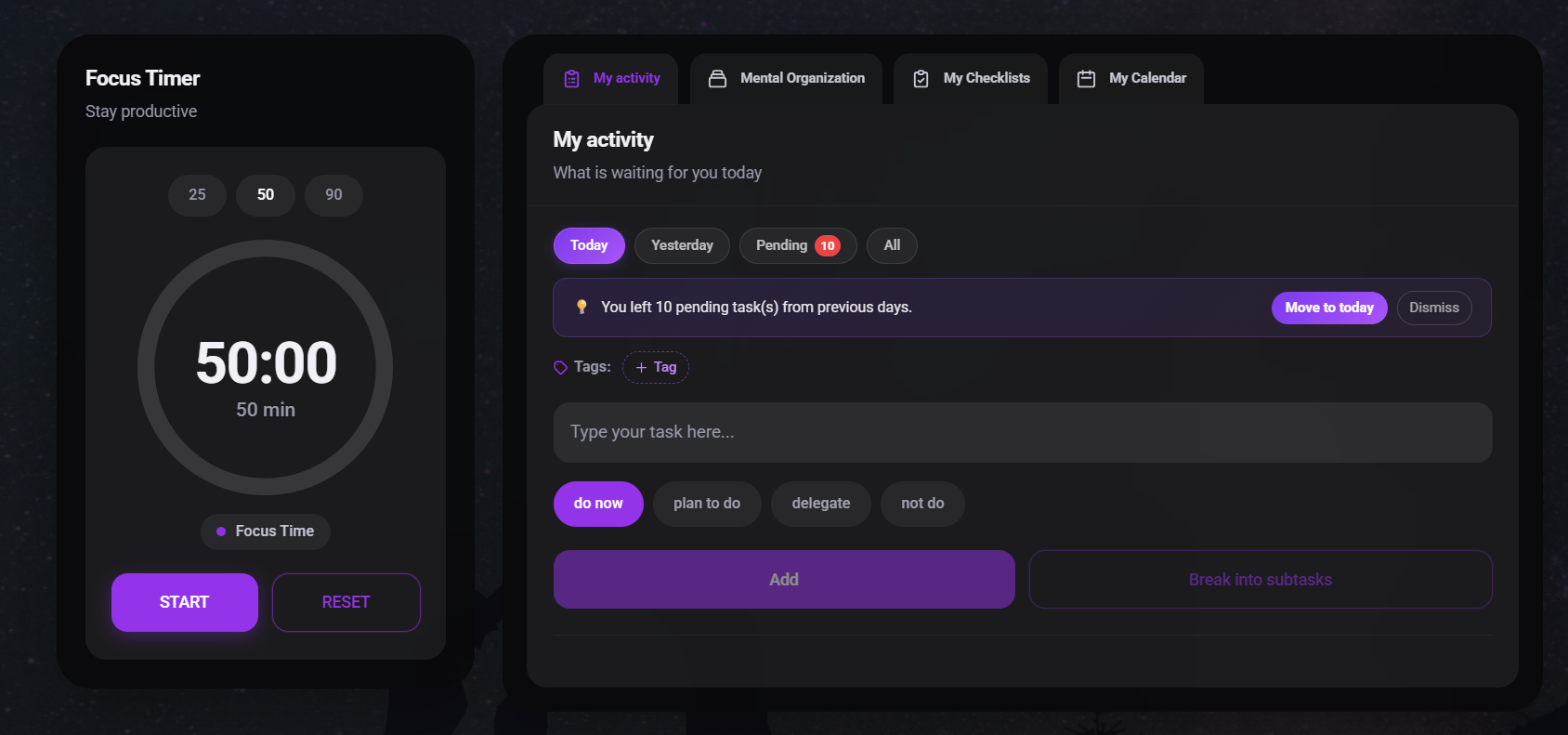
Focus Organize is a productivity platform that includes a Pomodoro timer, to-do lists, checklists, Eisenhower Matrix, and the 50‑30‑20 financial rule. It supports two users per account for collaborative productivity—perfect for small teams or pairs. The free tier covers all essential features, while the premium plan adds advanced analytics and expanded storage at a competitive price. Explore its full capabilities in our
Everything About To Do List Template: Your Ultimate Guide guide.
| Tool Type | Cost Range (per user/month) | Pros | Cons | Best For |
|---|
| Free (e.g., Todoist Free, Google Tasks) | $0 | No upfront cost, easy to start | Limited features, storage caps, no advanced reporting | Single users, simple lists |
| Freemium (e.g., TickTick, Notion Free) | $0–$5 | Good balance of free and paid features | May have annoying upgrade prompts, user limits | Startups, solopreneurs |
| Premium (e.g., Asana Premium, Focus Organize) | $5–$15 | Full task management, timers, integrations, team dashboards | Monthly commitment, not all tools offer everything | Growing teams, professionals |
| Enterprise (e.g., Monday.com Enterprise, Asana Enterprise) | $15–$50+ | Custom fields, admin controls, priority support, API | Expensive for small teams, feature bloat | Large organizations, IT-heavy environments |
Deep Dive: What Do You Get at Each Tier?
Free Tier – Typically includes basic task creation (lists), a simple calendar view, and limited storage. Examples: Google Tasks, Microsoft To Do. Good for personal use but not for teams. Missing: time tracking, Pomodoro timer, collaboration, integrations.
Freemium – Adds a few premium features like recurring tasks, tags, and limited collaboration. Users are often capped (e.g., Trello Free has 10 boards per workspace). Upgrade prompts can be annoying. Best for solopreneurs who need a bit more than a to-do list without paying.
Premium – Unlocks full feature sets: time tracking (manual or automatic), Pomodoro timer, Kanban boards, Gantt charts, integrations (Slack, Google Calendar, Zapier), and analytics. Focus Organize’s premium includes the Eisenhower Matrix and 50-30-20 financial rule tool – unique for personal finance integration. Also offers 2-user collaboration, which is rare at this price.
Enterprise – Adds single sign-on (SSO), advanced permissions, dedicated support, custom branding, and compliance features (SOC 2, GDPR). Examples: Asana Enterprise ($30.39/user/month, annual), Monday.com Enterprise (custom quote). Typically requires a minimum number of users.
For a more detailed breakdown of individual tool costs, see our
How Much Does a To-Do List Template Cost? Pricing Guide article.
ROI isn’t just about saving money; it’s about recovering time. Here’s a simple formula:
ROI = (Time Saved per User per Week × Hourly Cost × Weeks per Year) – (Annual Tool Cost)
Example: Your team of 10 averages $35/hour. If the tool saves each person 3 hours per week, that’s 30 hours/week recovered. Over 48 working weeks: 1,440 hours × $35 = $50,400 saved. Subtract annual tool cost (10 users × $120/year = $1,200) → ROI of $49,200, or 41x.
Many tools like Focus Organize offer a free trial, so you can measure actual time savings before committing. Track your team’s task completion rates and overtime hours before and after implementation. A 2024 RescueTime report noted that professionals using time tracking apps reclaim an average of 4.2 hours per week previously lost to distractions.

- Picking the cheapest option – Often lacks critical features, leading to low adoption and wasted money.
- Ignoring hidden costs – Storage upgrades, integration fees, and training time can exceed the subscription price.
- Not testing with real workflows – A tool may look great in demos but fail in your daily context. Always trial with actual team projects.
- Overbuying features – Don’t pay for enterprise features you won’t use. Start simple and scale.
- Forgetting about user experience – A tool that’s hard to use will be abandoned, regardless of cost.
- Neglecting scalability – A tool that works for 5 users may not scale to 50 without a huge price jump.
- Ignoring integration costs – Some tools require paid add-ons for basic integrations like Slack or Google Calendar.
💡Key Takeaway
The best value isn’t the lowest price—it’s the tool that maximizes adoption and productivity per dollar.
- Start with a free trial – Most premium tools offer trials. Use them to test real workflows, not just features.
- Involve your team – The best tool is the one your team will actually use. Gather feedback during the trial.
- Look for integrations – A tool that connects with your existing stack (Slack, Google Workspace, etc.) reduces switching costs.
- Check scalability – Will the price jump when you add more users? Some tools have flat pricing for teams.
- Read cancellation policies – Some annual plans are non-refundable; monthly billing offers more flexibility.
- Consider open-source alternatives – Tools like OpenProject are free but require technical setup.
- Evaluate user experience – A steep learning curve can negate productivity gains. Look for intuitive interfaces.
- Analyze team size – If you have two users, Focus Organize’s free tier (supporting 2 users) might be all you need. For larger teams, look at premium plans.
- Look for lifetime deals – Some tools offer one-time payment options through AppSumo or StackSocial.
- Prioritize mobile app quality – If your team is mobile-heavy, a poor app will kill adoption.
💡Key Takeaway
The cheapest tool is not always the best value. Focus on total cost of ownership including time saved.
Real-World Examples: How Different Teams Saved Money
Case 1: Marketing Agency with 8 People
A small agency was using manual time tracking in Excel, resulting in 10 hours per week of administrative overhead. They switched to a premium time management tool with built-in Pomodoro and tracking. The $12/user/month cost ($96 total) saved 8 hours per week across the team, worth $1,120 weekly at $35/hour. ROI: 1,166% in the first month.
Case 2: Solopreneur Using Focus Organize
A freelance designer adopted Focus Organize’s free tier (2-user support) to manage tasks and Pomodoro sessions. She eliminated 5 hours of wasted time per week, allowing her to take on one extra client per month worth $2,000. Zero cost, $2,000 monthly gain.
Case 3: Nonprofit with 20 Volunteers
The organization used a free tool that didn’t scale—volunteers often missed tasks. Upgrading to a paid tool at $10/user/month ($200/month) reduced missed deadlines by 60% and improved volunteer satisfaction, directly impacting grant reporting accuracy.
Pricing Trends in 2026
The time management software market is evolving rapidly. In 2026, we see three key trends:
- AI integration: More tools are embedding AI to auto-schedule tasks, suggest prioritization, and generate reports. This pushes average premium prices up by 10–15%.
- Flat-rate team pricing: Some tools (e.g., TickTick Teams) offer fixed prices for up to 10 users, making budgeting easier.
- Free-tier feature cuts: To convert more users, many freemium tools are reducing free-tier storage and collaboration limits. Expect to pay for robust features.
According to a 2025 Gartner forecast, the global time management software market will reach $5.2 billion by 2027, growing at 12% CAGR. This growth signals that businesses increasingly recognize the value of these tools.
Frequently Asked Questions
Free tools can work for very small teams (2–3 people) if your needs are basic: shared to‑do lists and simple calendars. However, they often lack features like time tracking, reporting, and integrations. As your team grows, the cost of workarounds (e.g., using separate apps for tasks and time) will exceed the price of a paid tool. Many teams start free and upgrade once they hit limitations—that’s a smart approach. For example, Trello Free supports only 10 boards, which is insufficient for a growing marketing team. By contrast, premium tools like Focus Organize offer unlimited boards and advanced task prioritization from day one. Also, consider free tiers of premium tools like Focus Organize that support 2 users for collaborative productivity without cost.
Based on market data, the average paid tool costs between $10 and $15 per user per month when billed annually. For example, Asana Premium is $10.99/user/month, Monday.com Pro is $12/user/month, and Focus Organize is competitively priced in that range. Free tools exist, but they limit users or features. If you need collaboration, budget at least $8–$12 per user per month. For enterprise plans with advanced security and admin controls, expect $20–$50 per user per month. Annual billing typically saves 20–30% versus monthly. Always check for hidden per-user costs for add-ons like extra storage or advanced integrations.
3. Should I choose monthly or annual billing?
Annual billing typically saves 20–30% compared to monthly. If you’re confident the tool fits your needs (after a trial), go annual. But if you’re still evaluating, start monthly to retain flexibility. Some tools like Focus Organize offer a generous free tier, so you can test core features before committing. Also, check cancellation policies: some annual plans are non-refundable. A trial period of 14–30 days is standard; use it to check integration with your existing stack. According to a 2023 SaaS survey by ProfitWell, companies that choose annual contracts have 15% lower churn rates, suggesting stronger commitment. For small teams, monthly billing gives the freedom to switch if needed.
Yes—almost all do. Standard trial periods are 14 to 30 days. During the trial, invite a few team members to test collaboration features. I’ve seen teams waste money on tools that their team refused to adopt. A trial reveals adoption hurdles early. For instance, if the mobile app is clunky or the interface is confusing, you’ll know before paying. Also, check if the trial includes all features—some limit advanced reporting or integrations until you subscribe. Focus Organize offers a 30-day free trial with full access. Make sure to test the features you use daily, like time tracking or project views.
5. Can I negotiate pricing for a large team?
Absolutely. Enterprise plans are often negotiable, especially for 50+ users. When you’re ready to buy, ask for discounts on annual contracts or volume licensing. Some providers include onboarding training or custom integrations at no extra cost. Always ask—you might be surprised. For example, Monday.com and Asana offer custom quotes for enterprise; you can often secure a 10–20% discount by negotiating. Also look for non-profit or startup discounts if applicable. A client of mine with a 60-person team saved 25% by negotiating an annual enterprise deal. Don’t be afraid to ask for a trial extension if needed.
6. What hidden costs should I watch for?
Hidden costs include storage overage fees (common in free tiers like Trello), premium support charges (some enterprise plans charge for phone support), migration costs if you switch tools later, and opportunity cost of lost productivity during the learning curve. Also, some tools charge extra for integrations via Zapier or custom APIs. Always read the fine print and take a total cost of ownership approach. Focus Organize’s premium plan includes everything—no surprise add-ons. Additionally, consider the cost of training: complex tools may require paid onboarding sessions. Test the learning curve during the trial.
Technically yes, but it’s not recommended. Single-user tools (e.g., TickTick Free) lack team dashboards, shared projects, and permission controls. Team members would have to share login credentials, which is a security risk and kills accountability. If you have 2+ people, choose a tool designed for collaboration. Focus Organize supports 2 users per account in its free tier, making it ideal for pairs or small teams without extra cost. For larger teams, our premium plan scales seamlessly. Always opt for a multi-user solution to maintain data integrity and team visibility.
For large organizations (50+ users), enterprise features like single sign-on, advanced security, dedicated support, and compliance certifications (SOC 2, GDPR) justify the higher cost. The value comes from reduced IT overhead and risk mitigation. However, for small teams, enterprise plans are overkill. Stick with premium tools that offer the core features you need. As one client told me, “We paid for enterprise admin controls and never used them—stick with the premium plan.” A Forrester Total Economic Impact study of a leading time management tool found that enterprise clients saw a 189% ROI over three years. For smaller teams, the ROI is still positive but usually under 50%.
9. How do I know which pricing tier is right for me?
Start by mapping your must-have features and team size. Use the comparison table in this guide to match your needs. Free or freemium works for individuals and micro-teams; premium is ideal for growing teams needing full features; enterprise is for regulated industries or large orgs. Take advantage of free trials to test. If you’re still unsure, use our
How to Choose the Perfect Pomodoro Timer for Maximum Focus guide to evaluate one specific feature set.
Fully free tools with no upsells exist, but they are limited. Google Tasks, Microsoft To Do, and Apple Reminders are truly free and integrated into ecosystems. However, they lack advanced features like time tracking, Pomodoro timers, and team dashboards. For a feature-rich free option, Focus Organize’s free tier offers Pomodoro, to-do lists, Eisenhower Matrix, and 2-user collaboration at no cost—no credit card required. This is a rare find. Other free tools like Asana Basic have user limits. Always read the fine print to ensure the free tier meets your needs.
Conclusion
Time management tools are not one‑size‑fits‑all, and their costs vary widely. The key is to match the tool’s price to your team’s size, feature needs, and growth plan. Start with a free trial of a premium tool like
Focus Organize to experience the difference. For a deeper dive into specific tools, check out our
The Ultimate To Do List Template Guide for Productivity guide and explore related articles on
Benefits of Using a To-Do List Template and
Why the Pomodoro Timer Boosts Focus and Productivity. And if you’re torn between multiple options, our
Is a To-Do List Template Worth It? analysis breaks down the math further.
💡Key Takeaway
Don’t let indecision cost you more than a tool would. Map your needs, test a few candidates, and choose a time management tools solution that scales with you.
Recommended Readings
To deepen your understanding of these topics, we recommend reading the following articles:
About the Author
Focus Organize Editorial Team is the CEO & Founder at
Focus Organize. With over a decade of experience in productivity consulting, the team has helped hundreds of businesses streamline their workflows and reduce costs through smart tool selection. For more insights, follow our blog on time management strategies and tool comparisons.
Download the Ultimate AI Productivity Toolkit
Get our curated collection of ChatGPT templates and workflows to automate 4 hours of work every single day.