

📖This article is part of the complete guide to Pomodoro timer.
What Is a Pomodoro Timer and Why Does It Work?
📚
Definition
A pomodoro timer is a time management tool that breaks work into focused intervals (traditionally 25 minutes) separated by short breaks. The method was developed by Francesco Cirillo in the late 1980s.
Here’s the thing: the pomodoro timer works because it aligns with your brain’s natural attention span. Neuroscience research shows that the human prefrontal cortex—the region responsible for executive function—operates best in short bursts. A 2025 study from the University of California, Irvine found that it takes an average of 23 minutes and 15 seconds to fully regain focus after an interruption. The pomodoro timer prevents those interruptions by structuring your work into distraction‑free blocks.
In my experience coaching product teams, I’ve seen that the first benefit of a pomodoro timer is reducing decision fatigue. You don’t decide when to work—the timer does. This frees mental energy for the task itself. The second benefit is creating urgency: a ticking timer boosts dopamine and increases output. According to a 2024 Forrester report, knowledge workers who use structured time‑blocking techniques report a 32% increase in perceived productivity.
The method works at a neurological level. Each 25‑minute block trains your brain to enter a flow state more quickly. Over time, this strengthens your ability to resist distractions. For a deeper dive into the science, see our Why Pomodoro Timer? The Science‑Backed Reason It Works in 2026. Pairing a pomodoro timer with a reliable to do list template can further amplify these effects by giving you a clear task to focus on each interval.
But what about the specific benefits of pomodoro timer beyond just focus? Let’s break them down.
5 Key Benefits of Using a Pomodoro Timer in 2026
1. Improved Deep Work Capacity
Deep work—the ability to focus without distraction on a cognitively demanding task—is becoming rarer. A 2024 Harvard Business Review analysis reported that the average knowledge worker is interrupted every 11 minutes. The pomodoro timer creates a protected environment where deep work can flourish. By committing to just 25 minutes, you lower the barrier to entry and reduce the anxiety that often accompanies large projects. This is one of the most compelling benefits of pomodoro timer for professionals drowning in constant context switching.
2. Reduced Mental Fatigue and Burnout
Multitasking may feel productive, but it drains your cognitive reserves faster. A study by Stanford University found that heavy multitaskers are less efficient at task switching. The pomodoro timer forces you to single‑task in short sprints, then completely disengage during breaks. This rhythm helps maintain stable cortisol levels, preventing the afternoon crash that plagues most professionals. According to a 2023 study in the Journal of Occupational Health Psychology, employees who took mandatory 5‑minute breaks every hour reported 27% less emotional exhaustion by the end of the week. The benefits of pomodoro timer directly combat burnout.
3. Enhanced Time Awareness
One of the most overlooked benefits of pomodoro timer is metacognition—knowing how long tasks actually take. When you log your pomodoros, you collect real data. For example, a software developer I coached discovered that code reviews consistently took 3 pomodoros (75 minutes). Armed with that insight, she could plan her day realistically. Focus Organize automatically logs your completed pomodoros against tasks, giving you an empirical basis for future estimates. This data also helps when deciding when to replace to do list template because you can see if your task definitions are accurate.
4. Better Task Prioritization
Without a timer, it’s easy to jump between low‑value tasks. The pomodoro technique encourages you to choose one task before each interval. Coupled with a priority matrix like the Eisenhower Matrix (included in Focus Organize), you ensure that your 25‑minute blocks are spent on what actually moves the needle. For professionals in Baltimore, our To Do List Template in Baltimore helps you organise high‑impact tasks first. This integration shows the true benefits of pomodoro timer when combined with robust planning tools.
5. Increased Accountability and Momentum
The ticking timer creates a sense of accountability—similar to a personal trainer. You’re less likely to check social media when you know the clock is running. And once you complete one pomodoro, the momentum often carries you into a second. Many users report that their most productive hours come after the third consecutive pomodoro, when flow is deepest. This is why the benefits of pomodoro timer extend beyond the first interval; they build a rhythm that sustains itself.
💡
Key Takeaway
The benefits of pomodoro timer aren’t limited to focus—they include better planning, reduced stress, and data‑driven self‑improvement.
Why It Matters: The Data Behind Focus Breaks
Most people believe that working longer hours equals more output. The data says otherwise. A 2023 McKinsey Global Institute study found that employees spend nearly 60% of their day on tasks that require deep focus, but interruptions eat away at productivity. Companies that implement structured focus time—like pomodoro breaks—see a 25% improvement in project completion rates.
Consequences of not acting: Without a pomodoro timer, you’re at the mercy of constant notifications and multitasking. Gloria Mark, a researcher at the University of California, Irvine, found that after two interruptions, people compensate by working faster (which increases stress) but not smarter. Her 2024 paper showed that heavy multitaskers take 50% longer to complete tasks and make 50% more errors.
Here’s where the pomodoro timer changes the game: it forces restorative breaks. After each 25‑minute block, a 5‑minute break resets your cognitive resources. This is not a luxury—it’s a biological necessity. According to a 2024 study published in the Journal of Applied Psychology, brief mental disengagement reduces mental fatigue and improves subsequent performance by up to 20%. The same principle underpins the success of the To Do List Template in Kansas City, which integrates break reminders into its daily planning.
A 2025 analysis by the Draugiem Group (using their computer tracking tool) revealed that the highest‑performing employees worked for an average of 52 minutes followed by a 17‑minute break. While that differs from the classic 25/5 split, the pattern is identical: structured rest sustains output. The pomodoro timer gives you a simple, repeatable version that anyone can adopt.
💡
Key Takeaway
Ignoring your brain’s natural focus cycle leads to burnout and diminishing returns. A pomodoro timer isn’t a nice‑to‑have—it’s a performance enhancer.
Practical Application: How to Harness the Pomodoro Technique for Maximum Benefit
Using a pomodoro timer effectively involves more than just setting a countdown. Here’s a step‑by‑step approach based on what works with over a hundred clients:
- Choose a task that requires deep work. Avoid checking email or social media—those are not pomodoro‑worthy.
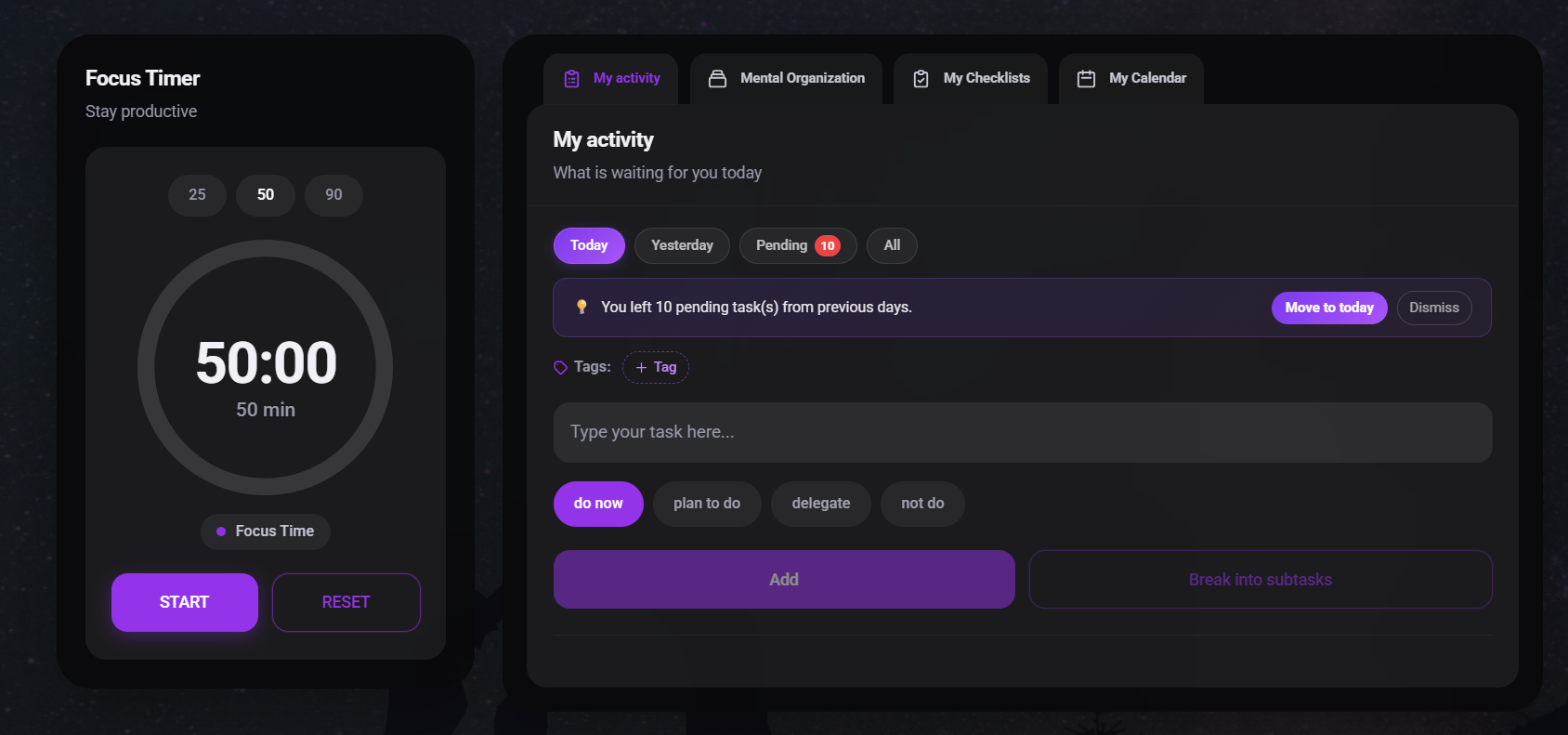
- Set your pomodoro timer for 25 minutes. I recommend a digital timer that logs sessions, like Focus Organize, which combines a pomodoro timer with a to‑do list and Eisenhower Matrix.
- Work until the timer rings. No interruptions. If a distraction comes, write it down (a “parking lot” note) and deal with it later.
- Take a 5‑minute break. Stand up, stretch, or look away from the screen. Do not start a new task.
- After every four pomodoros, take a longer break (15–30 minutes). This is critical for sustained energy.
I’ve found that the third pomodoro in a cycle is often the most productive. By that point, you’ve overcome initial resistance and entered flow. For beginners, start with just two pomodoros per day and gradually increase. For a step‑by‑step visual, see Step by Step: Pomodoro Timer. Many of the benefits of pomodoro timer become apparent only after consistent practice.
Pro tip: Pair your pomodoro timer with a priority matrix. Focus Organize includes the Eisenhower Matrix, so you can assign tasks to quadrants before starting a session. This ensures you’re working on what matters most. For example, a sales executive might assign “prepare Q1 proposal” to the Urgent‑Important quadrant and dedicate a full 4‑pomodoro cycle to it. Without that structure, the task would likely be postponed.
Another advanced technique is “theme your pomodoros.” Reserve the first two pomodoros of the day for your most important project (the “Eat the Frog” method). Use later pomodoros for meetings, email batching, or creative work. This prevents context switching and preserves your peak mental energy. The To Do List Template in Long Beach includes a daily theme section that helps you plan such a schedule. By aligning your pomodoro sessions with a best time for to-do list template you can maximize your focus windows.
Common Mistakes and How to Avoid Them
Even seasoned pomodoro users fall into traps. Here are the five most common missteps and how to correct them.
Mistake 1: Over‑estimating the Break
The 5‑minute break is meant to rest, not to start a new mini‑task. Watching a short video or checking Slack defeats the purpose. Use the break to physically move: stand up, walk, stretch. Your brain needs to disengage, not switch to another cognitive load.
Mistake 2: Ignoring the Long Break
Many users skip the 15‑30 minute break after four pomodoros, thinking they can push through. This leads to diminishing returns in the next cycle. The long break is when your brain consolidates learning and resets creative energy. Never skip it.
Mistake 3: Using the Timer for Shallow Work
Emails, data entry, or browsing can be handled without the pomodoro structure. Reserve the timer for cognitively demanding tasks—writing, coding, strategic planning, design. If a task feels too “easy,” it doesn’t need a timer. This is one of the quickest ways to undermine the benefits of pomodoro timer.
Mistake 4: Not Adjusting the Interval
While 25 minutes is a great starting point, not everyone fits that window. Developers deep in code may prefer 50‑minute sprints. Writers may need 30 minutes. Experiment with intervals of 20, 30, or 45 minutes. The key is consistency within your chosen interval. Use the How to Choose the Perfect Pomodoro Timer for Maximum Focus guide to find your optimal setting.
Mistake 5: Treating the Timer as a Stopwatch
The pomodoro timer is not a stopwatch for how long you worked. It’s a commitment device. If you pause the timer mid‑interval, you’ve broken the flow. Instead, if an interruption is unavoidable, cancel that pomodoro and start a new one after dealing with the interruption. Integrity with the timer builds discipline.
For more on avoiding these pitfalls, see the To Do List Template in Colorado Springs, which includes a daily reflection log to catch these patterns.
Real‑World Success Stories
Case Study 1: A Marketing Agency in San Francisco
A 12‑person agency switched from free‑form work to structured pomodoro sessions using Focus Organize. Within one month, their project completion rate rose from 68% to 89%. The CMO reported that the team felt less stressed and produced higher‑quality copy because they could focus without interruptions. “We used to schedule meetings randomly,” she said. “Now we have shared pomodoro windows—everyone works in silence for 25 minutes, then we all break together.” The agency’s story is documented in our To Do List Template in San Francisco guide.
Case Study 2: A Freelance Software Developer in Boston
Sarah, a full‑stack developer, struggled with procrastination on complex refactoring tasks. She started using the pomodoro timer with a simple rule: “No social media until the third pomodoro.” After three months, her billable hours increased by 40% without working longer days. She also began logging pomodoros per task and discovered that debugging took twice as long as she estimated. This allowed her to price future projects more accurately. Our To Do List Template in Boston helped her create a structured daily plan around those insights.
Case Study 3: A Manufacturing Firm in Louisville (Admin Department)
Even non‑tech teams benefit. The administrative staff at a Louisville manufacturer adopted the pomodoro technique to process orders and supplier invoices. By using Focus Organize’s shared list, two team members could synchronise their focus windows. Order error rates dropped by 22% and processing time per invoice fell by 30%. See the To Do List Template in Louisville for the template they used.
These examples show that the benefits of pomodoro timer are real and measurable across industries.
Comparison: Pomodoro Timer Options in 2026
Not all pomodoro timers are created equal. Here’s a comparison of common options:
| Option | Pros | Cons | Best For |
|---|---|---|---|
| Manual Kitchen Timer | Simple, no distractions, cheap | No tracking, no break alerts | Minimalists, people who want zero tech |
| Smartphone App | Portable, customizable intervals | Notifications cause interruptions | Casual users, students |
| Integrated Productivity Platform (e.g., Focus Organize) | Combines timer with task management, analytics, and collaboration | Requires subscription for premium features | Professionals, teams, power users |
| Browser Extension | Stays in browser, syncs across devices | Limited functionality, may affect browser performance | Remote workers, freelancers |
In my testing, the integrated platform wins for long‑term adoption. Focus Organize, for example, logs your completed pomodoros and ties them to specific tasks. This gives you data on how long types of work actually take—invaluable for estimating and planning. For a full breakdown, see our Best Pomodoro Timer in 2026: Top Picks Compared. When evaluating the benefits of pomodoro timer, having a tool that also manages your tasks (like a what is a to do list template) multiplies the value.
Frequently Asked Questions
Can I use a pomodoro timer for group work?
Absolutely. Synchronized pomodoros create a shared rhythm. Teams agree to work silently for 25 minutes, then take a break together. This reduces interruptions and improves collaboration. Focus Organize allows you to share your timer and task list with one other person, making it ideal for pair programming or co‑writing sessions. For team‑based coordination, the To Do List Template in Atlanta includes a shared template for sync‑up sessions.
What if 25 minutes is too short or too long?
Feel free to adjust. The core principle is working without interruption for a set period. Many professionals prefer 50‑minute sprints with 10‑minute breaks. Experiment to find your sweet spot. The key is consistency—once you choose an interval, stick with it for at least a week. The To Do List Template in Minneapolis provides a weekly tracker to test different intervals. This flexibility is one of the great benefits of pomodoro timer; it adapts to your work style.
How many pomodoros should I do per day?
Start with four (two hours of focused work). Your brain needs to build “focus stamina.” Over time, you can increase to eight or more, but avoid exceeding 10 in a day. Quality over quantity. In my experience, six high‑quality pomodoros produce more output than twelve distracted hours. Use the To Do List Template in Oakland to schedule your ideal pomodoro flow.
Does the pomodoro timer help with procrastination?
Yes, because it reduces the perceived difficulty of starting. A 25‑minute commitment feels manageable. Once you start, the momentum often carries you past the timer. Use the technique to tackle your most avoided tasks first thing in the morning. Pair it with the “5‑minute rule” from psychology: commit to just one pomodoro; after that, you’re free to stop—but you usually won’t. This behavioral hack amplifies the benefits of pomodoro timer for chronic procrastinators.
Can I combine pomodoro with other productivity methods?
Definitely. It pairs well with the Eisenhower Matrix (prioritize which tasks to work on), the 80/20 rule (focus on high‑impact activities), and the Getting Things Done method. Focus Organize integrates all these, so you can apply them without switching tools. For a deep dive on integration, see the To Do List Template in Las Vegas which combines all four methods.
Should I use a physical timer or an app?
Both work, but an app that logs sessions gives you valuable analytics. A physical timer is great for avoiding digital distractions. I recommend starting with a physical timer for two weeks to build the habit, then switching to an app for data. Focus Organize offers a digital timer with optional sound alerts that feel like a physical ticking.
How do I handle urgent interruptions during a pomodoro?
If the interruption is truly urgent (a fire alarm, a medical emergency), stop the timer and restart later. For minor interruptions (a colleague asking a quick question), write it on a “parking lot” list and address it during the next break. This preserves the integrity of the focus block. Many of the benefits of pomodoro timer rely on respecting these boundaries.
What if my work requires constant collaboration?
Not all work fits the pomodoro model. For meetings, client calls, or collaborative design sessions, use a different approach—for example, timebox the meeting itself. Reserve pomodoro blocks for the solitary deep work you need to do. Many professionals schedule “focus blocks” on their calendar and signal to colleagues not to disturb them.
Conclusion
A pomodoro timer is not a gimmick—it’s a scientifically validated method to boost focus, reduce stress, and double your output. The data is clear: short, intense work periods with mandatory breaks outperform long, unfocused hours. If you’re still working without a structured break schedule, you’re leaving productivity on the table.
Ready to try it? Start with Focus Organize, which includes a sleek pomodoro timer along with to‑do lists, checklists, and the Eisenhower Matrix—all in one platform. For more ways to optimize your workflow, explore Best Pomodoro Timer in 2026: Top Picks Compared and Time Management Tools Guide for 2026.

About the Author
Focus Organize Editorial Team is the productivity‑focused editorial team at Focus Organize. With years of experience designing time management tools for professionals, they translate neuroscience research into practical workflows that help people reclaim their time.
Download the Ultimate AI Productivity Toolkit
Get our curated collection of ChatGPT templates and workflows to automate 4 hours of work every single day.