

📖This article is part of the complete guide to Pomodoro timer.
The 5 Types of Pomodoro Timers: Which Format Fits Your Focus Style?
The Pomodoro Technique has remained a cornerstone of productivity since its inception in 1987 by Francesco Cirillo. What started as a simple kitchen timer shaped like a tomato has evolved into a diverse ecosystem of timer formats, each designed to cater to unique focus styles and environments. In 2026, the Pomodoro timer market offers an array of specialized options, from silent gravity cubes to advanced software-integrated suites. Choosing the right timer can mean the difference between seamless focus and subtle friction that disrupts your workflow.
This guide breaks down the 5 primary types of Pomodoro timers, their mechanisms, ideal use cases, and how Focus Organize integrates these tools into a comprehensive productivity system.
Quick Summary: Comparing the 5 Timer Types
| Timer Category | Core Mechanism | Sound Level | Best For | Top Hardware / Tool Example |
|---|---|---|---|---|
| Gravity Cube & Flip Timers | Internal accelerometer | Silent (LED/Vibration) | Minimalist desk work | TickTime Pro Hexagon |
| Visual Disappearing Disc Timers | Receding colored wedge dial | Silent sweep | ADHD, time blindness | Time Timer MOD |
| Mechanical Rotary Timers | Wind-up mechanical spring gear | Audible ticking | Tactile feedback enthusiasts | Classic Mechanical Tomato Timer |
| Digital Rotary & Multi-Function | LED/LCD screen with bezel ring | Silent countdown | Precise second-by-second tracking | KWANWA Digital LED Timer |
| Integrated Productivity Suites | Cloud SaaS software & browser tab | Customizable chimes | Task tracking + analytics | Focus Organize Workspace |
💡
Key Takeaway
Each timer type caters to specific focus styles and environments. The right choice depends on your workflow, sensory preferences, and task complexity.
1. Gravity Cube & Flip Timers: The Zero-Friction Option

Gravity timers, often shaped as cubes or hexagons, use internal accelerometers to detect orientation. Each face displays a preset interval (e.g., 5, 15, 25 minutes), making them ideal for quick, frictionless transitions.
How They Work
Place the timer on your desk with your target interval facing upward. The internal accelerometer detects the orientation and starts the countdown. To pause or reset, simply rotate the timer to its neutral position.
Pros:
- Instant Activation: No buttons to press—starts in under a second.
- Silent Operation: Perfect for quiet environments like libraries.
- Rechargeable Models: Premium options like the TickTime Pro charge via USB-C.
Cons:
- Limited to preset intervals unless manually programmed.
Best Suited For: Programmers, writers, and knowledge workers who need minimal friction between focus and break intervals.
2. Visual Disappearing Disc Timers: The ADHD-Friendly Option

Visual timers replace numerical countdowns with a colored disc that gradually disappears as time elapses. This format externalizes time, making it tangible and easier to process for individuals with ADHD or time blindness.
How They Work
Turn the central knob to your desired interval (e.g., 25 minutes), and a colored wedge covers the dial. As the quartz movement advances, the wedge shrinks proportionally.
Pros:
- Externalizes Time: Helps combat time blindness.
- Zero Math Required: View remaining time peripherally without numerical focus.
- Clinical Use: Widely adopted in ADHD coaching and sensory therapy.
Cons:
- Most models max out at 60 minutes.
Best Suited For: ADHD individuals, neurodivergent students, and visual thinkers.
3. Mechanical Rotary Timers: The Classic Choice

Mechanical timers operate via internal clockwork springs, offering a tactile, retro experience. They’re perfect for those who enjoy rhythmic ticking and tactile feedback.
How They Work
Wind the outer dial past your desired interval (e.g., 25 minutes). As the spring unwinds, it produces rhythmic ticking before triggering a metal chime.
Pros:
- Battery-Free Operation: Never runs out of power.
- Tactile Feedback: The physical act of winding signals the start of work.
- Affordable: Classic models cost under $10.
Cons:
- Audible ticking may distract in silent environments.
Best Suited For: Purists, home office workers, and cooking sprints.
4. Digital Rotary & Multi-Function Timers: The Precision Option

Digital timers feature LED/LCD displays with customizable countdowns and stopwatch functions. They’re ideal for tasks requiring exact second-by-second precision.
How They Work
Set custom intervals using a rotary bezel or push buttons. Models like the KWANWA LED Timer display minutes and seconds with high contrast.
Pros:
- Exact Second Precision: Perfect for detailed tasks.
- High Contrast Displays: Visible in dimly lit rooms.
- Volume Controls: Customizable alarms and mute options.
Cons:
- Requires manual input for each session.
Best Suited For: Laboratory workers, fitness circuits, and presentation rehearsals.
5. Software & Cloud-Integrated Timers: The All-In-One Workspace

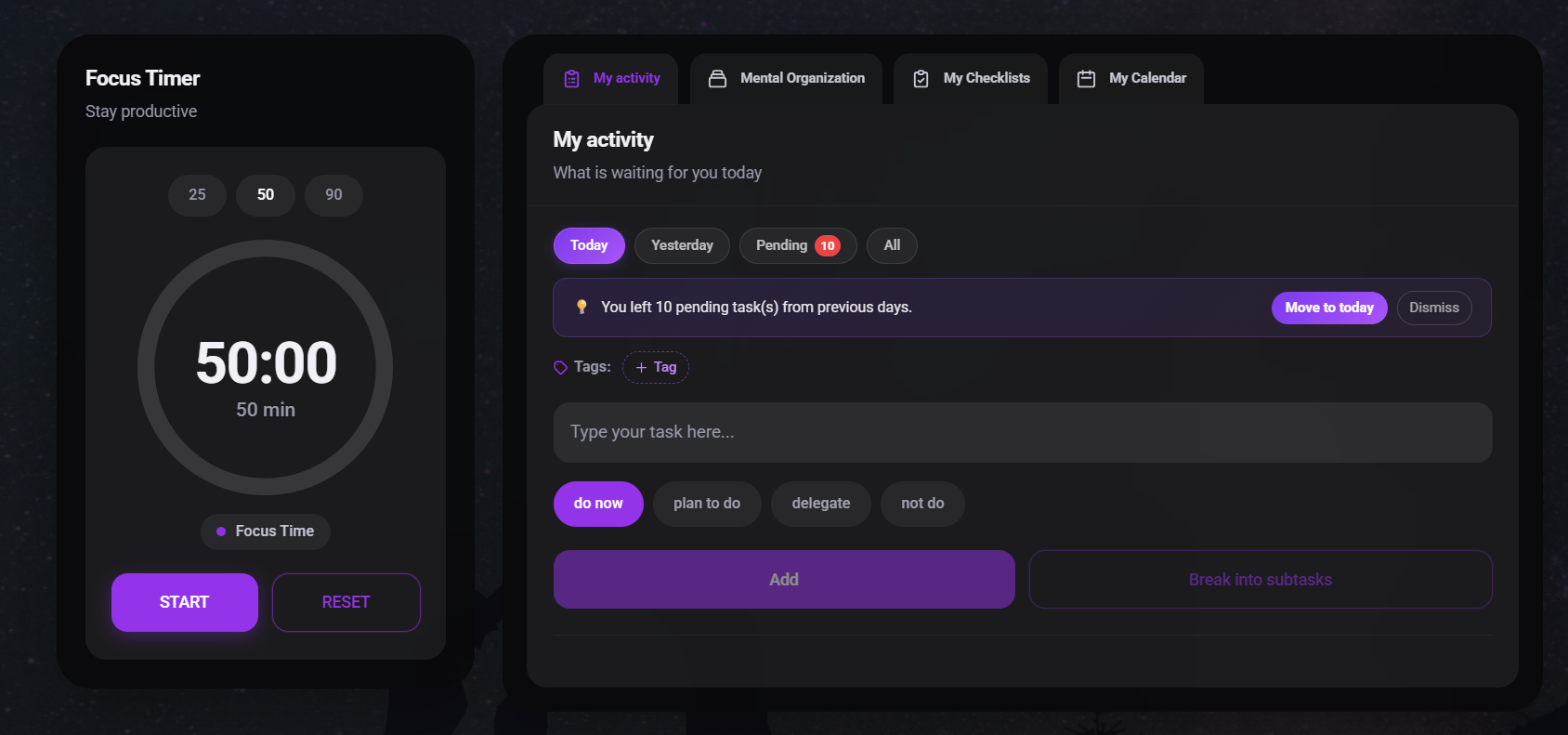
Software timers integrate directly with task management systems, offering features like task prioritization, checklists, and time analytics. Focus Organize combines Pomodoro timing with the Eisenhower Matrix and comprehensive task tracking.
How Focus Organize Enhances Pomodoro Timers
Focus Organize provides tools that physical timers cannot:
- Task Prioritization: Link tasks to specific Pomodoro sessions.
- Checklists: Break projects into actionable steps.
- Time Analytics: Track peak focus hours and project allocation.
Best Suited For: Professionals managing complex workflows and multi-project backlogs.
Decision Flow: Which Timer Type Should You Buy?
Choosing the right Pomodoro timer depends on your focus style and work environment:
- ADHD or Time Blindness: Visual Disappearing Disc Timer (Time Timer MOD).
- Quiet Spaces: Gravity Cube with Silent LED/Vibration (TickTime Pro).
- Tactile Feedback: Mechanical Rotary Timer (Classic Tomato).
- Precision Tracking: Digital Rotary LED Timer (KWANWA).
How to Maximize Your Pomodoro Timer Experience
- Set Clear Goals: Before starting a session, define what you aim to achieve.
- Eliminate Distractions: Silence notifications and create a focused workspace.
- Pair with Task Management: Use Focus Organize to prioritize tasks and track progress.
- Review Analytics: Analyze historical data to optimize your focus cycles.
Frequently Asked Questions
Which Pomodoro timer is best for ADHD?
Visual disappearing disc timers like the Time Timer MOD are ideal for ADHD because they externalize time, making it easier to process.
Can I use a Pomodoro timer on my phone?
Yes, software-based timers like Focus Organize offer mobile app compatibility for on-the-go productivity.
How long should a Pomodoro session be?
The standard Pomodoro interval is 25 minutes, followed by a 5-minute break. Adjust based on your focus capacity.
What’s the difference between mechanical and digital timers?
Mechanical timers use clockwork springs and are battery-free, while digital timers offer precise second-by-second tracking with customizable alarms.
Can I use Focus Organize with a physical timer?
Yes, many users combine Focus Organize for task management with a physical timer for focused execution.
Final Thoughts
The Pomodoro Technique remains a versatile productivity tool in 2026, with timer formats catering to diverse focus styles and environments. Whether you prefer tactile mechanical timers, silent gravity cubes, or all-in-one software suites, choosing the right format can elevate your productivity.
For seamless task management and advanced analytics, explore Focus Organize today.
Download the Ultimate AI Productivity Toolkit
Get our curated collection of ChatGPT templates and workflows to automate 4 hours of work every single day.