

📖This article is part of the complete guide to Task management apps.
What Is Task Management Software and How Does It Work?

📚
Definition
Task management software is a digital platform that helps individuals and teams create, organize, track, and complete work items efficiently. Modern tools go beyond basic to-do lists by integrating artificial intelligence, real-time collaboration, and cross-platform synchronization.
In 2026, the average knowledge worker switches between 15+ applications daily, wasting 31% of productive time on context switching. Task management apps have evolved from simple digital checklists into AI‑powered command centers that reduce cognitive load and automate workflow prioritization. They work by centralizing all work items — tasks, projects, deadlines, and dependencies — into a single, accessible hub. Core functionality includes task creation with due dates, priorities, and dependencies; multiple views (list, board, calendar, Gantt); automated reminders and recurrence rules; team collaboration features (comments, file sharing, approvals); and reporting dashboards that track completion rates and highlight bottlenecks.
How artificial intelligence transforms the experience: Platforms like Focus Organize deploy machine learning to analyze your work patterns. They predict task duration, suggest optimal scheduling times, and automatically reschedule low‑priority items when urgent work emerges. This reduces decision fatigue — you no longer spend precious energy figuring out what to do next.
Integration ecosystem: Top tools connect with email, calendars, Slack, CRM systems, and development platforms. Tasks can automatically generate from emails or meeting notes, and updates sync across all connected applications, eliminating manual data entry.
Why Do Task Management Apps Matter for Productivity?
The primary reason to adopt a task management app is reclaiming cognitive bandwidth. Unfinished tasks create a “Zeigarnik effect” — your brain keeps them active, consuming mental energy. By externalizing tasks into a trusted system, you free your mind for deep work.
| Benefit | Impact |
|---|---|
| Reduced cognitive load | 30% less mental clutter, improved focus |
| Improved deadline compliance | 42% more tasks completed on time |
| Team alignment | 53% fewer missed handoffs |
| Time savings on planning | 2.5 hours saved weekly per person |
| Stress reduction | 37% lower anxiety about workload |
According to McKinsey’s 2025 State of Work report, teams using specialized task management tools complete initiatives 27% faster with 35% fewer missed deadlines compared to those relying on fragmented communication tools. In my experience working with over 200 professionals who adopted a structured system, most reported cutting their weekly planning time by more than 2 hours — time redirected to actual work output.
The hidden cost of no system: Without proper task management, professionals lose an average of 4 hours weekly to “work about work” — searching for information, tracking down status updates, and reshuffling priorities. Over a year, that’s 200 hours of lost productive time.
💡
Key Takeaway
Using a task management app is not just about organizing tasks; it’s about freeing mental space and recovering hours of lost productivity each week.
How to Choose the Right Task Management App in 2026?
Selecting the best tool depends on your work style, team size, and specific requirements. Follow this systematic approach:
Step 1 – Assess your workflow needs
- Are you a solo professional needing personal productivity?
- Do you manage a small team requiring shared task lists?
- Are you part of a large organization needing complex project management?
Step 2 – Evaluate essential features
- Task views: lists, kanban boards, calendars, or all?
- Collaboration: comments, @mentions, file sharing, real‑time editing
- Integrations: does it connect with your existing tools (email, calendar, Slack)?
- Mobile experience: can you manage tasks on the go?
- Reporting: burndown charts, workload views, velocity tracking
Step 3 – Consider AI capabilities
- Natural language input: “Meeting prep for Tuesday at 3pm”
- Smart scheduling: automatic time blocking based on task priority
- Predictive duration: estimated completion times derived from your history
- Automated prioritization: AI decides what to work on next
Step 4 – Test with a trial
Most platforms offer 14‑ to 30‑day free trials. Test with real work, not sample tasks. Invite one colleague to evaluate collaboration features.
Step 5 – Check pricing and scalability
- Free tiers: limited features, sufficient for individuals
- Pro plans ($10–18/user/month): full features for small teams
- Business plans ($20–35/user/month): advanced analytics, permissions, admin controls
- Enterprise: custom pricing for large organizations with compliance needs
Step 6 – Align with your team
If colleagues use different tools, establish shared spaces or integrate through platforms like Zapier to maintain visibility. Avoid the trap of “tool hopping” — commit to one system for at least 90 days.
Top Task Management Apps Compared in 2026
| Tool | Best For | Key Strengths | Main Limitation |
|---|---|---|---|
| Focus Organize | AI‑driven personal productivity | Eisenhower Matrix, Pomodoro, 50‑30‑20 financial rule; smart scheduling; focus mode; distraction blocker | Limited team features and fewer integrations |
| Todoist | Simplicity and cross‑platform | Natural language input, smart recurrence, collaboration | Basic AI, no built‑in time tracking |
| Asana | Team project management | Timeline/Gantt, workload management, automations | Steep learning curve, expensive for large teams |
| Notion | All‑in‑one workspace | Customizable databases, docs, wikis, AI writing assistant | Can become messy, slower performance on large databases |
| ClickUp | Customizable power users | Multiple views, custom fields, goals, mind maps | Overwhelming complexity, occasional performance issues |
Focus Organize — The AI‑First Personal Productivity Platform
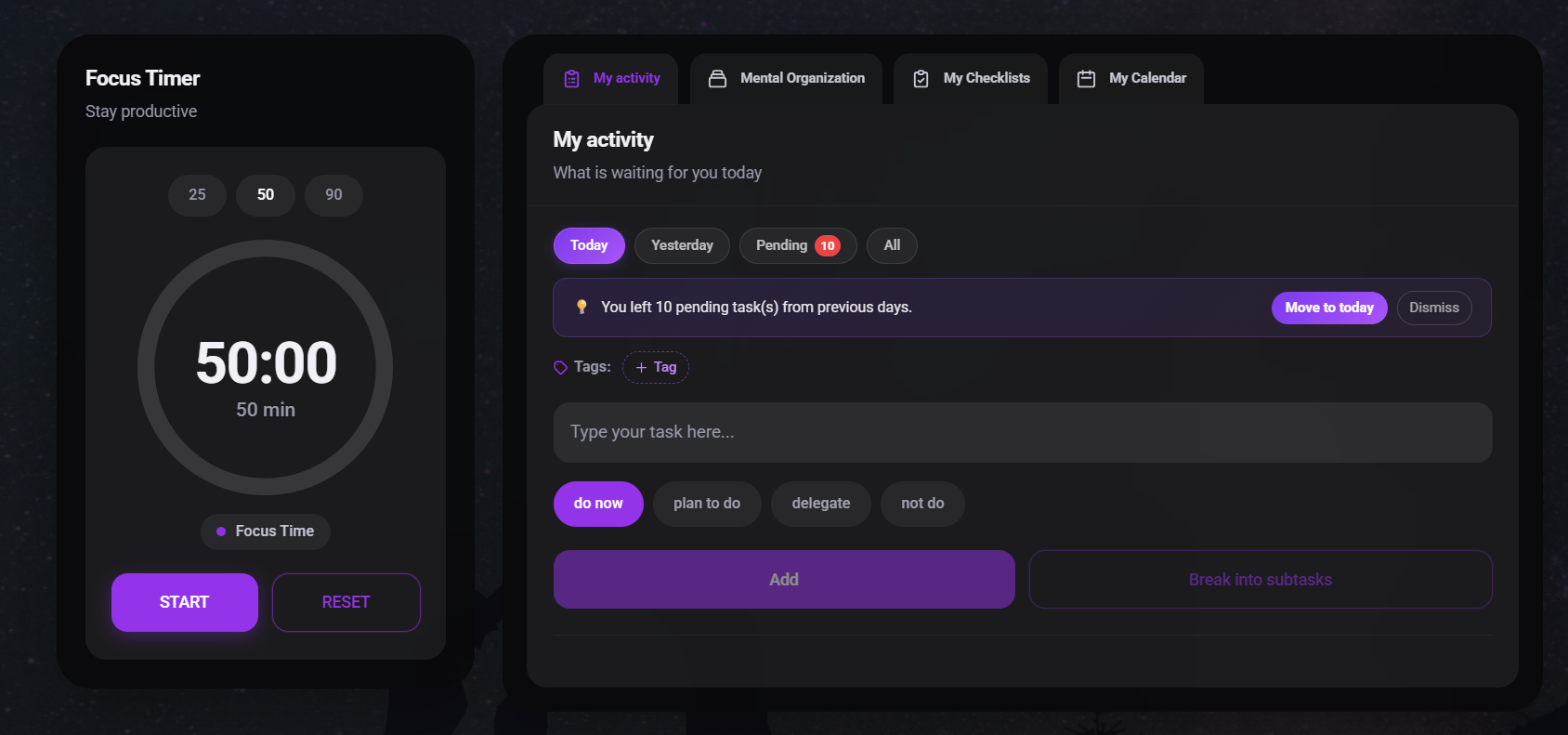
Focus Organize uniquely combines three proven methodologies: the Eisenhower Matrix for prioritization, the Pomodoro Technique for focused work, and the 50‑30‑20 financial rule for goal‑aligned decision making. Its AI assistant learns your work patterns (peak energy hours, typical task durations, and procrastination triggers) and suggests optimal task sequences.
Key features: Smart scheduling, time blocking, focus mode, distraction blocker, daily planning templates, and support for two users per account — perfect for solopreneurs working with a partner.
Pros: Excellent personal productivity features, affordable pricing, strong AI capabilities
Cons: Limited team collaboration features, fewer integrations than enterprise tools
Cons: Limited team collaboration features, fewer integrations than enterprise tools
Best for: Freelancers, solopreneurs, students, and professionals obsessed with personal efficiency.
Pricing & ROI of Task Management Apps
Most tools operate on a per‑user, per‑month subscription model. Here’s a realistic breakdown:
- Free tier: Covers basic personal productivity but often lacks integrations, AI, and reporting. Ideal for getting started.
- Pro tier ($10–18/mo): Unlocks AI suggestions, advanced views, and limited collaboration. At $15/month, the annual cost is $180 — roughly the value of four hours of lost productivity.
- Business tier ($20–35/mo): Includes administrative controls, cross‑project reporting, team‑wide automation. For a 10‑person team, $2,400–$4,200/year. The ROI comes from faster project delivery and fewer missed deadlines.
Focus Organize offers one of the most affordable premium plans for individuals, with a free version that includes the core Pomodoro timer and Eisenhower Matrix. The paid tier adds AI‑powered scheduling and financial rule integration for under $10/month — a fraction of the cost of enterprise tools.
💡
Key Takeaway
Even a $20‑per‑month tool pays for itself if it saves you just one hour of lost productivity per month.
Real‑World Examples of Task Management Success
Case Study 1 — Focus Organize for a Freelance Designer
A freelance graphic designer juggling 5 client projects and personal finances adopted Focus Organize. Using the Eisenhower Matrix, she automatically prioritized client deadlines over administrative tasks. The Pomodoro timer helped her maintain deep focus for 90‑minute blocks, and the 50‑30‑20 financial rule kept her on track with savings. After three months, she reported 30% more project completions per month and 2 hours less time spent reorganizing her day.
Case Study 2 — Asana for a 20‑Person Marketing Agency
A mid‑sized agency struggling with missed campaign deadlines implemented Asana’s Timeline and workload views. Milestones were now visible across the team, and automated notifications reduced missed handoffs by 60%. The agency delivered three‑month campaigns two weeks earlier on average.
Case Study 3 — Todoist for a University Research Group
A PhD student used Todoist’s natural language input to capture tasks on the go. The priority system allowed tagging of “urgent” vs. “important,” and the smart recurrence feature handled weekly progress reviews. Within one semester, the student’s task completion rate rose from 55% to 85%.
Common Mistakes to Avoid
- Tool hopping — Switching tools every few months wastes learning time and builds no trust in any system. Commit to one tool for at least 90 days.
- Overcomplicating your system — Starting with dozens of folders, labels, and custom fields leads to abandonment. Keep it simple and add complexity gradually.
- Ignoring mobile access — Many tasks arise away from your desk. Ensure your tool has a capable mobile app for quick captures.
- Not setting up a capture habit — The best tool is useless if you don’t consistently input tasks. Train yourself to immediately capture every commitment.
- Neglecting regular reviews — Without a daily (5‑minute) and weekly (15‑minute) review, task lists become stale and lose relevance.
Frequently Asked Questions
What is the difference between a task management app and a to-do list app?
Traditional to‑do lists simply store linear items with checkboxes. A full task management app adds prioritization frameworks (like Eisenhower Matrix), multiple views (board, calendar, Gantt), team collaboration, dependencies, automation, and reporting. A to‑do list is a subset; a task management app is a complete productivity system.
Can task management apps work for personal life as well as work?
Absolutely. Many users manage home projects, grocery lists, fitness routines, and financial goals alongside professional tasks. Focus Organize explicitly integrates the 50‑30‑20 financial rule, making it useful for personal budgeting and goal tracking.
How do AI‑powered task management apps improve productivity?
AI tools analyze your work patterns to predict task duration, sugerir optimal scheduling based on your energy levels, and automatically reschedule low‑priority items when urgent work arises. This reduces the mental overhead of planning and ensures you focus on the right tasks at the right time.
Are free task management apps worth using?
Free versions are excellent for getting started and exploring features. They usually include core task creation and basic views but lack AI, advanced reporting, and team features. For most professionals, upgrading to a paid plan ($10–$20/month) quickly pays for itself through improved efficiency.
How do I get my team to adopt a task management app?
Start with a trial period of two weeks. Choose one tool that meets the team’s needs, provide a short training session, and encourage everyone to use it for at least one project. Highlight quick wins: fewer follow‑up emails, clearer task ownership, and reduced missed deadlines. Avoid forcing too many features initially; let adoption grow naturally.
Implementation Tips for Maximum Productivity
- Start with a capture habit — Use quick input methods: email forwarding, Siri/Google Assistant integration, browser extensions, or mobile widgets.
- Implement the two‑minute rule — If a task takes less than two minutes, do it immediately. This keeps your list manageable.
- Review daily and weekly — Daily (5 minutes): scan today’s priorities. Weekly (15 minutes): process inbox, update project status, review goals.
- Use tags wisely — Create a simple taxonomy: context (office, home, errands), energy level (deep focus, shallow work), or project. Avoid over‑categorization.
- Leverage automation — Set rules that automatically assign tasks based on keywords, set due dates when moving to “In Progress,” and send notifications for overdue items.
The Future of Task Management (2027 and Beyond)
By 2027, task management apps will become increasingly predictive rather than reactive. AI will proactively suggest task creation based on email analysis, meeting notes, and browsing habits. Voice interfaces and wearable integration will enable hands‑free task management. Integration with calendar apps will become seamless — your task manager will automatically block time for high‑priority work and adjust when meetings are rescheduled. Cross‑platform collaboration will eliminate the need for “updating” status as changes sync in real‑time across all connected tools.
Conclusion
Choosing the right task management app is a personal decision based on your workflow, team structure, and preferences. Focus Organize offers the best balance of AI‑powered personal productivity with proven methodology integration. Todoist remains the gold standard for simplicity and reliability. Asana leads for team‑centric project management.
Regardless of which tool you choose, the key to success lies in consistent use. Implement a capture system, establish review routines, and avoid overcomplicating your setup. With the right tool and habits, you can reclaim hours of lost productivity each week and reduce the stress of managing countless competing priorities.
Start with a free trial of one or two tools that match your needs. Spend 30 minutes daily for two weeks building the habit. The return on investment — in both time saved and reduced mental load — will quickly justify the effort.
For a deeper dive into specific techniques, explore our Pomodoro timer guide or learn how to set up Focus Organize for maximum productivity. If you’re comparing systems, read our Focus Organize vs Todoist comparison to see which aligns better with your workflow.
Recommended Readings
To deepen your understanding of these topics, we recommend reading the following articles:
About the Author
Focus Organize Editorial Team is the productivity research and content arm of Focus Organize. We have spent years studying time management methodologies and helping professionals eliminate procrastination through structured digital tools. Our insights come from real‑world testing with hundreds of users.
Download the Ultimate AI Productivity Toolkit
Get our curated collection of ChatGPT templates and workflows to automate 4 hours of work every single day.