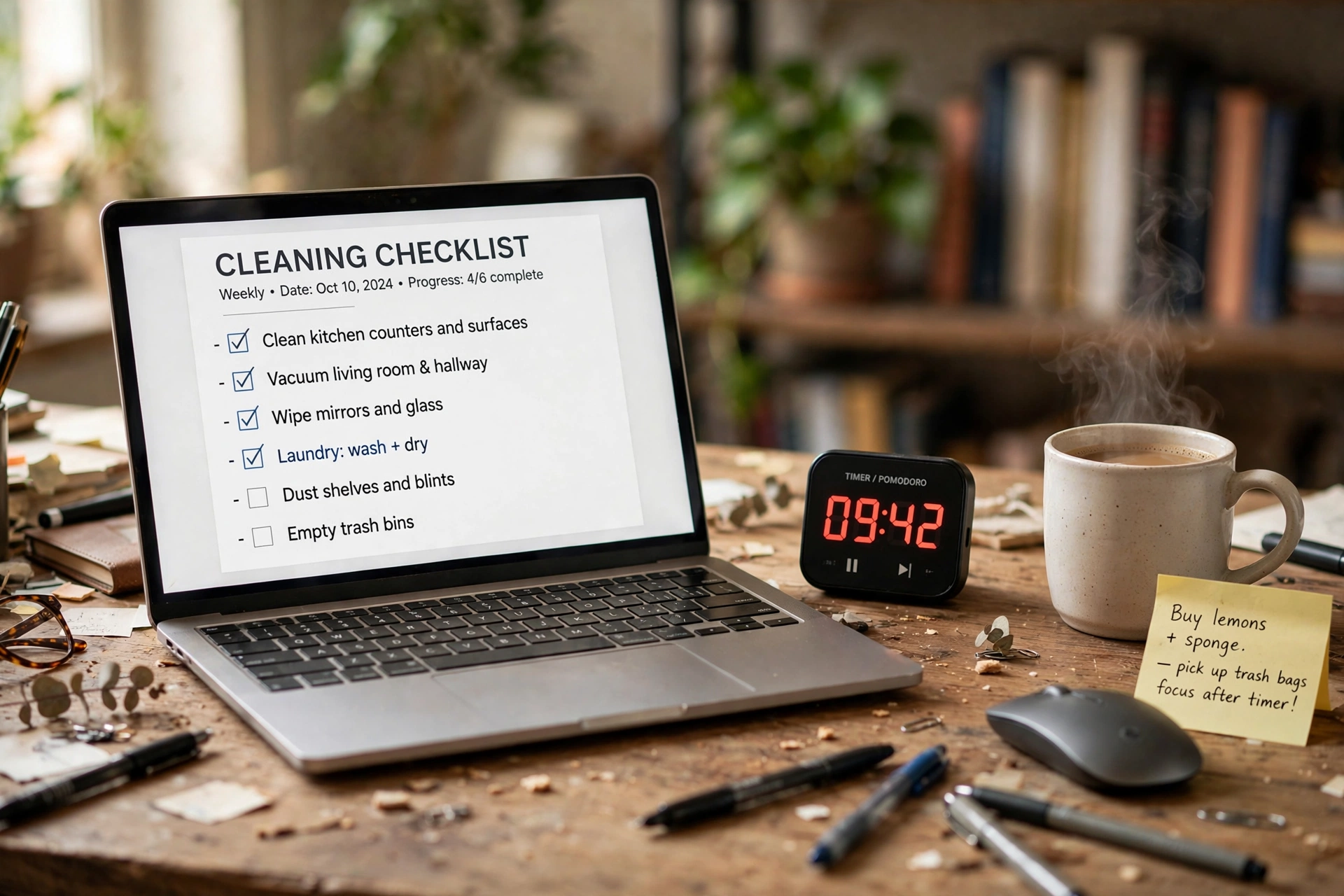
When Should You Replace Your Cleaning Checklist Template?
Maintaining a pristine environment requires a system that evolves alongside your space. You should replace your cleaning checklist template the moment you notice a "performance gap"—when the actual state of your environment no longer matches the checkboxes on your page. This typically happens during three specific triggers: a significant change in physical layout, a shift in staffing or family dynamics, or when the current process consistently fails to produce the desired cleanliness standard despite being "completed."
In my experience working with high-performance individuals, the biggest mistake is treating a checklist as a static document. I've seen dozens of clients diligently check off every box on a template they downloaded three years ago, yet their homes or offices still feel cluttered. The failure isn't in the execution; it's in the tool. When the template no longer reflects the reality of your daily frictions, it becomes a psychological burden rather than a productivity aid. For those looking to optimize their entire workflow, understanding Why You Need the Best to do List App for Productivity is the first step in moving from rigid templates to dynamic systems.

Understanding the Lifecycle of a Cleaning System
A cleaning system is not a "set it and forget it" asset. To maintain a high standard of hygiene and organization, you must treat your documentation as a living organism. Most people cling to a cleaning checklist template long after it has lost its utility because they confuse "having a list" with "having a process."
📚
Definition
A Cleaning Checklist Template is a structured framework—digital or physical—designed to standardize cleaning tasks, ensure consistency across different areas of a facility, and provide a verifiable record of completed maintenance.
The lifecycle of these templates generally follows a curve of diminishing returns. Initially, a new template provides a surge of productivity because it removes decision fatigue. However, as the environment changes—perhaps you added new high-maintenance surfaces like marble or installed a complex HVAC system—the old list creates blind spots. If you are ignoring 20% of your home's needs because they aren't on the list, your system is effectively broken.
According to research by the Harvard Business Review on operational excellence, standardization is only effective when it is paired with a continuous feedback loop. Without a mechanism to update the "standard," the process becomes a ritual of mindless ticking rather than an actual improvement of quality. This is why the "When" of replacement is tied to the "What" of your current environment. If your operational needs have shifted, your documentation must shift with them.
Why Template Obsolescence Impacts Your Bottom Line
Ignoring the need to update your cleaning protocols isn't just about a little bit of dust; it has real-world financial and psychological implications. When a cleaning checklist template becomes obsolete, it leads to "invisible decay"—the gradual buildup of grime in areas the template forgot, which eventually requires expensive professional remediation rather than simple daily maintenance.
From a business perspective, the cost of inefficiency is staggering. According to a report by Gartner on operational efficiency, organizations that fail to update their internal process documentation see a significant drop in employee engagement and a rise in "shadow work"—tasks that are being done but aren't tracked, leading to burnout and unpredictable timelines. In a residential setting, this manifests as "decision fatigue." When you look at a checklist that doesn't feel right, your brain spends more energy questioning the list than actually cleaning.
The risk of not replacing an outdated template includes:
- Asset Depreciation: Failure to clean specialized equipment according to current manufacturer guidelines (which change over time) leads to shorter equipment lifespans.
- Health Risks: Outdated lists often miss new allergen sources or fail to incorporate updated sanitation standards, especially in post-pandemic environments.
- Mental Friction: The psychological gap between "the list is done" and "the house is still dirty" creates a sense of failure and procrastination.
Now here's where it gets interesting: most people think the solution is just "adding more items" to the old list. But adding to a flawed foundation only increases the friction. Instead, you need to evaluate if the entire framework is still valid. If you've moved from a 1-bedroom apartment to a 3-bedroom house, you don't need a longer list; you need a new system entirely. For a deeper look at how to transition, check out the Advantages of Best to do List App (2026 Overview).
How to Execute a Template Transition Step-by-Step
Replacing your cleaning checklist template should be a strategic move, not a random act of frustration. If you simply swap one PDF for another, you'll be back in the same position in six months. The goal is to move toward a system that is agile.
First, perform a "Gap Analysis." Spend one week ignoring your current checklist and instead write down every single thing that actually needs cleaning as you encounter it. Compare this "Real World List" to your "Template List." Any item on the Real World List that is missing from the template is a red flag that your system is obsolete.
Second, categorize tasks by frequency. Most templates fail because they mix "daily" tasks with "quarterly" tasks in a way that feels overwhelming. Use the Eisenhower Matrix approach: separate the urgent (sanitizing counters) from the important but non-urgent (cleaning baseboards). This is where a dedicated platform like Focus Organize becomes invaluable. Instead of a static piece of paper, you can use a dynamic system that triggers reminders based on time, not just a manual checkmark.
Third, implement a "Beta Phase." Don't commit to a new template forever. Try a new version for 14 days. At the end of the second week, ask yourself: "Did I skip any items because they felt redundant?" and "Did I notice any areas that are still dirty despite the list?"
💡
Key Takeaway
The most effective cleaning systems are those that are audited monthly. A template should be viewed as a hypothesis of how to keep a space clean; the actual cleaning process is the experiment that proves or disproves that hypothesis.

If you find that the manual process of updating lists is too tedious, it might be time to consider When to Replace Your Best to do List App: Top Signs to ensure your digital infrastructure supports your physical goals.
Comparing Cleaning Management Approaches
When deciding when to replace your template, you are usually choosing between three levels of sophistication. Most people stay at Level 1 for too long, leading to the very frustration that prompts them to search for a new template.
| Approach | Method | Pros | Cons | Best For |
|---|---|---|---|---|
| The Traditionalist | Paper-based / Static PDF | Low tech, easy to print | Hard to update, easily lost, no reminders | Small, unchanging spaces |
| The Generic Digital | Basic Notes App / Spreadsheet | Searchable, easy to edit | Lacks structure, high manual input, no "smart" triggers | People with very simple routines |
| The Modern System | Focus Organize / Dedicated Productivity App | Dynamic, collaborative, time-tracked, automated | Requires initial setup time | Busy households, professionals, businesses |
The transition from a paper list to a modern system isn't just about moving pixels; it's about changing the logic of the work. In the traditional approach, the list is the boss. In the modern approach, you are the architect, and the tool is the executor. For those wondering if the investment in a digital system is worth it, our analysis on Is Best to do List App Worth It? (2026 Overview) provides a detailed cost-benefit breakdown.
Common Myths About Cleaning Templates
There is a lot of misinformation regarding "perfect" cleaning schedules. Most guides get this wrong by suggesting that there is one "ultimate" template you can download and use forever. This is a fallacy.
Myth 1: "I just need a more detailed template."
The correction: Detail is not the same as effectiveness. In fact, overly detailed templates often lead to "checklist fatigue," where the user begins to blindly check boxes just to finish the list, regardless of whether the task was actually performed. The solution is not more detail, but better categorization.
Myth 2: "My template is fine; I'm just not disciplined enough to follow it."
The correction: This is rarely a discipline problem and usually a design problem. If you consistently skip the "dusting the ceiling fans" task, it's not because you are lazy; it's because the task is poorly placed in the sequence of your workflow. If the friction is too high, the template is the problem, not the person.
Myth 3: "Professional templates are always better than DIY lists."
The correction: A professional template is a generic average. It doesn't know that you have a dog that sheds excessively in the winter or that your kitchen has an unusual layout. A customized list, even a simple one, will always outperform a "professional" template that doesn't fit your specific environment. This is why Understanding Best to do List App (2026 Overview) is so helpful—it teaches you how to build a system around your life, not a template's life.
Frequently Asked Questions
How often should I realistically update my cleaning checklist template?
You should perform a light audit every quarter and a deep overhaul once a year. Seasonal changes—such as spring cleaning or winterizing a home—naturally alter the types of debris and maintenance required. For example, in the summer, you may need more frequent filter changes for AC units, while winter requires more attention to entryway mud and salt. If you wait a full year, you lose months of efficiency. A quarterly review allows you to adjust for the "micro-seasons" of your life, such as the start of a school year or a change in work-from-home status.
What are the immediate red flags that my current template is obsolete?
The most prominent red flag is "phantom checking," where you find yourself checking boxes for tasks that no longer seem necessary or a task that takes 5 minutes but is listed as a "deep clean" item. Another sign is when you consistently notice dirt in an area that isn't on the list. If your baseboards are filthy but your template focuses heavily on polishing silverware you rarely use, the logic of the template has diverged from the needs of the room. This is a clear signal that the system is no longer serving its primary purpose.
Can I just add new tasks to my old cleaning checklist template?
While adding tasks is a quick fix, it often leads to "template bloat." When you keep adding to an old list, the sequence of tasks becomes illogical. You might find yourself walking back and forth across the house because the new tasks weren't integrated into a logical path. Instead of adding, you should "prune and replant." Remove everything that hasn't been useful in the last 30 days and reorganize the remaining tasks based on the physical flow of your space to minimize wasted movement.
Is a digital cleaning checklist better than a physical one?
Yes, primarily because of the "friction of update." A physical list requires you to rewrite the entire document or use messy erasers and white-out to make changes. A digital system, particularly through Focus Organize, allows you to pivot instantly. Digital lists also support collaboration; for instance, you can assign specific tasks to different family members or employees in real-time. This transparency reduces the "mental load" on the primary organizer and ensures a more equitable distribution of labor.
How do I know if I need a different type of template entirely?
You need a new type of template when your "cleaning persona" changes. If you've moved from "maintenance mode" (keeping things tidy) to "restoration mode" (deep cleaning a neglected space), a daily checklist will fail you. You need a project-based template. Similarly, if you are scaling a business and moving from a single-room office to a multi-floor facility, you must move from a "Task List" to a "Zonal Management" system. Check our guide on Types of Best to do List App (2026 Overview) to see which structure fits your current scale.
Final Thoughts on the Cleaning Checklist Template
The moment you stop questioning your cleaning checklist template is the moment it starts failing you. Efficiency in any environment is the result of a constant cycle of implementation, observation, and refinement. If your current system feels like a chore rather than a tool, it is time to replace it.
Whether you are managing a corporate office or a busy household, the goal is to reduce the cognitive load of maintenance. Stop fighting with a static document that doesn't understand your space. Transition to a dynamic approach where your tasks are organized by priority, frequency, and physical location.
If you're ready to stop the cycle of obsolete templates and start a system of high performance, explore Focus Organize. By combining a Pomodoro Timer for focused bursts of cleaning with an Eisenhower Matrix for task prioritization, you can transform cleaning from a stressful obligation into a streamlined process. For those who want to further optimize their time, we recommend looking into The 5 Types of Pomodoro Timers for Optimal Focus to maximize every cleaning session.
Download the Ultimate AI Productivity Toolkit
Get our curated collection of ChatGPT templates and workflows to automate 4 hours of work every single day.