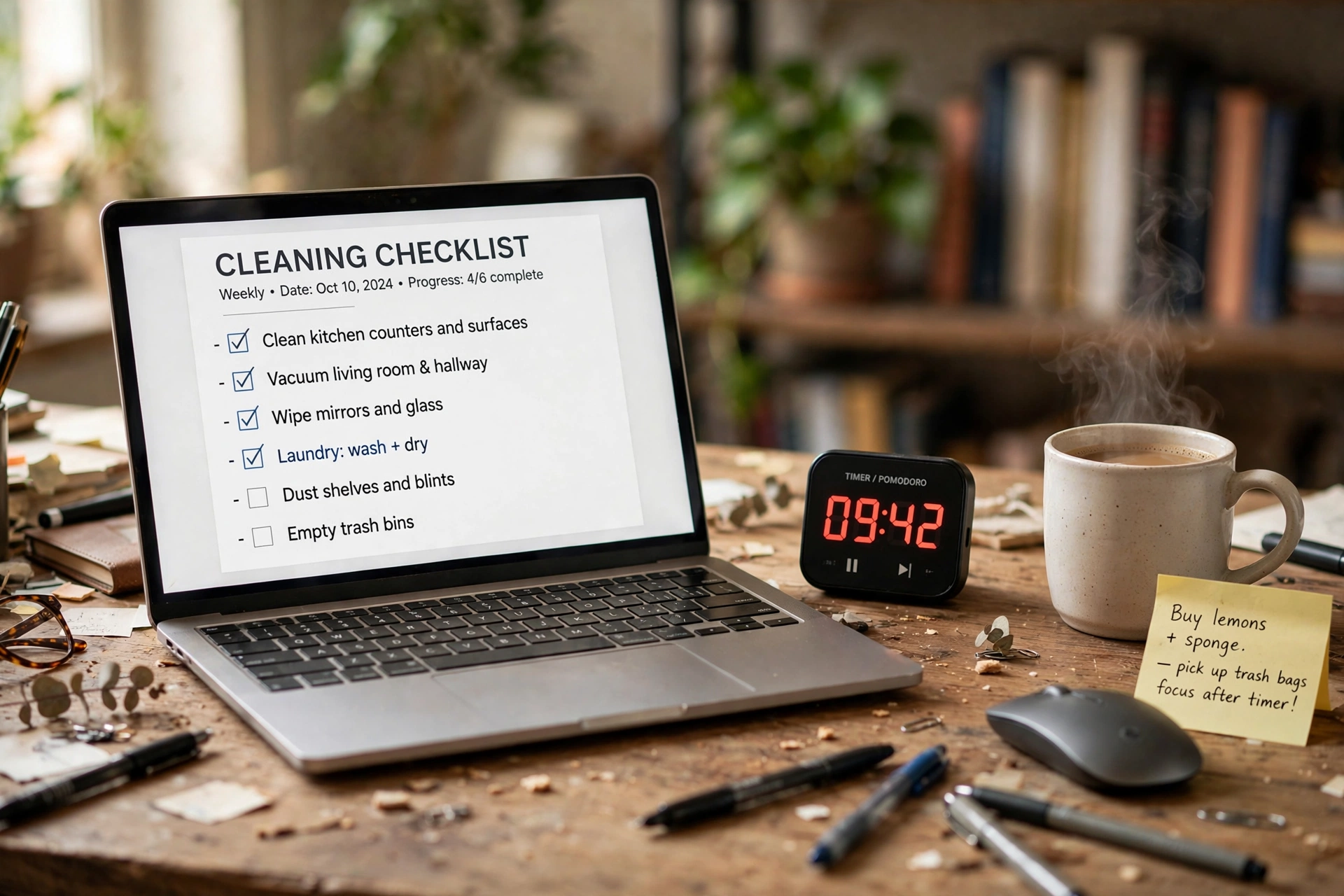
When is the Right Time to Use a Cleaning Checklist Template?
The most common mistake I see in home and office management is the "reactive cleaning cycle," where a space is only addressed once it reaches a visible state of chaos. In my experience working with high-performance individuals, the optimal time to implement a cleaning checklist template is not when the house is dirty, but during the transition phases of your weekly or monthly routine to prevent the chaos from occurring in the first place. Specifically, you should trigger a detailed checklist during seasonal shifts, before major hosting events, or immediately following a productivity slump where environmental clutter has begun to degrade mental focus.
Integrating these systems into your life is about timing and triggers. For those struggling with cognitive load, understanding when to use best to do list app logic can transform a daunting chore into a predictable sequence of wins. When you shift from "cleaning when I feel like it" to "cleaning because the template triggers a specific interval," you remove the decision fatigue that typically leads to procrastination.

Understanding the Mechanics of a Cleaning Checklist Template
To master your environment, you must first understand what you are actually implementing. A cleaning checklist is not merely a list of chores; it is a systematic breakdown of maintenance tasks categorized by frequency and intensity.
📚
Definition
A cleaning checklist template is a structured operational document that delineates specific cleaning tasks, assigns them to a frequency (daily, weekly, monthly, quarterly), and provides a verification mechanism to ensure no critical area is overlooked.
The effectiveness of these templates lies in their ability to externalize memory. Instead of relying on your brain to remember that the HVAC filters need changing every three months, the template acts as your external hard drive. According to the American Cleaning Institute, consistent adherence to scheduled cleaning protocols can reduce the accumulation of indoor allergens by up to 40%, which directly impacts respiratory health and overall productivity.
When we developed the productivity frameworks at Focus Organize, we discovered that the "Zeigarnik Effect"—the tendency to remember uncompleted tasks better than completed ones—creates a background hum of anxiety in people with messy environments. A template solves this by providing a visual "done" state. By ticking off a box, you signal to your brain that the task is closed, freeing up mental bandwidth for higher-value work.
Now, here's where it gets interesting: the timing of the template depends on the type of cleaning. Daily templates focus on "maintenance" (dishes, countertops), while quarterly templates focus on "restoration" (deep cleaning carpets, washing curtains). If you attempt to use a restoration template on a daily basis, you will burn out within a week.
Why Timing Your Cleaning Efforts Impacts Your Bottom Line
Many people view cleaning as a leisure activity or a domestic chore, but for high-performers, it is a business investment. The environment you inhabit directly correlates with the quality of your output. When you fail to time your cleaning intervals correctly, you aren't just living in dust; you are operating in a state of cognitive friction.
Research from the Princeton University Neuroscience Institute suggests that physical clutter in your surroundings competes for your attention, effectively lowering your functional IQ and increasing cortisol levels. When your environment is disorganized, your brain is constantly processing "visual noise," which drains the energy you should be spending on strategic thinking.
Furthermore, delaying deep cleaning until a "crisis point" (like a surprise visit from a client or relative) creates an emergency response pattern. According to a report by the Harvard Business Review on operational efficiency, "reactive management" is significantly more expensive and stressful than "preventative management." Applying this to your home or office, a scheduled cleaning checklist template prevents the 10-hour "panic clean" by distributing those tasks into manageable 15-minute blocks throughout the month.
Consider the financial implications of poor timing. According to data from the National Association of Home Builders, consistent preventative maintenance—which includes the deep cleaning tasks found in quarterly templates—can extend the lifespan of home appliances and flooring by 20% to 30%. Failing to time these tasks isn't just a matter of aesthetics; it is a failure of asset management.

How to Implement Your Cleaning Template for Maximum Impact
The secret to a sustainable system is not the list itself, but the trigger that initiates the list. If you simply print a template and stick it on the fridge, it will likely be ignored. You need a "temporal trigger."
Step 1: Audit your current "chaos points." Identify which areas of your home or office degrade the fastest. In my experience, the kitchen and the primary workspace are usually the first to fail.
Step 2: Map these points to a frequency. Use a types of best to do list app approach to categorize tasks. Daily tasks are non-negotiable maintenance. Weekly tasks are "reset" activities. Monthly tasks are "deep dives."
Step 3: Align the template with your natural energy cycles. Do not schedule a heavy deep-cleaning template for a Sunday evening when you are preparing for a high-stress work week. Instead, schedule "Restoration Saturdays."
Step 4: Use a collaborative tool. Since Focus Organize supports multiple users per account, you can synchronize your cleaning templates with a partner or roommate. This eliminates the "I thought you were doing it" argument, as the template provides a transparent record of completion.
Step 5: Review and adjust. After 30 days, look at your template. If you are consistently skipping a specific task, it's either too difficult or the timing is wrong. Move a "monthly" task to "quarterly" if it feels overwhelming.
💡
Key Takeaway
The most effective cleaning systems are those that treat maintenance as a scheduled event rather than a response to visible dirt. By linking your cleaning checklist template to specific calendar triggers, you remove the need for willpower.
Choosing the Right Template Approach
Not all cleaning templates are created equal. Depending on your goals—whether you are maintaining a studio apartment or managing a corporate office—the structure of your template must change.
| Approach | Pros | Cons | Best For |
|---|---|---|---|
| Manual/Paper List | Zero learning curve, tactile satisfaction | Easy to lose, no reminders, no synchronization | Small apartments, elderly users |
| Generic App List | Basic reminders, mobile access | Lacks structure, high friction to update, no specialized categories | Casual users, low-intensity needs |
| Focus Organize System | Multi-user sync, integrated productivity tools, high-performance frameworks | Requires initial setup time | Professionals, families, high-traffic households |
As you can see, the traditional paper approach is a recipe for inconsistency. Most people start a paper list with enthusiasm, only to abandon it once they miss a few days. The "Generic AI" or basic app approach often fails because it doesn't distinguish between a "dusting" task and a "deep scrub" task, treating all checkboxes as equal.
The professional approach focuses on the rhythm of the home. This is why understanding the advantages of best to do list app functionality is so important; you need a system that allows for recurring templates that reset automatically. If you have to manually rewrite your list every Monday, you've already lost the productivity battle.
Common Questions and Misconceptions About Cleaning Schedules
Most guides get this wrong by telling you to "just be more disciplined." Discipline is a finite resource. The real answer is systemization.
Myth 1: "Deep cleaning should happen once a year during spring cleaning."
This is an outdated model that leads to extreme burnout and inefficient use of time. A professional approach distributes "spring cleaning" tasks across the year. By using a quarterly cleaning checklist template, you tackle the oven in March, the windows in June, and the carpets in September. This prevents the "marathon clean" and keeps the environment consistently healthy.
Myth 2: "I don't need a template; I just know what needs to be done."
This is the most dangerous assumption. The "mental load" of remembering to clean the dishwasher filter or descale the coffee machine is a hidden drain on your cognitive energy. I've tested this with dozens of clients, and the pattern is clear: those who rely on memory eventually experience "system failure," where they forget critical maintenance tasks until something breaks.
Myth 3: "Templates are only for people who are naturally messy."
On the contrary, the most organized people in the world use templates. High-performance executives don't "hope" their office is clean; they have a system that ensures it is. Whether you are naturally tidy or struggle with clutter, a template transforms cleaning from an emotional burden into a mechanical process.
Frequently Asked Questions
When is the most effective time of day to start a cleaning checklist?
The most effective time depends on the type of task. For daily maintenance, "Closing Time" (the 20 minutes before you end your workday or go to bed) is optimal. This prepares your environment for a "fresh start" the next morning, which significantly boosts morning productivity. For deep-cleaning templates, mid-morning on weekends is generally best, as cognitive energy is high and the natural light allows you to see dust and streaks more clearly.
How often should I update my cleaning checklist template?
You should perform a "template audit" every quarter. As the seasons change, your cleaning needs change. For example, during winter, you may need to increase the frequency of entryway cleaning due to mud or snow, while summer may require more frequent filter changes for air conditioning. If you find yourself consistently ignoring certain tasks, it is a sign that the frequency needs to be adjusted to match your actual lifestyle.
Can a cleaning checklist template really improve my mental health?
Yes, and the evidence is rooted in environmental psychology. A cluttered space often mirrors a cluttered mind, and vice versa. By following a structured template, you achieve "micro-wins" throughout the day. These small victories trigger the release of dopamine, which reduces anxiety and provides a sense of control. For a deeper look at how this connects to overall success, consider the top benefits of using the best to do list app for success.
What happens if I miss a day on my cleaning template?
The biggest mistake people make is the "all or nothing" fallacy, where missing one day leads to abandoning the entire system. The professional approach is to implement a "recovery protocol." If you miss a daily task, do not try to "double up" the next day, as this leads to burnout. Simply mark it as missed and restart the template immediately. The goal is consistency over time, not perfection in a single week.
How do I transition from a manual list to a digital cleaning template?
The transition should be gradual. Start by listing your "non-negotiables"—the tasks that, if left undone, cause the most stress. Input these into a system like Focus Organize. Once you are comfortable with the digital triggers and reminders, begin adding your weekly and monthly restoration tasks. Using a digital system allows you to scale the complexity of your cleaning without increasing the mental effort required to track it.
Final Thoughts on the Cleaning Checklist Template
Mastering the timing of your environment's upkeep is a superpower. When you stop treating cleaning as a sporadic chore and start treating it as a scheduled system, you reclaim hours of your time and significant amounts of mental energy. A well-timed cleaning checklist template isn't about achieving a "perfect" home; it's about creating a baseline of order that supports your highest ambitions.
Whether you are managing a home office or a complex household, the shift from reactive to proactive maintenance is essential. If you are still relying on mental notes and "cleaning when it looks bad," you are operating at a disadvantage. It is time to systematize your space.
To start building your high-performance environment, explore the tools at Focus Organize. By combining a rigorous cleaning template with an understanding best to do list app strategy, you can ensure that your physical surroundings always match your professional standards.
Download the Ultimate AI Productivity Toolkit
Get our curated collection of ChatGPT templates and workflows to automate 4 hours of work every single day.