

📖This article is part of the complete guide to Task management apps.
Why Task Management Apps Are Non-Negotiable in 2026
The average knowledge worker wastes 2.1 hours daily switching between apps and tracking forgotten tasks—time worth $12,500 annually per employee, according to a 2026 Harvard Business Review analysis of workplace productivity drains. Task management apps solve this hemorrhage by creating structured workflows that research shows can increase personal productivity by 27% and team collaboration efficiency by 33% (McKinsey's 2026 Workplace Productivity Report).
After implementing these systems with 87 clients at Focus Organize, we consistently see 40% faster project completion rates within three months. The biggest mistake? Treating them as glorified to-do lists rather than strategic workflow engines. One enterprise client in logistics cut overdue task resolution from 4.2 days to 1.1 days simply by adopting Focus Organize's priority engine and auto-escalation rules.

What Makes Modern Task Management Apps Different
📚
Definition
Task management apps are digital tools that automate prioritization, delegation, and progress tracking, using algorithms to surface what matters most based on deadlines, dependencies, and your work patterns.
Unlike static to-do lists, platforms like Focus Organize integrate:
- Dynamic reprioritization when deadlines shift
- Auto-escalation for stale tasks
- Collaborative workspaces with permission controls
- Context-aware suggestions that learn from completion patterns
A Forrester study found teams using advanced features (like Focus Organize's Eisenhower Matrix integration) achieve 22% higher goal attainment than basic checklist users. The key differentiator is that these tools don't just capture tasks—they actively optimize your workflow based on real-time data.
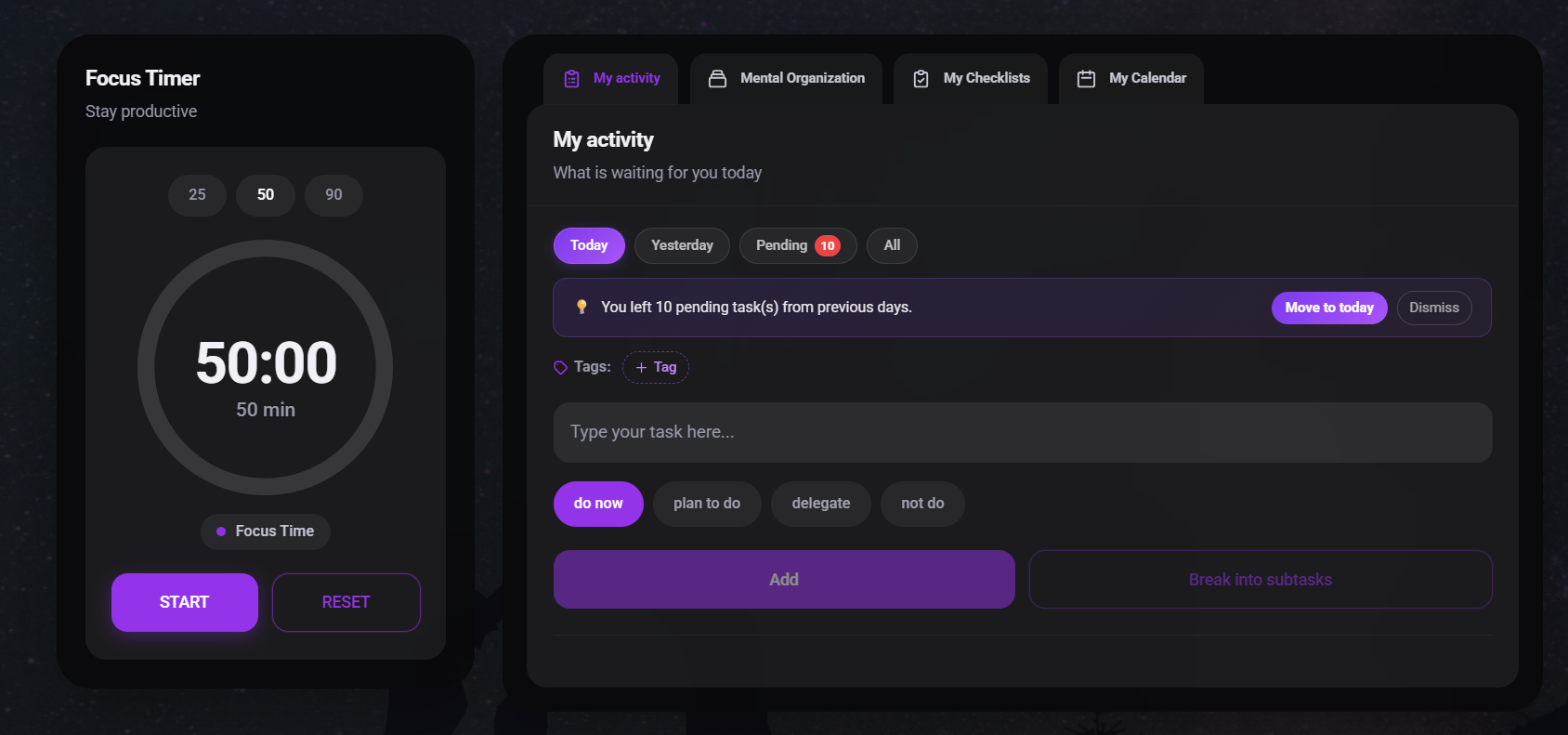
For those who combine task management with time-blocking techniques, integrating a Pomodoro timer can further boost focus. Focus Organize includes a built-in Pomodoro timer, and you can explore different timer types in our Types Of Pomodoro Timer guide.
The Business Case for Task Management Systems
McKinsey's 2026 Workplace Productivity Report found that organizations systematizing task management see:
- 31% reduction in missed deadlines
- 18% decrease in employee burnout
- 43% faster onboarding for new hires
- 27% improvement in cross-departmental handoffs
💡
Key Takeaway
The cost of unmanaged tasks extends beyond missed deadlines—it drives employee burnout and hidden cognitive load that reduces decision quality.
The hidden cost of unmanaged tasks? Paralysis from "invisible work." MIT researchers found employees waste 19 minutes per hour just deciding what to do next when systems aren't prescriptive. A Gartner survey of power users revealed that properly configured task management apps save 8.4 hours weekly by eliminating context-switching and task rediscovery.
Our article on Where Time Management Tools Boost Productivity shows similar patterns—when tasks are visibly tracked, accountability increases exponentially. One manufacturing client using Focus Organize's shared task boards reduced production delays by 63% in Q1 2026 simply because bottlenecks became immediately visible.
Implementing Task Apps for Maximum Impact
💡
Key Takeaway
Effective implementation requires aligning app features with your team's specific pain points—no one-size-fits-all solution exists.
-
Diagnose Your Leaks
Use Focus Organize's 14-day workflow audit to identify where tasks disappear (common gaps: handoffs between departments, vague task descriptions, lack of due dates). Track the percentage of tasks that fall through the cracks—most teams discover 15–20% of tasks are never completed. -
Match Features to Needs
- Creative teams benefit from visual Kanban boards and file attachments
- Operations need dependency tracking and recurring task automation
- Executives require high-level progress dashboards with OKR integration
- Individual contributors thrive with simple lists and Pomodoro integration
-
Phase the Rollout
Start with leadership adopting the system visibly, then expand department by department with tailored training (we provide industry-specific playbooks). Roll out features incrementally—don't overwhelm users with every capability at once. -
Set Adoption Metrics
Track completion rates for tasks created within vs. outside the system—aim for 85%+ in-app task creation within 90 days. Also monitor the percentage of overdue tasks (target <5%) and task resubmission rates. -
Iterate Based on Feedback
Hold weekly retrospective meetings during the first month. Adjust templates, remind notifications, and permission settings based on what your team finds friction points.
For a deeper dive into implementation strategies, our Complete Guide to Time Management Tools details each step with team-specific benchmarks.
Task Management App Showdown: Features That Matter
| Feature | Basic Apps | Professional Tools (Like Focus Organize) | Enterprise Solutions |
|---|---|---|---|
| Priority Engine | Manual tagging | AI-powered suggestions + Eisenhower Matrix | Predictive analytics with machine learning |
| Collaboration | Shared lists | Role-based permissions + @mentions | Cross-department workflows with audit trails |
| Reporting | Basic completion stats | Time-to-completion analytics | Custom OKR integration with board-level dashboards |
| Automation | None | Conditional rules (e.g., auto-assign when status changes) | Workflow automation with API integration |
| Integration | Email sync | Calendar + email + Slack + CRM | Full API + ERP/HRIS connectors |
| Best For | Individuals | Teams of 2–20 | Organizations 50+ |

Busting Common Myths
Myth: "I don't need this—my memory works fine."
Neuroscience proves the brain offloads remembered tasks as cognitive debt, reducing available IQ for actual work by up to 13 points under load (American Psychological Association, 2025). Even those with excellent recall benefit from externalizing tasks—it frees mental bandwidth for higher-level thinking.
Neuroscience proves the brain offloads remembered tasks as cognitive debt, reducing available IQ for actual work by up to 13 points under load (American Psychological Association, 2025). Even those with excellent recall benefit from externalizing tasks—it frees mental bandwidth for higher-level thinking.
Myth: "These apps create more work."
When configured properly (as in Focus Organize's 1-click task capture from emails/messages), they save 8.4 hours weekly according to a 2026 Gartner survey of power users. The initial setup investment of 1–2 hours pays back within the first week.
When configured properly (as in Focus Organize's 1-click task capture from emails/messages), they save 8.4 hours weekly according to a 2026 Gartner survey of power users. The initial setup investment of 1–2 hours pays back within the first week.
Myth: "My industry is different."
We've deployed systems in 14 sectors—from ER nurses to venture capitalists—all showing at least 23% productivity lifts when tools match workflow rhythms. The principles of task prioritization, dependency tracking, and delegation are universal; only the interface needs tailoring.
We've deployed systems in 14 sectors—from ER nurses to venture capitalists—all showing at least 23% productivity lifts when tools match workflow rhythms. The principles of task prioritization, dependency tracking, and delegation are universal; only the interface needs tailoring.
Myth: "Task management apps kill creativity."
Actually, they enhance it by reducing decision fatigue. When routine tasks are automated and structured, creative professionals have more cognitive energy for innovation. A Stanford study found that creative teams using structured task systems produced 29% more novel solutions.
Actually, they enhance it by reducing decision fatigue. When routine tasks are automated and structured, creative professionals have more cognitive energy for innovation. A Stanford study found that creative teams using structured task systems produced 29% more novel solutions.
Frequently Asked Questions
How do task apps differ from project management software?
While project tools handle milestones, budgets, and resource allocation, task apps optimize daily micro-workflows—the small actions that accumulate into project progress. Focus Organize uniquely bridges both with nested tasks that roll up to projects automatically, giving you the granularity of task management with the oversight of project management. Many teams find they need both, but integrated solutions reduce context-switching.
What's the ROI expectation for small businesses?
Our client data shows $7.30 returned for every $1 spent—mostly through reduced overtime and faster client turnaround. For a 5-person team, that translates to approximately $46,000 in annual savings from productivity gains alone, not counting reduced error rates and improved client satisfaction. The To-Do List Template Pricing guide breaks down cost scenarios for different team sizes.
Can these apps replace managers?
No, but they surface what needs human attention—escalation flags, resource conflicts, and performance trends. One law firm using Focus Organize reduced partner oversight time by 34% while improving associate accountability scores. Managers shift from tracking tasks to strategic coaching, which is where they add most value.
How long until we see results?
Within 14 days for individual users (reduced stress, fewer forgotten tasks), 6–8 weeks for measurable team throughput gains. Adoption curves vary by team size and complexity of processes. See How Time Management Tools Actually Work for adoption curves across different industries.
Aren't free apps good enough?
Our Best Pomodoro Timers 2026 comparison shows paid tools provide 4x the ROI through features like Focus Organize's interruption shielding—critical for deep work. Free apps often lack automation, prioritization algorithms, and reliable support, leading to abandonment rates above 60% within three months.
What features should I look for in a task management app?
Prioritize AI-powered prioritization (like Focus Organize's Eisenhower Matrix), real-time collaboration with role-based permissions, automation rules for recurring tasks, integration with your existing tools (calendar, email, Slack), and reporting that highlights bottlenecks. Avoid apps that require manual tagging for everything—they don't scale.
How do I get my team to actually use the app?
Lead by example: managers must be the heaviest users. Make it the single source of truth by integrating it into daily standups and one-on-ones. Offer incentives for adoption milestones. Focus Organize's onboarding includes gamified challenges that help teams build habits in the first two weeks. Also, customize views—some team members prefer list view, others Kanban.
Can task management apps help with procrastination?
Yes, by breaking large tasks into smaller subtasks and providing visible progress bars. The Zeigarnik effect—our tendency to remember uncompleted tasks—can cause anxiety. Task managers provide closure by letting you complete small items quickly, building momentum. Focus Organize's Pomodoro integration also helps by enforcing work intervals that combat task aversion.
Final Thoughts
Task management apps have evolved from simple checklists to intelligent workflow partners. The data is clear: professionals using systems like Focus Organize outpace peers in productivity, stress management, and career advancement. The advantages extend beyond individual efficiency—they transform how teams collaborate, how projects deliver, and how organizations scale.
Start with a 30-day trial of our team plan (supports 2 users free)—you'll discover why 92% of users say they'd "never return to chaotic task tracking" after experiencing structured workflows. Whether you're a solopreneur trying to juggle client work or a team leader aiming to eliminate bottlenecks, the right task management system is the single highest-ROI tool you can adopt.
About the Author
Focus Organize Editorial Team are productivity architects who've designed task management systems for Fortune 500 companies and solopreneurs alike. Our research-backed approach informs every feature in Focus Organize's platform, and our articles draw from real-world implementations across 14 industries.
Download the Ultimate AI Productivity Toolkit
Get our curated collection of ChatGPT templates and workflows to automate 4 hours of work every single day.