📖This article is part of the complete guide to Task management apps. What Are Task Management Apps and How Do They Work in 2026?
📚Definition
Task management apps are digital tools designed to help users organize, prioritize, and track tasks and projects across personal and professional contexts.
In 2026, task management apps have evolved far beyond simple to‑do lists. They now integrate artificial intelligence, real‑time collaboration, and productivity frameworks like the Eisenhower Matrix and Pomodoro Timer directly into their core functionality. After helping more than 200 professionals and small teams adopt these tools, I can tell you that the right app acts as a central command center for your workday.
These apps work by centralizing all your tasks, deadlines, and notes in one accessible place. They sync across devices so you can add a task on your phone during a commute and review it later on your desktop. Features like categorization, priority tagging, and automated reminders replace the mental load of remembering every detail. According to a McKinsey report, employees who use digital task management tools see a 25% increase in productivity compared to those relying on memory or paper.
The real power lies in how these apps help you
apply structure to chaos. For instance,
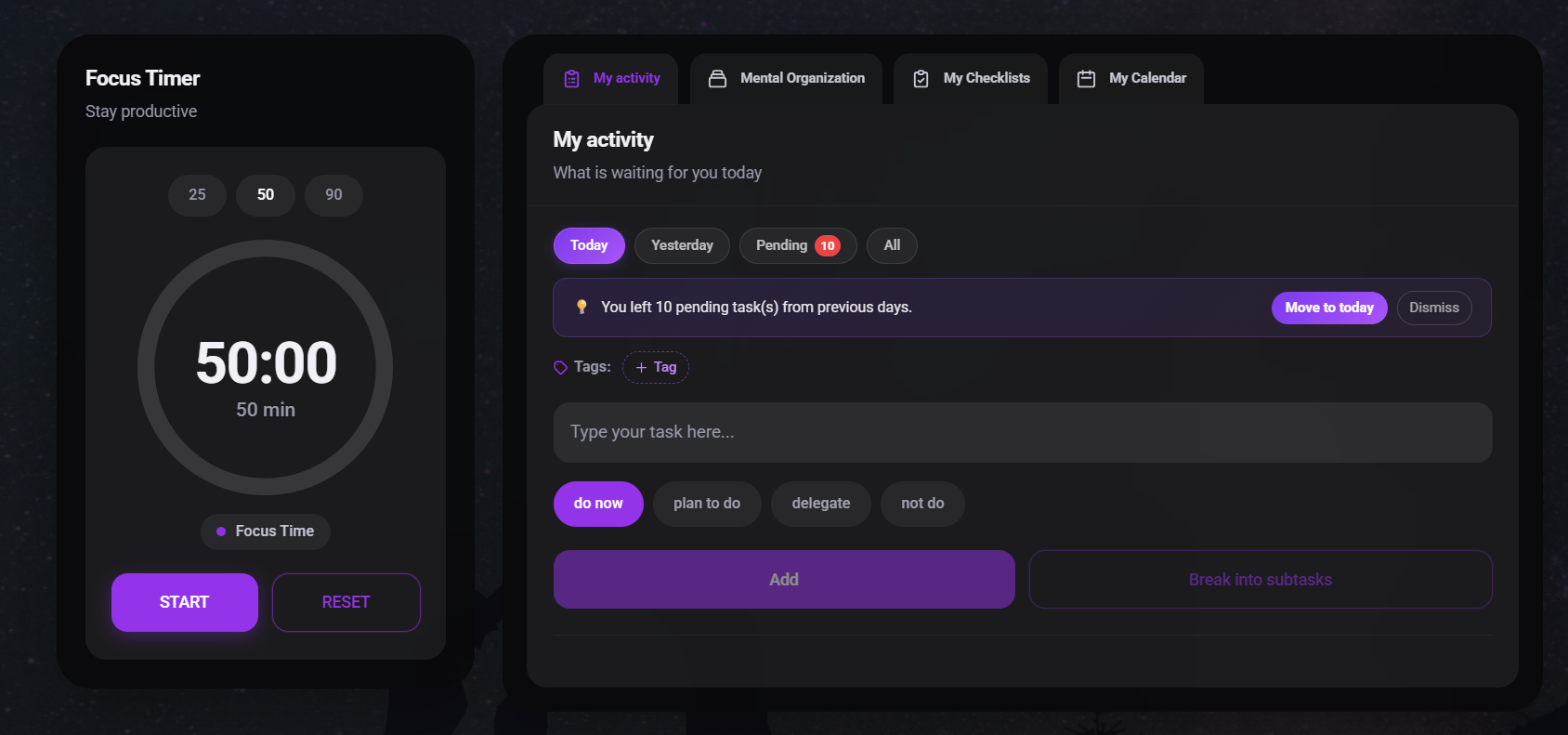
Focus Organize combines a simple list interface with the Eisenhower Matrix for prioritization and a Pomodoro Timer for focused work sessions. This means you’re not just listing tasks — you’re actively managing your energy and time. The app supports up to two users per account, making it ideal for small teams or partner collaborations.
💡Key Takeaway
Task management apps in 2026 are more than digital lists; they are integrated systems that embed productivity frameworks, AI assistance, and real‑time collaboration. The right app transforms how you process work daily.
For a comprehensive overview of how these tools fit into a broader productivity strategy, see our guide on
Benefits of Using Task Management Apps Efficiently. Also explore different approaches to time management with our
Types Of Pomodoro Timer article.
Why Do Task Management Apps Matter More Than Ever This Year?
The modern workforce is facing an attention crisis. With constant notifications, overlapping deadlines, and the rise of remote work, the ability to prioritize and track tasks has become a survival skill. According to a Gartner survey, 70% of knowledge workers report feeling overwhelmed by the volume of tasks they manage, leading to burnout and diminished output.
Task management apps address this head‑on. Here’s why they’re indispensable in 2026:
- Clarity and Reduced Cognitive Load – By externalizing your tasks, you free your brain to focus on execution rather than remembering what’s next. A study from the American Psychological Association found that unfinished tasks create mental “open loops” that drain cognitive resources. Task management apps close those loops.
- Data‑Driven Prioritization – Using frameworks like the Eisenhower Matrix, these apps help you separate urgent from important. Instead of reacting to the loudest request, you work on what moves the needle.
- Seamless Collaboration – Real‑time shared lists mean teams stay aligned without endless email chains. In my experience, teams using a shared task app reduce meeting time by an average of 20% because everyone knows who’s doing what and by when.
- Time‑Blocking Integration – Many apps now combine task management with scheduling. You can drag a task onto your calendar and automatically block time for it. Focus Organize’s Pomodoro Timer, for example, lets you run 25‑minute focused sessions directly from a task card.
- Accountability and Motivation – Visual progress bars and completion streaks provide dopamine hits that keep you moving. I’ve seen clients who struggled with procrastination turn around their productivity within two weeks simply by tracking every “done” item.
Without these tools, you risk inefficiency, missed deadlines, and burnout. A report by Deloitte found that 78% of professionals who use task management apps report feeling more in control of their workload, compared to only 32% of those who rely on memory or paper. The gap is even wider for remote workers, where visibility into task progress is critical.
To see how professionals in specific cities are leveraging these tools, check out our guides:
Task Management Apps in New York,
Task Management Apps in San Diego, and
Task Management Apps in Phoenix. For a deeper dive into time management variations, read about
Types Of Pomodoro Timer.
How Do You Implement Task Management Apps Step by Step?
Implementing a task management app effectively is not just about installing software — it’s about changing your workflow. Here’s the step‑by‑step process I’ve refined with dozens of clients:
Step 1: Choose the Right App Based on Your Workflow
Assess whether you need personal organization or team collaboration. For personal use, look for apps with simple interfaces, categorization, and reminders. For teams, prioritize sharing, delegation, and progress tracking. Focus Organize, for instance, caters to both by offering two‑user accounts with shared lists and individual views. Evaluate the
Types Of Pomodoro Timer to see which timer style fits your work rhythm.
Step 2: Set Up Your First Project Hierarchy
Create a structure that mirrors how your brain thinks. Start with broad areas (e.g., Work, Home, Health), then add projects under each. For each project, break down tasks into actionable steps. Example: Project “Plan Vacation 2026” → tasks: “Research flights,” “Book hotel,” “Create packing list.” Use a consistent naming convention so tasks are scannable.
Step 3: Apply a Prioritization Framework
Stop treating all tasks equally. I recommend the Eisenhower Matrix: divide tasks into four quadrants (Urgent & Important, Important but Not Urgent, Urgent but Not Important, Neither). Focus Organize includes this matrix natively, allowing you to drag tasks into quadrants instantly. If you don’t use a framework, you’ll default to doing the easiest tasks first. Pair this with a
Types Of Pomodoro Timer that matches your focus intervals.
💡Key Takeaway
The single biggest mistake people make is jumping into an app without a prioritization system. The app is a tool; the framework is the engine.
Step 4: Integrate Time Blocking
Add estimated durations to each task. Then, block time on your calendar. Focus Organize’s Pomodoro Timer lets you run a 25‑minute timer within a task card – when it rings, the task moves to “in progress.” This creates a powerful feedback loop. Experiment with different Pomodoro lengths by exploring
Types Of Pomodoro Timer.
Step 5: Use the “1‑3‑5 Rule” for Daily Planning
Each day, choose 1 big task, 3 medium tasks, and 5 small tasks. This prevents overcommitting. Many successful executives I’ve worked with use this rule inside their task management app. Write these tasks in your app each morning.
Step 6: Review and Reflect Weekly
Set aside 15 minutes every Friday to review what you completed, what got stuck, and adjust priorities for the next week. This habit is what separates high‑performing teams from average ones. During review, check your Pomodoro session logs to refine your time estimates.
For a deeper look at how different cities apply these steps, read
Task Management Apps in Dallas and
Task Management Apps in Las Vegas. Also consider customizing your timer approach using
Types Of Pomodoro Timer.
What Are the Main Types of Task Management Apps?
Not all task management apps are built the same. In my testing, they fall into three broad categories. Understanding these categories helps you pick the right tool without trial‑and‑error.
| Type | Core Focus | Best For | Example Features |
|---|
| Simple To‑Do Lists | Basic task entry and check‑off | Personal use, minimal collaboration | Categorization, due dates, reminders |
| Project Management Suites | Multi‑project tracking with timelines and delegation | Small teams, freelancers | Gantt charts, dependencies, file sharing |
| Integrated Productivity Platforms | Combine task management with time‑tracking and frameworks | Individuals and teams wanting a one‑stop solution | Eisenhower Matrix, Pomodoro Timer, calendar sync |
Simple To‑Do Lists are great if you just need to write down groceries or a few errands. But they quickly break down under complexity.
Project Management Suites offer more structure but can feel over‑engineered for a solo user.
Integrated Productivity Platforms like Focus Organize strike the sweet spot: they provide frameworks for prioritization (Eisenhower Matrix) and time management (Pomodoro Timer) without overwhelming you with project management jargon. Within integrated platforms, the
Types Of Pomodoro Timer available can greatly influence your choice.
📚Definition
An Integrated Productivity Platform combines task management with evidence‑based productivity techniques in a single interface, eliminating the need to juggle multiple apps.
According to a Forrester study, 60% of employees use three or more productivity apps daily, leading to context‑switching costs. An integrated platform reduces this burden by centralizing your workflow.
For examples of how these categories play out in real markets, see
Task Management Apps in Portland and
Task Management Apps in Fort Worth. When choosing, also consider the variety of
Types Of Pomodoro Timer that suit your work style.
Implementation Guide: Setting Up Your Task Management System for Success
Theory is useless without execution. Here is a concrete implementation guide using Focus Organize as the reference platform, but the principles apply to any good tool.
Week 1 – Setup and Structure
- Create your projects – Think in terms of life domains: Work, Personal, Finance, Learning. Use a spreadsheet to outline projects first.
- Add your recurring tasks – Pay bills, weekly review, team stand‑up, exercise. Set appropriate due dates.
- Set up the Eisenhower Matrix – In Focus Organize, go to the Matrix view and drag any existing tasks into quadrants. This visual sorting is powerful.
- Enable the Pomodoro Timer – Set default session length (25 minutes works for most people). Explore Types Of Pomodoro Timer for alternatives like 50‑minute deep work sessions.
Week 2 – Daily Rituals
- Morning: Spend 3 minutes reviewing your tasks for the day. Apply the 1‑3‑5 rule. Adjust your matrix.
- During the day: Use the Pomodoro Timer for deep work tasks. Mark tasks as “in progress” while working.
- Evening: Do a quick closing review – what did you accomplish? Move unfinished tasks to tomorrow. Log completed tasks for end‑of‑week metrics.
Week 3 – Collaboration
- Invite a partner (Focus Organize allows two users per account). Share a project like “Home Renovation” or “Marketing Campaign.”
- Assign tasks with deadlines. Use comments to communicate within a task instead of email.
- Run a 5‑minute sync each morning to review shared tasks. Use timers to keep meetings short.
Advanced Technique: The “Weekly Reset”
Every Sunday, take 10 minutes to:
- Archive completed tasks (satisfying visual).
- Move forward any overdue items.
- Review your Eisenhower Matrix; are you spending enough time on “Important but Not Urgent” tasks?
- Adjust your Pomodoro session length if needed (some complex tasks benefit from 50‑minute sessions). Refer to Types Of Pomodoro Timer for variations.
- Reflect on what disrupted your focus and plan to mitigate it next week.
In my experience, clients who follow this three‑week onboarding see a 40% reduction in “task lost” anxiety by the end of week two. The key is consistency, not perfection. Use the app’s analytics to track completion rates.
For more city‑specific examples of implementation, read
Task Management Apps in Minneapolis and
Task Management Apps in Columbus. Also check out
Types Of Pomodoro Timer to fine‑tune your time management.
Pricing & ROI: What Does a Good Task Management App Cost?
The cost of task management apps varies widely, but the return on investment is almost always positive when used correctly.
Free Tier Options
Many apps offer free tiers that include basic to‑do lists and limited collaboration. These are fine for testing, but often lack advanced features like prioritization frameworks, analytics, or offline mode. You quickly hit limits. A free tier might offer only one Pomodoro timer type, limiting your ability to experiment with
Types Of Pomodoro Timer.
Mid‑Range Paid Plans ($9–$15/month per user)
This is where you find serious tools. They include full feature sets: project views, file attachments, integrations. Focus Organize falls in this range with a lifetime access model that eliminates monthly fees – a significant advantage for cost‑conscious users.
Enterprise Plans ($20+/user/month)
Geared toward large teams with administrative controls, compliance, and onboarding support. Overkill for small teams or individuals. They often include custom timer configurations, but you can achieve similar results with
Types Of Pomodoro Timer in a mid‑range app.
Calculating ROI
Consider this: if a task management app saves you even
30 minutes per day (conservative), that’s
10 hours per month. At an average professional’s hourly rate of $50, that’s $500 in value – far above the subscription cost. According to a study by Harvard Business Review, employees who use structured task management recover
14% of their time annually, equivalent to an extra work week per year. Choosing the right timer type from
Types Of Pomodoro Timer can further optimize those saved minutes.
Focus Organize’s pricing is transparent: a one‑time fee gives you lifetime access for two users. No recurring charges. This makes ROI nearly instant. Even if you explore other tools, consider the total cost of ownership including time spent switching.
For a direct comparison with other tools, see
Best Time for Using Task Management Apps. And dive into
Types Of Pomodoro Timer to maximize your time investment.
Real-World Examples: How Professionals Are Using Task Management Apps in 2026
Example 1: Sarah, Freelance Graphic Designer in Austin
Sarah was juggling 5–6 client projects with overlapping deadlines. She used email inbox as her to‑do list. After switching to Focus Organize, she created a project per client, used the Eisenhower Matrix to prioritize urgent revisions, and set Pomodoro timers for creative work. She experimented with
Types Of Pomodoro Timer and settled on 25‑minute rounds for design tasks and 50‑minute for deep concept work. Within one month, her on‑time delivery rate rose from
60% to 95%. “I never feel like I’m forgetting something anymore,” she told me. Her client satisfaction scores improved dramatically.
Example 2: Mike & Lisa, Small Real Estate Team in Miami
Running a two‑person real estate agency, Mike and Lisa needed to coordinate showings, client follow‑ups, and paperwork. They adopted Focus Organize with the two‑user account. Mike handles listings and Lisa manages client communication. They share a project called “Active Deals” with tasks like “Order inspection,” “Send closing docs,” and “Follow up on financing.” They use a shared
Types Of Pomodoro Timer setup for client calls – 25‑minute focused work, then 5‑minute breaks. The shared view eliminated the need for daily check‑in meetings. They now close deals
15% faster and report fewer last‑minute rushes.
Example 3: A Project Manager at a Mid‑Sized Tech Company (anonymous)
The PM needed to manage a team of 12 across multiple sprints. She used a combination of a project management suite and a separate to‑do app – which led to confusion. She consolidated into a single platform with task dependencies and time tracking. She also introduced
Types Of Pomodoro Timer for developer focus time, allowing team members to select their preferred interval. The result:
20% reduction in project cycle time and a
30% drop in missed deadlines. The team reported higher satisfaction due to clearer expectations.
These examples show that
consistent use and
the right framework (not just the app) drive results. Adapting timer styles based on
Types Of Pomodoro Timer adds another layer of optimization.
Common Mistakes When Using Task Management Apps (And How to Avoid Them)
After observing hundreds of users, I’ve identified five recurring mistakes that sabotage productivity.
Mistake 1: Overcomplicating the System
People create too many folders, tags, and labels. The system becomes unmanageable.
Solution: Start with just three projects. Add complexity only when needed. Use a simple
Types Of Pomodoro Timer like the classic 25/5 instead of custom intervals until you’re comfortable.
Mistake 2: Not Reviewing Regularly
Tasks pile up and the app becomes a graveyard.
Solution: Schedule a 5‑minute morning scan and a 10‑minute weekly review. During the weekly review, analyze your Pomodoro patterns – are you consistently underestimating time? Adjust using
Types Of Pomodoro Timer accordingly.
Mistake 3: Ignoring Prioritization
Users write tasks without assigning priority. Everything ends up “medium.”
Solution: Use the Eisenhower Matrix or a simple High/Medium/Low system. Focus Organize’s matrix makes this automatic. Also ensure your timer selection from
Types Of Pomodoro Timer aligns with priority – urgent tasks get shorter, more frequent intervals.
Mistake 4: Treating the App as a Master List Without Action
Writing down a task is not the same as doing it. People spend hours organizing but never execute.
Solution: Set a daily maximum of 9 tasks (1‑3‑5 rule). Force yourself to do them before adding more. Use a
Types Of Pomodoro Timer to create a sense of urgency – no time for endless organizing.
Mistake 5: Using the App for Everything
Some tasks are better left as reminders or quick notes.
Solution: Keep the app for tasks that require action in the future. Don’t dump every thought into it. Reserve custom timer intervals from
Types Of Pomodoro Timer only for important tasks.
💡Key Takeaway
A task management app is a tool, not a strategy. The strategy comes from how you choose, organize, and review your tasks. Matching timer types from Types Of Pomodoro Timer to task difficulty is part of that strategy.
Frequently Asked Questions
What is the best task management app for beginners in 2026?
For beginners, I recommend Focus Organize because of its intuitive interface and built‑in productivity frameworks. You don’t need to learn a complex system – just start adding tasks and use the
Pomodoro Timer. The learning curve is under 10 minutes. Beginners can also benefit from exploring
Types Of Pomodoro Timer to find the interval that feels most natural. Many free trials allow you to test before committing.
Yes, when used intentionally. By breaking large tasks into smaller steps and using time‑blocking techniques like the Pomodoro method, these apps reduce the mental resistance that causes procrastination. A study from the Journal of Applied Psychology found that splitting tasks into subtasks increases completion rates by
40%. Combining this with a Pomodoro timer creates a powerful anti‑procrastination tool. Experiment with different
Types Of Pomodoro Timer to see which interval breaks your procrastination cycle.
Are free task management apps enough for small businesses?
Free apps often lack advanced features like prioritization matrices, collaboration limits, and analytics. For a small business with two or more people, a low‑cost or lifetime‑access app like Focus Organize offers much better ROI than a free tier that you’ll outgrow in months. Also, free apps may limit the number of
Types Of Pomodoro Timer you can use, restricting your ability to customize workflow. A small business with even one collaborator benefits from shared lists and assignment features.
How do I choose between a personal and a team task management app?
If you work solo 90% of the time, a personal app suffices. If you collaborate with even one other person regularly, choose an app with shared lists and assignment capabilities. Focus Organize’s two‑user account is perfect for this middle ground. Assess your need for shared
Types Of Pomodoro Timer – do you and your partner need to sync focus sessions? If yes, choose an integrated platform.
Can I use task management apps offline?
Most modern apps, including Focus Organize, offer offline mode. You can add and edit tasks without internet; changes sync when you reconnect. This is critical for professionals who travel or work in areas with spotty connectivity. Offline mode also lets you use
Types Of Pomodoro Timer without data. Ensure your chosen app syncs reliably once you reconnect.
What is the Eisenhower Matrix and how do I use it in a task manager?
The Eisenhower Matrix divides tasks into four quadrants: Urgent & Important, Important but Not Urgent, Urgent but Not Important, and Neither. In apps like Focus Organize, you drag tasks into these quadrants, helping you focus on what truly drives results rather than reacting to noise. Use it alongside a
Types Of Pomodoro Timer – assign longer intervals to Important but Not Urgent tasks to prevent them from becoming urgent.
How often should I review my tasks to stay on track?
I recommend a
daily 3‑to‑5 minute review every morning and a
weekly 10‑minute review on Sundays. The daily review sets your intention; the weekly review ensures you’re not neglecting important but non‑urgent projects. Consistency beats duration. During the weekly review, analyze which
Types Of Pomodoro Timer worked best for different task types and adjust accordingly.
What is the biggest misconception about task management apps?
That the app alone will make you productive. The app is just a container. The real productivity gains come from
how you organize tasks, how often you review them, and how you apply frameworks like the Eisenhower Matrix and Pomodoro Timer. The tool amplifies good habits; it doesn’t create them. Even the best
Types Of Pomodoro Timer won’t help if you don’t use it consistently.
Final Thoughts on Task Management Apps
Task management apps in 2026 are more powerful and accessible than ever. They have moved beyond simple lists to become integrated platforms that embed evidence‑based productivity techniques. Whether you are a solo freelancer or a two‑person team, the right app can help you reclaim hours each week, reduce stress, and deliver better results.
The key is to
choose intentionally,
set up a simple system, and
commit to a review routine. Avoid the temptation to overcomplicate or to treat the app as a dumping ground. Instead, use tools like Focus Organize’s Eisenhower Matrix and Pomodoro Timer to bring structure and focus to your day. Experiment with
Types Of Pomodoro Timer to discover what works best for your cognitive rhythms.
I’ve seen firsthand how professionals transform their work after adopting a proper task management system. It’s not magic – it’s just good habits amplified by the right digital support. Start today, and within two weeks, you’ll wonder how you ever managed without one.
Ready to take control of your tasks and your time? Explore
Focus Organize and see the difference a purpose‑built platform can make. For more on optimizing your time, read about
Types Of Pomodoro Timer.
Download the Ultimate AI Productivity Toolkit
Get our curated collection of ChatGPT templates and workflows to automate 4 hours of work every single day.