


What Exactly Is a Cleaning Checklist Template?
Maintaining a pristine environment often fails not because of a lack of effort, but because of a lack of system. A cleaning checklist template is a structured document or digital framework that itemizes every necessary cleaning task, categorized by frequency or location, to ensure no area is overlooked. Instead of relying on memory, which is prone to failure during stressful days, this system transforms cleaning from a chaotic chore into a repeatable process.
In my experience working with high-performance individuals, the most common barrier to a clean home or office isn't laziness; it's decision fatigue. When you walk into a messy room, your brain spends significant energy deciding where to start. A cleaning checklist template removes that cognitive load by prescribing the exact sequence of operations. By integrating these lists into a broader system, such as the advantages of a best to do list app, you can transition from reactive cleaning to proactive maintenance.

How Does a Cleaning Checklist Template Function in Practice?
At its core, a cleaning checklist template acts as a standard operating procedure (SOP) for the physical environment. It breaks down the overwhelming concept of "cleaning the house" into granular, manageable micro-tasks. For example, instead of a vague goal like "Clean Kitchen," a professional template specifies "Wipe microwave interior," "Degrease stovetop," and "Sanitize sink basin." This granularity is what prevents the "invisible dirt" phenomenon, where high-traffic areas are cleaned while baseboards and ceiling fans are ignored for months.
📚
Definition
A Cleaning Checklist Template is a standardized inventory of maintenance tasks designed to ensure consistency, accountability, and thoroughness in the sanitation of a space, typically divided into daily, weekly, monthly, and seasonal cadences.
The effectiveness of these templates is backed by organizational psychology. When a task is written down and then checked off, the brain releases a small amount of dopamine, creating a positive feedback loop. This is why many people find that understanding a best to do list app significantly reduces the anxiety associated with household management.
From a technical standpoint, these templates are usually organized by "zones" or "frequencies." Zone-based cleaning focuses on one area (e.g., the master bathroom) until every item on the list is complete. Frequency-based cleaning separates tasks by how often they must occur. According to the American Cleaning Institute, maintaining a consistent schedule of "high-touch" surface disinfection can reduce the spread of common household pathogens by up to 80%. By utilizing a template, you ensure that these high-touch points—light switches, door handles, and remote controls—are never missed.
Why Does a Structured Cleaning System Matter for Productivity?
The link between environmental order and mental clarity is not merely anecdotal; it is biological. A cluttered environment competes for your attention, leading to increased cortisol levels and decreased focus. When you operate without a cleaning checklist template, you are essentially performing "adhoc cleaning," which is the least efficient way to maintain a space. You move back and forth across rooms, waste time looking for supplies, and often repeat tasks while forgetting others.
Research from the Princeton University Neuroscience Institute found that physical clutter in your surroundings competes for your attention, resulting in decreased performance and increased stress. When you implement a structured template, you are effectively outsourcing your memory to a system. This allows your brain to remain in a "flow state" for deeper work. This is precisely why we emphasize why you need the best to do list app for productivity within the Focus Organize ecosystem; the goal is to minimize the time spent on "maintenance" so you can maximize the time spent on "creation."
The business implications are even more severe. In a professional setting, the absence of a checklist leads to inconsistent hygiene standards, which can impact employee health and client perception. According to a report by Gartner on operational excellence, standardized checklists in facility management reduce the "error rate" of maintenance tasks by approximately 40%. In a corporate office, this translates to fewer sick days and a more professional atmosphere.
Furthermore, the financial cost of neglect is high. Regular maintenance—driven by a checklist—extends the lifespan of carpets, HVAC filters, and kitchen appliances. A template that reminds you to clean refrigerator coils every six months can prevent a costly compressor failure. In short, the checklist is not just about aesthetics; it is a tool for asset preservation and mental health.
How to Implement a Cleaning Checklist Template Step-by-Step
The mistake I made early on—and that I see constantly—is creating a list that is too ambitious. People often build a "dream list" that requires six hours of work per day, leading to burnout and abandonment within a week. The secret to a sustainable system is the "Minimum Viable Clean" (MVC).
Here is the professional approach to implementing your template:
- The Environmental Audit: Walk through your space with a notebook. Do not clean; just observe. List every single surface that requires attention, from the top of the fridge to the bottom of the baseboards.
- Categorization by Frequency: Assign each task a cadence.
- Daily: Dishes, wiping counters, taking out trash.
- Weekly: Vacuuming, mopping, bathroom scrubbing.
- Monthly: Dusting blinds, cleaning oven, wiping cabinet doors.
- Seasonal: Washing windows, cleaning gutters, deep-cleaning carpets.
- Sequence Optimization: Order your tasks to minimize movement. Always clean from top to bottom (dust falls down) and from the furthest point in the room toward the exit.
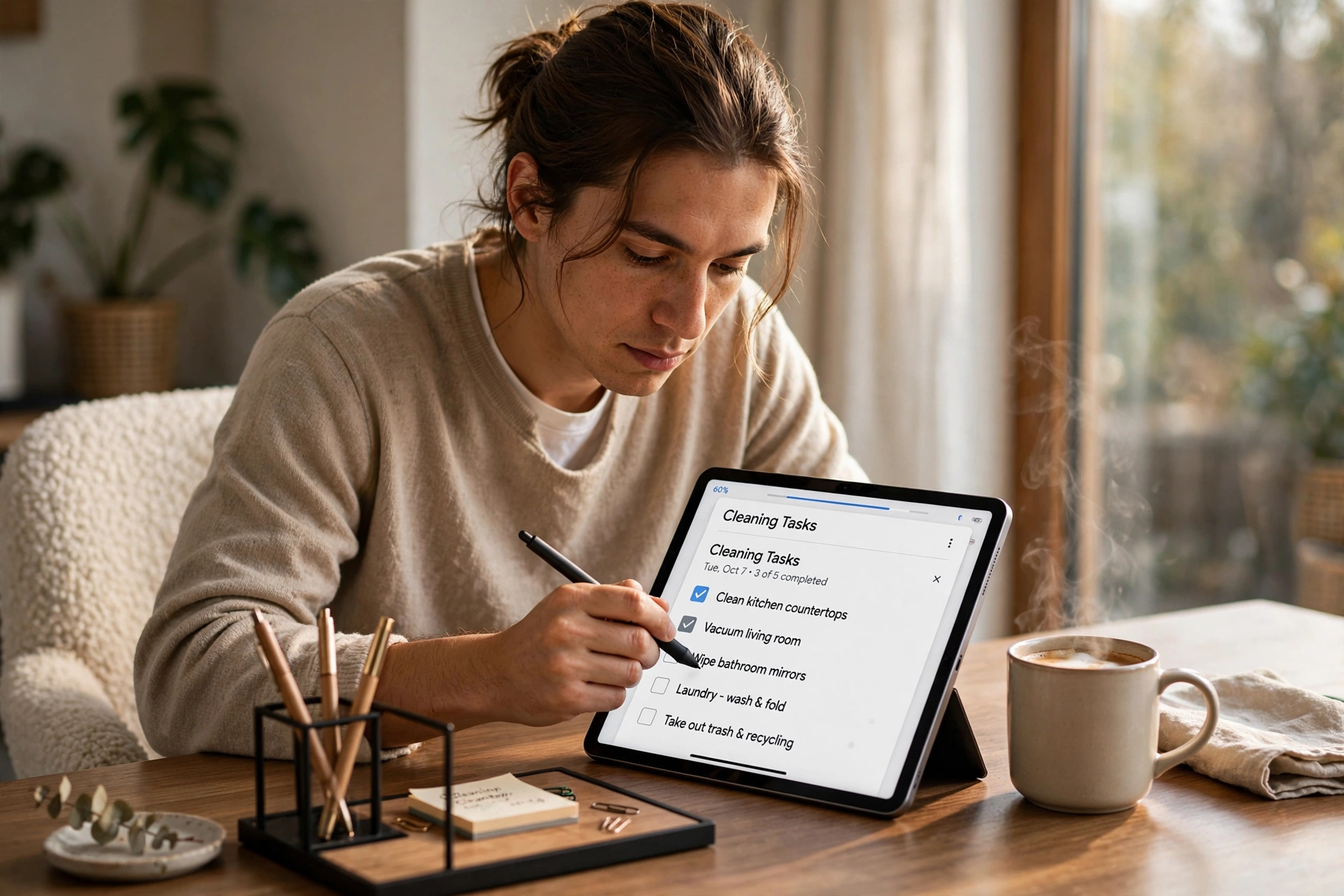
- Digital Integration: Transfer your static list into a dynamic tool. Using a top best to do list app option for maximum productivity allows you to set recurring reminders so you don't have to manually rewrite the list every Monday.
- The Review Cycle: Every 30 days, evaluate the list. If you find you are consistently skipping a task, ask why. Is it too hard? Is it unnecessary? Adjust the template to fit your actual life, not an idealized version of it.
💡
Key Takeaway
The most effective cleaning templates prioritize "top-to-bottom" sequencing and utilize a "Minimum Viable Clean" approach to prevent burnout and ensure long-term consistency.
When using Focus Organize, this process becomes seamless. Our platform allows you to create these recurring checklists and link them to a Pomodoro Timer. This prevents cleaning from becoming a marathon of exhaustion; instead, you work in focused 25-minute sprints, ensuring high quality without the physical crash.
Comparing Cleaning Approaches: Manual vs. Generic vs. Professional
Many people believe that any list is a good list. However, there is a vast difference between a handwritten scrap of paper and a professional productivity system. The "Generic AI" approach often produces lists that are too vague ("Clean the kitchen") or geographically illogical, suggesting you mop the floor before dusting the ceiling.
| Feature | Traditional Manual List | Generic AI/Template | Focus Organize Approach |
|---|---|---|---|
| Reliability | Low (Easily lost/forgotten) | Medium (Static document) | High (Automated reminders) |
| Efficiency | Poor (Random sequencing) | Medium (Generic order) | Optimal (Zonal optimization) |
| Psychology | Low (Feels like a chore) | Low (Checking a box) | High (Gamified progress/Pomodoro) |
| Adaptability | None (Must rewrite) | Low (Hard to edit) | High (Dynamic task shifting) |
| Best For | Occasional guests | Basic apartments | High-performance households |
As the table demonstrates, the professional approach isn't just about the list itself, but the infrastructure supporting the list. This is why considering when to replace your best to do list app is important; if your current tool doesn't support recurring cadences or time-blocking, it is hindering your progress.
Common Questions and Misconceptions
Most guides get this wrong by suggesting that "deep cleaning" should be the primary focus. They tell you to spend a whole weekend scrubbing every inch of the house. This is a recipe for failure. The "Weekend Warrior" approach creates a cycle of extreme filth followed by extreme effort, which is exhausting and inefficient.
Myth 1: "I don't need a template because I know my house."
This is the most dangerous misconception. Familiarity breeds blindness. When you look at a room every day, your brain "filters out" the dust on the picture frames or the grime on the light switches. A template forces you to look at the objects you have become blind to.
Myth 2: "Checklists are only for professional cleaners."
In reality, the highest-performing individuals in every field—from surgeons to pilots—use checklists to prevent catastrophic failure. In the home, "failure" is a buildup of allergens and mold that impacts your health. Standardizing your cleaning is a mark of professional home management, not a sign of inability.
Myth 3: "Digital lists are distracting."
If you are using a generic app with notifications for everything, then yes. But when using a dedicated system like Focus Organize, the digital list is a tool for focus. By utilizing the 5 types of pomodoro timers for optimal focus, you turn the "distraction" of a device into a rhythmic pacer for your work.
Frequently Asked Questions
How do I start a cleaning checklist template if I am completely overwhelmed?
The key is to start with the "Critical Path." Ignore the baseboards, the inside of the oven, and the windows. Create a list containing only three items: dishes, trash, and clear surfaces. Once you have successfully checked these off for seven consecutive days, add one "weekly" task, such as vacuuming. By building the habit of "checking the box" before adding complexity, you avoid the overwhelm that leads to abandonment. This incremental approach is a core tenet of high-performance habit formation.
What is the difference between a cleaning checklist and a cleaning schedule?
A checklist is the "What"—the inventory of tasks that must be completed to reach a standard of cleanliness. A schedule is the "When"—the assignment of those tasks to specific days or times. For example, "Vacuuming the living room" is a checklist item; "Vacuuming the living room every Tuesday at 10 AM" is a schedule. To achieve true efficiency, you need both. The checklist ensures quality, while the schedule ensures consistency. Using everything about the best to do list app for productivity allows you to merge these two into one automated system.
Should I organize my template by room or by task type?
For most people, organizing by room (zonal cleaning) is more efficient because it reduces "tool switching." If you organize by task (e.g., "all dusting"), you will find yourself walking from the bedroom to the kitchen and back again multiple times. If you organize by room, you take your caddy into the bathroom, complete every task on the bathroom checklist, and then move on. This minimizes physical fatigue and keeps your focus centered on one environment at a time, which is significantly more mentally rewarding.
How often should I update my cleaning checklist template?
Your environment is dynamic. You may buy new furniture, change your habits, or enter a different season. I recommend a quarterly audit. Every three months, review your template and ask: "Which of these tasks provide the most value?" and "Which of these feel like a waste of time?" For instance, dusting a guest room every week may be unnecessary in the winter but essential in the spring. Adjusting your list ensures the system serves you, rather than you serving the system.
Can a cleaning checklist template actually help with anxiety?
Yes, absolutely. Anxiety often stems from a feeling of loss of control. A messy home is a physical manifestation of chaos, which triggers a stress response in the brain. By using a template, you replace that chaos with a predictable, finite set of actions. The act of checking off a task provides a sense of agency and accomplishment. When you combine this with is best to do list app worth it considerations, you realize that the tool is actually a mental health aid that provides structure to an otherwise overwhelming day.
Final Thoughts on the Cleaning Checklist Template
A cleaning checklist template is far more than a list of chores; it is a blueprint for a low-stress, high-functioning life. By removing the decision-making process from your cleaning routine, you preserve your mental energy for the things that actually matter—your career, your family, and your personal growth. Whether you are managing a small apartment or a large family estate, the principle remains the same: systemize the routine to liberate the mind.
If you are tired of the "cycle of chaos" and want to implement a system that actually sticks, it is time to move beyond paper and pencil. Focus Organize provides the tools necessary to turn these checklists into an automated engine of productivity. From Pomodoro integration to collaborative lists, we help you maintain your environment without sacrificing your sanity.
Ready to reclaim your time and your space? Start your journey toward a more organized life at focusorganize.com. For more insights on optimizing your daily flow, explore our top benefits of using the best to do list app for success.
Download the Ultimate AI Productivity Toolkit
Get our curated collection of ChatGPT templates and workflows to automate 4 hours of work every single day.



