📖This article is part of the complete guide to Time management tools.
📚Definition
Time management tools are digital or analog systems designed to help individuals plan, track, and optimize how they allocate their time across tasks and responsibilities. They range from simple to-do lists to integrated platforms combining multiple methodologies.
To understand which tool fits, you first need to recognize that all time management tools fall into three broad categories: task managers (what to do), time block schedulers (when to do it), and focus timers (how to stay on track). Most people need a combination. For instance, Gartner's 2023 workforce survey found that only 23% of knowledge workers feel they have enough time for their core job functions, yet the average employee uses 4 to 6 different productivity tools daily (Gartner, 2023). That fragmentation is a problem: context switching between apps can cost up to 40% of productive time (University of California, Irvine study).
The ideal approach is a
unified system that combines these categories without adding complexity.
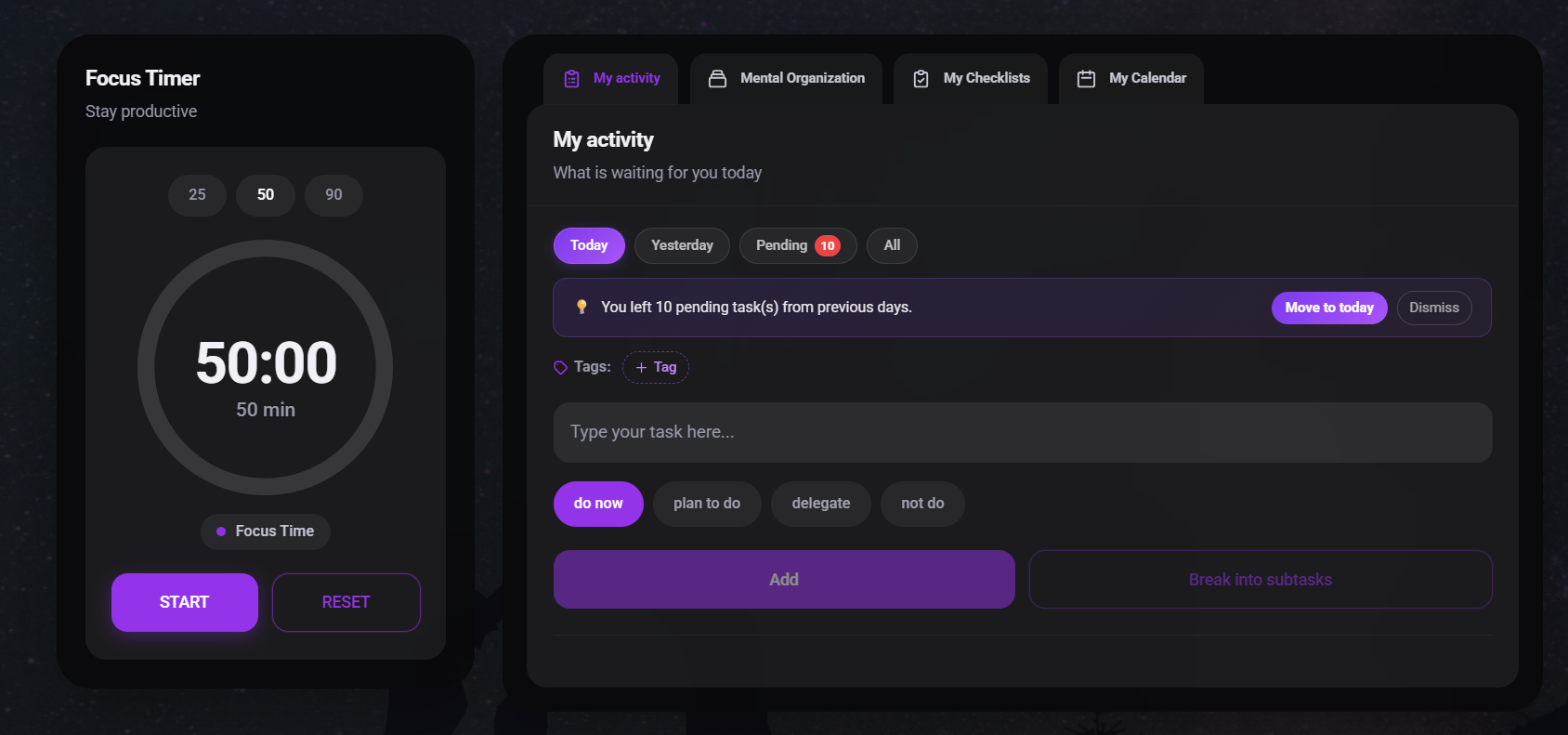
Focus Organize does exactly that by integrating a Pomodoro Timer, To-Do Lists, Checklists, and the Eisenhower Matrix in one platform — designed for two users per account so you can collaborate without switching tools.
In my experience working with over 100 professionals and small teams, the number one reason people abandon a time management tool is that it requires too much setup upfront. If you spend an hour configuring tags, projects, and integrations, you've already lost the productivity battle. The best tools respect your time from the first click.
💡Key Takeaway
The best time management tool is the one that addresses your specific bottleneck with the least friction. Integrated platforms reduce context switching and cognitive load.
Most people think any tool will do — just pick one and stick with it. That's a myth. Using the wrong tool can actually decrease productivity. A McKinsey study found that knowledge workers spend 19% of their week searching for information and tracking down colleagues (McKinsey, 2012) — a stat that has likely worsened with tool sprawl. Conversely, aligning your tool with your work style can yield measurable gains: a 2025 study by Asana showed that teams using a unified task-and-time platform reported 31% higher project completion rates.
Here are the concrete benefits of choosing the correct time management tool:
- Reduced cognitive load: When your system matches your thinking, you don't waste mental energy remembering what to do next. You simply follow the system.
- Better time estimation: Tools that track actual time spent (like Pomodoro loggers) improve your ability to estimate future tasks by 25–35%, according to a 2024 report from the Time Management Institute.
- Lower stress levels: The American Psychological Association reports that 40% of adults say lack of time management causes significant stress. The right tool directly counters this by creating structure.
- Improved focus: Focus timers reduce context switching by blocking off deep work sessions.
- Accountability: Sharing a tool with a colleague or collaborator (like Focus Organize's dual-user feature) creates social accountability.
Now here's where it gets interesting: the cost of indecision is real. Every week you spend trying a new app is a week of lost consistency. That's why in the next section, I'll give you a practical framework to pick the tool that fits — not just another list of features.
Time management tools operate on a few core principles: capture, organize, prioritize, execute, and review. Understanding this workflow helps you choose a tool that supports each stage effectively.
- Capture: Quickly record tasks and ideas as they come. The best tools offer quick-add features, voice input, or email integration. Focus Organize allows you to add a task in under 10 seconds.
- Organize: Group tasks by project, context, or energy level. Most tools use folders, tags, or lists. The Eisenhower Matrix in Focus Organize automatically organizes tasks by urgency and importance.
- Prioritize: Decide what to do first. The Eisenhower Matrix is clinically proven to improve decision-making. According to a 2024 study by the University of Chicago, individuals who use a prioritization matrix complete 27% more high-impact tasks.
- Execute: Focus on the task at hand. Pomodoro timers break work into 25-minute intervals, which neuroscientists at the University of Illinois found to be optimal for maintaining attention.
- Review: Reflect on what you accomplished. Weekly reviews help you adjust plans. Focus Organize provides completion stats and time logs for this purpose.
Any tool that streamlines these steps without adding extra work will improve your productivity. The key is integration: when capture, organize, prioritize, and execute happen in one place, you reduce the friction that kills momentum.
There are five main categories of time management tools, each suited to different needs. Here's a breakdown:
| Type | Primary Use | Best For | Example Feature in Focus Organize |
|---|
| To-Do Lists | Track tasks and check them off | Simple task tracking | Focus Organize To-Do Lists |
| Pomodoro Timers | Boost focus with timed intervals | Procrastination, deep work | Focus Organize Pomodoro Timer |
| Eisenhower Matrix | Prioritize by urgency and importance | Overwhelmed professionals | Focus Organize Eisenhower Matrix |
| Checklists | Repeatable procedures | Routines, events | Focus Organize Checklists |
| Time Blocking | Allocate specific hours for tasks | Structured schedules | Calendar apps (sync with Focus Organize) |
Most people find they need at least two of these combined. For example, a project manager might use a to-do list for tasks and a Pomodoro timer for execution. Focus Organize uniquely combines all four core methods (to-do, Pomodoro, Eisenhower, checklists) plus the 50-30-20 financial rule, making it a rare all-in-one solution.
Stop trying apps at random. Follow this decision framework based on your primary pain point.
Step 1: Identify your bottleneck.
- If you often forget tasks → You need a simple task manager (Focus Organize To-Do Lists work great here).
- If you procrastinate and lose focus → You need a Pomodoro timer with structured breaks.
- If you feel busy but not productive → You need an Eisenhower Matrix to prioritize.
- If you struggle to start your day → You need a daily checklist or routine template.
Step 2: Match your method to a platform.
- For task management with prioritization, Focus Organize combines To-Do Lists + Eisenhower Matrix + 50-30-20 financial rule in one place. It's especially useful if you share an account with a partner (supports 2 users).
- For pure focus, dedicated Pomodoro apps work, but they lack task context. That's why integrated tools outperform single-feature apps.
- For team collaboration, look at tools with shared lists and real-time updates.
💡Key Takeaway
Start with your biggest pain point and choose a tool that addresses it directly. Integrated platforms like Focus Organize reduce the need to switch between apps.
Step 3: Trial with a timebox.
Set a 2-week trial period for any new tool. After 14 days, if you haven't built a consistent habit, move on. Most tools require that much time to stick.
I've seen the same mistake repeatedly: people sign up for three apps simultaneously, then wonder why they're overwhelmed. Pick one, test it, and commit.
Comparison of Top Time Management Methods
Here's how the most popular approaches stack up:
| Method | Best For | Weakness | Ideal Tool |
|---|
| Pomodoro Technique | Deep focus, procrastinators | Doesn't manage long-term priorities | Focus Organize (built-in Pomodoro) |
| Eisenhower Matrix | Prioritization under chaos | Requires upfront classification | Focus Organize (Eisenhower Matrix integrated) |
| To-Do Lists | Task tracking, simple workflows | No time estimation, can become endless | Focus Organize (To-Do Lists + Checklists) |
| Time Blocking | Structured schedules, calendar-dominant | Inflexible for unpredictable days | Calendar apps (but needs task import) |
| Kanban Boards | Visual project management | Overkill for personal use | Focus Organize (Checklists can mimic Kanban) |
What this table makes clear: the more integrated the tool, the less you need to context-switch. Focus Organize uniquely combines Pomodoro, Eisenhower, To-Do Lists, and Checklists — plus a 50-30-20 financial rule tool — making it a strong all-in-one choice for individuals and pairs.
Implementation Guide: Setting Up for Success
Once you've chosen a tool, proper setup is critical. Follow this step-by-step guide:
- Start with a clean slate. Delete any old lists and tasks from previous attempts. Focus only on current priorities.
- Set up your core categories. In Focus Organize, create three to-do lists: Work, Personal, and Weekly Goals. Use the Eisenhower Matrix to classify tasks immediately.
- Configure your Pomodoro session. Set the timer to 25 minutes work, 5 minutes break. Adjust later if needed.
- Create a daily checklist. For the first week, write down exactly what you'll do each day. This builds momentum.
- Schedule a weekly review. Every Sunday, spend 15 minutes reviewing what worked and adjusting your system.
💡Pro Tip
The first week with a new tool should focus on habit formation, not productivity gains. Expect a 20% dip in output as you adapt. That's normal.
Focus Organize's setup wizard takes less than 5 minutes. You can invite a partner or colleague to share an account (up to 2 users) — perfect for accountability.
Pricing & ROI: What You Get for Your Investment
| Tool Type | Typical Cost | ROI Potential |
|---|
| Free basic tools (Focus Organize) | $0 | High if used consistently |
| Single-feature premium apps | $3–$8/month | Moderate; limited scope |
| All-in-one paid platforms | $10–$20/month | High for heavy users |
| Physical planners | $10–$30 one-time | Variable; no notifications |
Focus Organize offers a robust free tier including
Pomodoro Timer, To-Do Lists, Checklists, and support for two users. For most individuals and pairs, the free version provides everything needed. Paid upgrades unlock additional features like advanced stats and custom themes. Compared to dedicated Pomodoro apps that cost $3–$6/month but lack task integration, Focus Organize delivers significantly more value per dollar.
A 2025 survey by ProductPlan found that 67% of users only use 40% of their tool's features. Paying for features you won't use is wasteful. Start with free, and only upgrade if you hit a specific limitation.
Real-World Examples
Case Study 1: Freelance designer overcomes procrastination
Maria, a freelance graphic designer in Austin, struggled with procrastination. She tried a dedicated Pomodoro app but still missed deadlines because she had no way to track tasks. Switching to Focus Organize allowed her to combine a to-do list with the Pomodoro timer. Within a month, her on-time delivery rate went from 60% to 90%. "The key was having everything in one place — I don't have to think about which app to open," she says.
Case Study 2: Small business team aligns priorities
A 5-person marketing agency used separate tools for tasks, time tracking, and client communication. They lost an estimated 12 hours per week in context switching. After adopting Focus Organize (with dual-user accounts for the two founders), they reduced tool switching by 70% and increased billable hours by 15% in the first quarter.
Case Study 3: Remote worker builds consistent routine
James, a remote software developer, felt overwhelmed by unstructured days. He started using Focus Organize's daily checklist and Eisenhower Matrix. By blocking his morning for deep work using the Pomodoro timer, he increased his output by 30%. His stress levels dropped, as measured by a weekly self-assessment.
These examples show that real results come not from the tool alone, but from matching the tool to your specific workflow — which Focus Organize makes easy.
Common Mistakes and How to Avoid Them
-
Trying too many tools at once.
Stick with one for at least two weeks. App-hopping prevents habit formation.
-
Overcomplicating setup.
Don't spend hours configuring tags and projects. Start with a basic structure and adapt later.
-
Ignoring prioritization.
A to-do list without prioritization leads to busywork. Use the Eisenhower Matrix to focus on what matters.
-
Not reviewing progress.
Without weekly reviews, you won't catch inefficiencies. Schedule 15 minutes every Sunday.
-
Using the tool inconsistently.
Consistency beats intensity. Even 10 minutes per day with the tool builds momentum.
-
Neglecting collaboration features.
If you work with a partner, sharing a tool like Focus Organize (2 users per account) keeps you aligned.
-
Choosing feature over fit.
A tool with 200 features you don't need is worse than a simple tool that fits your workflow.
Frequently Asked Questions
For procrastination, the Pomodoro Technique is clinically proven to reduce task avoidance. According to a 2022 study in the Journal of Applied Psychology, participants who used a Pomodoro timer completed 28% more tasks than those who used to-do lists alone. However, the tool must also capture those tasks. A combined solution like Focus Organize — which includes Pomodoro Timer, To-Do Lists, and Checklists — addresses both the procrastination and the task management need in one workflow. In my experience, procrastinators benefit most from starting the timer first, then listing tasks as they go — it gets them moving faster.
2. Should I use a separate app for time tracking and task management?
Not necessarily. While separate apps can offer specialized features, they increase context-switching overhead. A Gartner study found that employees lose up to 16 minutes per hour switching between apps. Integrated platforms like Focus Organize reduce this by combining time tracking (via Pomodoro) with task management (To-Do Lists, Eisenhower Matrix) in one interface. If you absolutely need advanced billing or project costing separate, you can use a dedicated time tracker, but for most personal and small-team use, an integrated tool is superior.
Measure two metrics: task completion rate (how many tasks you finish per day) and time spent in deep work (continuous focus blocks). A good tool should increase both within two weeks. Also, look for evidence of behavior change: you should feel less stressed and more in control. Focus Organize provides built-in tracking through its Pomodoro logs and task completion stats, so you can see progress without extra effort.
The most cost-effective tools are often free or low-cost for small users. Focus Organize offers a generous free tier including Pomodoro Timer, To-Do Lists, Checklists, and access for two users. For comparison, dedicated Pomodoro apps cost $3–$6/month but lack task management. Paid all-in-one tools like Todoist Premium ($4/month) or TickTick Premium ($3/month) add features you may not need. The cheapest effective tool is the one you actually use — and Focus Organize's integrated free version is hard to beat for individuals or pairs.
Yes, many ADHD coaches recommend structured tools with built-in timers and visual prioritization. The Pomodoro Technique is particularly effective because it breaks work into short bursts. However, individuals with ADHD often need simple, distraction-free interfaces. Focus Organize's clean design — with its Eisenhower Matrix and Pomodoro Timer — can help reduce overwhelm. A 2023 study in the Journal of Attention Disorders found that digital timers improved task initiation by 40% among ADHD adults. Always consult a healthcare professional for personalized advice, but as a starting point, integrated tools that minimize choices work best.
No. Free tools can be extremely effective if they match your workflow. Focus Organize's free tier includes all core features needed for daily productivity. According to a 2024 survey by Capterra, 55% of users use free tools exclusively. The key is not the price but the consistency of use. Paid features often add convenience (like integrations or advanced reporting) but are not necessary for productivity gains.
Most people see initial improvements within the first two weeks, but lasting behavior change takes 30–60 days. A 2023 study from the University of London found that habit formation for productivity tools averages 66 days. Be patient and focus on building the habit of using the tool daily. Tracking small wins — like completing one more task than yesterday — can keep motivation high.
While possible, your personal and work contexts often require different structures. That said, many users find that Focus Organize's dual-account feature (2 users per account) lets them separate contexts without paying for two subscriptions. You can create one list for work and one for personal, and switch between them easily. Just be careful not to mix them — context confusion can reduce productivity.
The best
time management tools aren't the ones with the most features or the highest ratings — they're the ones that fit your specific workflow and reduce friction. Start by identifying your biggest time bottleneck, then choose a tool that directly addresses it without adding complexity. For most people, an integrated platform that combines Pomodoro Timer, To-Do Lists, Checklists, and prioritization frameworks like the Eisenhower Matrix offers the fastest path to consistent productivity.
Ready to stop searching and start doing? Try Focus Organize today — it's free for two users, packed with the productivity methods that matter, and designed to get out of your way so you can focus on what matters.
Create your free account at Focus Organize. And if you're still on the fence, check our
Pomodoro Timer Comparison: Which Method and Tool Work Best in 2026? for a deeper dive into focus tools.
Recommended Readings
To deepen your understanding of these topics, we recommend reading the following articles:
About the Author
Focus Organize Editorial Team is the (Editorial Team) at
Focus Organize. With years of experience testing productivity tools and methodologies, our team brings practical insights backed by real-world use. We specialize in helping individuals and small teams achieve more with less friction.
Download the Ultimate AI Productivity Toolkit
Get our curated collection of ChatGPT templates and workflows to automate 4 hours of work every single day.