
📖This article is part of the complete guide to Pomodoro timer.
Affiliate Disclosure: Focus Organize is reader-supported. When you buy through links on our site, we may earn an affiliate commission at no extra cost to you. We only recommend physical productivity tools we have evaluated for build quality, timer accuracy, and daily workflow utility. Learn more.
When you search for the best Pomodoro timer, your phone is often the worst tool for the job. Every time you unlock your smartphone to check your remaining work interval, you expose yourself to notifications, incoming emails, and social media rabbit holes.
According to cognitive research from the University of California, Irvine, it takes an average of 23 minutes and 15 seconds to regain deep focus after a single digital interruption. A standalone, dedicated physical Pomodoro timer creates a tactile, physical anchor on your desk that keeps you accountable without a single screen-based distraction.
Whether you are managing ADHD and time blindness, working in a quiet shared office, or grinding through intense study sessions, we tested and analyzed the top physical Pomodoro timers available in 2026.
Quick Comparison: The Best Pomodoro Timers at a Glance
| Timer & Model | Category / Best For | Mechanism | Power Source | Alarm Modes | Price Range | Check Price |
|---|---|---|---|---|---|---|
| TickTime Pro | 🏆 Best Overall Digital Cube | Gravity Hexagon Flip | USB-C Rechargeable | Sound (5 levels), Mute, LED Flash | ~$39.99 | View on Amazon |
| Time Timer MOD | 🧠 Best for ADHD & Time Blindness | Visual Disappearing Disc | 1x AA Battery | Sound (On/Off), Silent Sweep | ~$24.95 | View on Amazon |
| Mooas Multi-Cube | 💡 Best Budget Desk Cube | Gravity 4-Sided Flip | 2x AAA Batteries | High, Low, Silent / LED | ~$16.99 | View on Amazon |
| Yunbaoit Visual Timer | 🔕 Best Silent & Vibration for Office | Visual Disc + Backlight | 2x AAA Batteries | Vibration, Mute, Loud Beep | ~$18.99 | View on Amazon |
| Secura 60-Min Visual | 📐 Best Large Desk Display | Mechanical Visual Dial | Spring Mechanical (No Battery) | Mechanical Bell Ring | ~$15.99 | View on Amazon |
| KWANWA LED Digital | 🔢 Best High-Contrast Display | Digital Rotary Knob | 3x AAA Batteries | 3 Volume Levels, Auto-Dimming | ~$19.99 | View on Amazon |
| Retro Mechanical Tomato | 🍅 Best Pure Nostalgia | Mechanical Spring | 100% Battery-Free | Classic 5-Sec Ringer | ~$9.99 | View on Amazon |
In-Depth Reviews of the 7 Best Physical Pomodoro Timers
1. TickTime Pro Hexagon Timer — Best Overall Physical Pomodoro Timer

- Mechanism: Hexagonal Gravity Sensor with LED Digital Readout
- Preset Intervals: 3, 5, 10, 15, 25, and 30 minutes (plus custom duration mode)
- Power: USB-C Rechargeable Lithium Battery (lasts up to 10–14 hours of continuous use)
- Audio: 5-Level Adjustable Volume, Mute Mode with Flash Light Alert
- Magnetic Base: Yes (attaches to whiteboards, fridge, or metal desk frames)
The TickTime Pro solves the single biggest friction point of time-blocking: setting the timer. Instead of fiddling with buttons or dials, you simply flip the hexagon so your desired number of minutes faces up (e.g., face "25" up for a standard Pomodoro sprint). The internal gyroscope immediately begins countdown.
Why We Recommend It
- Zero Friction: Flipping a block takes less than 1 second, making it effortless to enter deep work cycles.
- USB-C Modern Convenience: No need to keep spare AA or AAA batteries in your drawer.
- Versatile Alerts: Features both a silent LED blinking mode for public libraries and loud audible chimes for cooking or home workouts.
- Custom Time Setting: Unlike older flip timers, the Pro version allows manual second-by-second adjustments using two discrete buttons on the front face.
Considerations
- Slightly higher price point compared to basic plastic timers.
- Requires periodic USB-C recharging (roughly once every 2–3 weeks depending on usage).
2. Time Timer MOD (Home Edition) — Best for ADHD & Time Blindness
- Mechanism: Patented Disappearing Red Colored Disc (Visual Countdown)
- Duration: Up to 60 minutes
- Power: 1x AA Battery
- Audio: Optional alert beep (switchable to 100% silent operation)
- Protective Silicone Case: Included (available in Charcoal, Sky Blue, Lake Day, and Berry)
If you struggle with time blindness—a common executive dysfunction trait associated with ADHD—numbers on a digital screen often feel abstract. You might look at "18:42" remaining and fail to perceive how quickly that time is vanishing.
The Time Timer MOD renders time as a physical, shrinking geometric slice. As the minutes tick down, the vibrant silicone-bordered colored disc physically recedes toward zero. This provides instantaneous visual feedback in your peripheral vision without forcing your brain to calculate numerical differences.
Why We Recommend It
- Clinical Gold Standard: Recommended by therapists, educators, and ADHD productivity coaches worldwide.
- Silent Sweep Quartz Movement: No audible clicking or mechanical ticking sounds that break concentration.
- Tactile Protective Cover: Removable soft silicone case protects the unit from desk drops and travel bumps.
- Intuitive Operation: Just rotate the central dial to set your target sprint (e.g., 25 or 50 minutes).
Considerations
- Runs on a standard AA battery rather than rechargeable lithium.
- Max duration is 60 minutes (ideal for standard Pomodoros, but not for 90-minute ultradian rhythms).
3. Mooas Multi-Cube Timer — Best Budget Desk Cube
- Mechanism: 4-Sided Gravity Flip Sensor
- Preset Intervals: 5, 15, 25, and 45 minutes
- Power: 2x AAA Batteries
- Audio: High Volume, Low Volume, and Silent Mute (LED indicator)
- Colors Available: Mint, White, Yellow, Navy
The Mooas Multi-Cube Timer is the benchmark for affordable, minimalist desk aesthetics. Built with a matte polycarbonate finish and crisp digital LCD side display, it gives you the four essential productivity blocks: 5 min (short break), 15 min (long break/recharge), 25 min (standard Pomodoro), and 45 min (deep learning sprint).
Why We Recommend It
- Great Price-to-Value Ratio: Provides instant gravity countdown functionality at nearly half the price of metal digital timers.
- Clean Scandinavian Aesthetic: Looks elegant on any modern workspace setup without creating visual clutter.
- Rotary Display Orientation: The LCD display automatically flips right-side up to match your orientation.
Considerations
- Does not offer custom minute configurations outside its 4 fixed presets.
- Uses disposable AAA batteries.
4. Yunbaoit Visual Analog Timer — Best Silent & Vibration Mode for Office Workers
- Mechanism: Mechanical Dial with Disappearing Colored Disk + Electronic Vibration
- Duration: 1 to 60 minutes
- Power: 2x AAA Batteries
- Audio & Haptic Alerts: Vibration Mode, 30-Second Alarm, 3-Second Alarm, Silent Flash
- Backlight: Built-in night/ambient backlight button
Working in an open-plan office or university study hall means you cannot have a loud buzzer ringing every 25 minutes. Most visual timers only offer a loud beep or complete silence. The Yunbaoit Visual Timer solves this with an integrated haptic vibration motor.
When your work sprint ends, the timer gently buzzes on your desk pad or flashes a warm LED, notifying only you without disturbing your coworkers.
Why We Recommend It
- Vibration Notification: Perfect for libraries, co-working spaces, and nighttime work sessions.
- Pause Functionality: You can press the top button to pause your interval during an unexpected interruption.
- Subtle Rainbow/Pastel Discs: Easier on the eyes than aggressive high-visibility primary colors.
Considerations
- Slightly larger desk footprint than gravity cubes.
5. Secura 60-Minute Visual Countdown Timer — Best Large Mechanical Display
- Mechanism: Pure Mechanical Visual Disc
- Duration: 1 to 60 minutes
- Power: 100% Mechanical Spring (Zero Batteries Required)
- Mounting: Tabletop Foldout Legs or Magnetic Back
The Secura Visual Countdown Timer delivers maximum visibility. Its bold red wedge is clearly legible from across a large room, making it ideal for classroom presentations, standing desk setups, and workshop facilitations.
Why We Recommend It
- Zero Battery Dependency: Wind it up clockwise to 55 minutes, then rotate counter-clockwise to your desired time. It runs purely on mechanical spring tension.
- Strong Magnetic Back: Sticks firmly to magnetic whiteboards, metal file cabinets, and monitor arms.
- Durable Construction: Sturdy casing built to survive daily classroom or workshop handling.
Considerations
- Produces a very faint, rhythmic mechanical ticking sound (soothing for some, but distracting for sensitive sound environments).
- Ringer sounds like a traditional mechanical bell.
6. KWANWA Digital LED Desk Timer — Best High-Contrast Display
- Mechanism: Digital Rotary Outer Ring with Oversized LED Screen
- Duration: 0 to 99 minutes, 55 seconds (Count Up & Count Down)
- Power: 3x AAA Batteries
- Display: Mirror Finish / High-Luminance Large Numbers
For creators and programmers who prefer precision down to the exact second, the KWANWA Digital Desk Timer provides an ultra-modern aesthetic. By twisting the outer bezel ring, you can quickly spin from 1 minute to 99 minutes with smooth tactile resistance.
Why We Recommend It
- Giant Readable Numbers: Crisp LED numerals that can be read effortlessly even in dim evening lighting.
- Auto Energy-Saving: Automatically dims brightness after 5 seconds of inactivity while keeping the countdown live.
- Stopwatch / Count-up Mode: Useful for tracking how long an open-ended task or client meeting actually took.
7. Classic Mechanical Tomato Timer — Best Pure Retro Nostalgia
- Mechanism: Classic Spring-wound Mechanical Gearbox
- Duration: Up to 60 minutes
- Power: Mechanical (No Electricity)
- Design: Red Kitchen Tomato Shape
In 1987, university student Francesco Cirillo used a simple, red tomato-shaped kitchen timer (pomodoro is Italian for tomato) to create the 25-minute focus method. If you want the authentic, tactile experience that started the entire productivity movement, a Classic Mechanical Tomato Timer is an unpretentious, durable desk piece.
Why We Recommend It
- Pure Simplicity: No firmware updates, no dead batteries, no configuration menus.
- Budget Friendly: Under $10.
- Tactile Engagement: Physically winding the ringer acts as a mental ritual signaling your brain to commence deep work.
How to Choose the Right Pomodoro Timer for Your Work Style
Before choosing your timer, evaluate these four critical criteria:
- Environmental Sound Tolerance:
- If you work in a private home office, mechanical ticking and audible bell ringers provide excellent auditory boundaries.
- If you work in a shared office, library, or coffee shop, prioritize models with vibration or silent flashing LED alerts (like the TickTime Pro or Yunbaoit).
- Cognitive Processing Style (ADHD vs Analytical):
- Visual thinkers and individuals with ADHD benefit dramatically from disappearing disc visual timers (Time Timer MOD), which translate abstract time into intuitive spatial volume.
- Analytical workers who track billable hours or specific code sprints often prefer digital LED displays with exact second readouts.
- Friction Level (Gravity vs Dials):
- Gravity cubes require zero cognitive effort to engage—just flip the block. If you tend to abandon productivity habits when they require too many steps, a gravity cube is your best bet.
- Power Source Preference:
- Decide whether you prefer USB-C rechargeability on your desk wire or the reliability of standard AA/AAA batteries that last 6 to 12 months per swap.
Physical Timers vs. Digital Productivity Workspaces: When to Use Focus Organize
A physical Pomodoro timer is unparalleled at keeping your physical desk distraction-free. However, a physical timer cannot:
- Prioritize your daily tasks according to urgency and importance (Eisenhower Matrix).
- Track which projects consumed your hours for client billing.
- Break down complex multi-week deliverables into structured daily checklists.
- Organize your personal finances alongside your work schedule.
🔄 The Optimal Hybrid Productivity Stack:
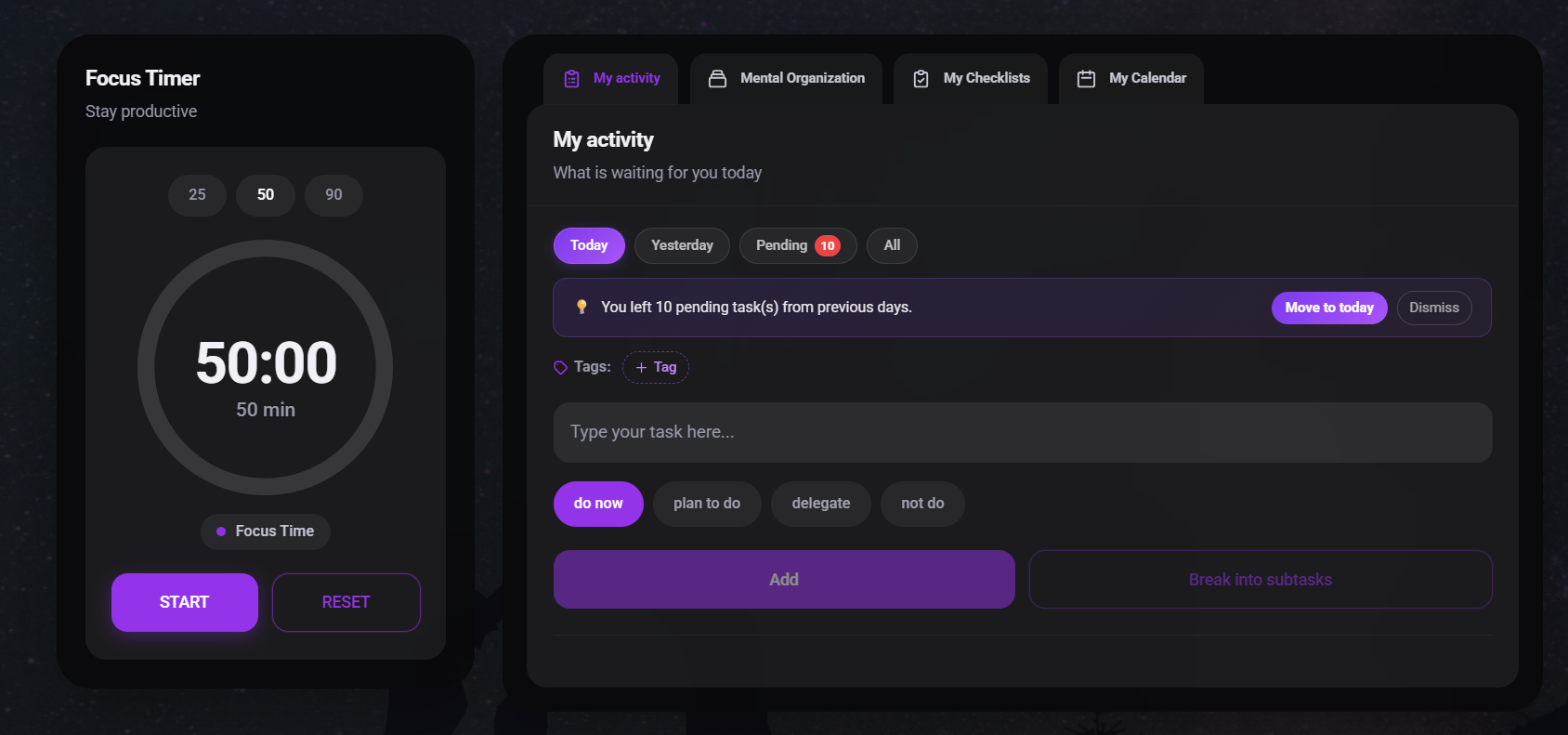
- Focus Organize Cloud Hub: Maps out your task backlog, project deadlines, and priority matrix.
- Physical Desk Timer: Anchors your 25-minute sprints with zero notifications, screen tabs, or digital distractions.
The most productive professionals combine both: they organize their tasks inside Focus Organize, and then place a physical timer on their desk to execute each 25-minute sprint in uninterrupted deep flow.
Frequently Asked Questions (FAQ)
What is the most effective Pomodoro interval length?
The classic Pomodoro interval is 25 minutes of work followed by a 5-minute short break. After completing 4 consecutive intervals, take a longer 15 to 30-minute break. For complex analytical tasks (like programming or writing), many professionals adapt this to the 50/10 rule (50 minutes of deep focus followed by a 10-minute break).
Why use a physical Pomodoro timer instead of a phone app?
Smartphone apps create an immediate risk of digital derailment. Notifications, message badges, and incoming alerts interrupt your train of thought. A physical timer sits quietly on your desk with a single, dedicated purpose.
Are visual timers better for people with ADHD?
Yes. Clinical studies show that neurodivergent individuals frequently experience time blindness—the difficulty in sensing the passage of time without concrete external cues. Visual timers with receding color discs externalize time as a physical dimension, making deadlines and intervals intuitive.
Do gravity cube timers tick?
No. Gravity cube timers such as the TickTime Pro and Mooas Cube use electronic sensors and silent digital circuits. They operate in complete silence during the countdown and only emit an alert when the time expires (which can also be muted or switched to flashing lights).
Affiliate Transparency Note: Prices and availability for the products listed above were accurate at the time of publication and are subject to change. As an Amazon Associate, Focus Organize earns from qualifying purchases made through links on this page. This does not impact our editorial scoring or product recommendations.
Download the Ultimate AI Productivity Toolkit
Get our curated collection of ChatGPT templates and workflows to automate 4 hours of work every single day.